
Day 13 – Wednesday, December 29, 2021
We woke up about 7 a.m., wanting to get an early start so we could have breakfast without feeling rushed to get to our first tour. We got ready and headed out, having decided to walk in the direction of Jackson Square and the place we were supposed to meet up with the tour group. We passed a couple of places, but most restaurants weren’t open yet or didn’t do breakfast. Nothing much appealed to us at that point, anyway. When we walked around Jackson Square we began to hear that classic: a New Orleans jazz band. The morning was a bit foggy, so we could hear it before we could see it (and I will put an aside here that if you’re ever in NOLA, definitely request a foggy morning from the gods above; it was glorious). When we did see the band, they were performing next to a building with a green awning on the side and a long line of people coming out of it. Café du Monde. Having not done my due diligence beforehand, I had no idea what the big deal was.
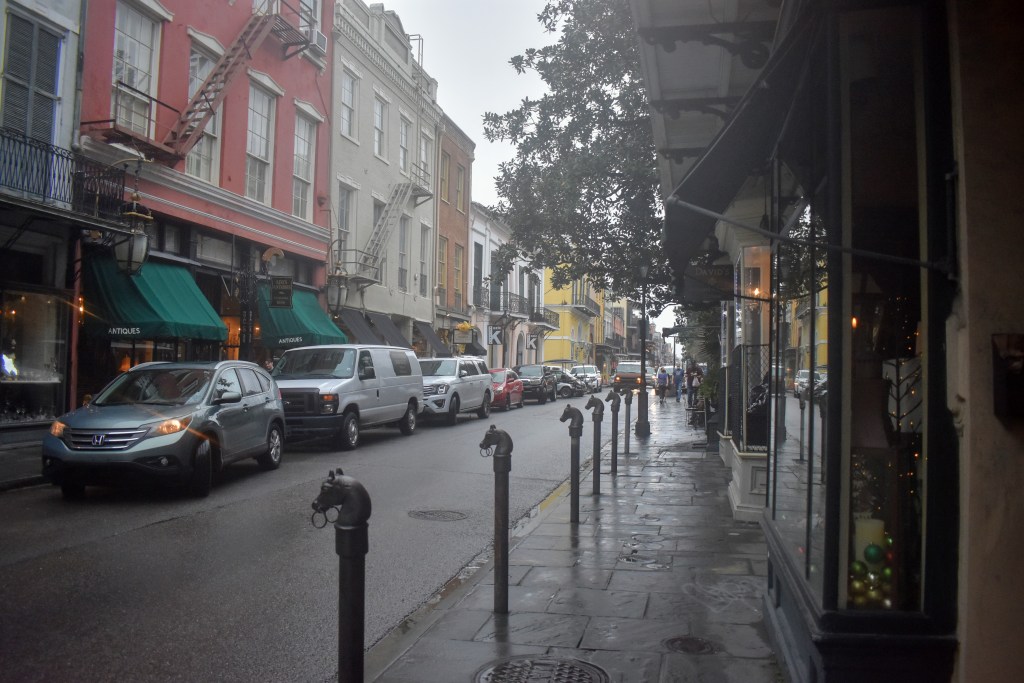
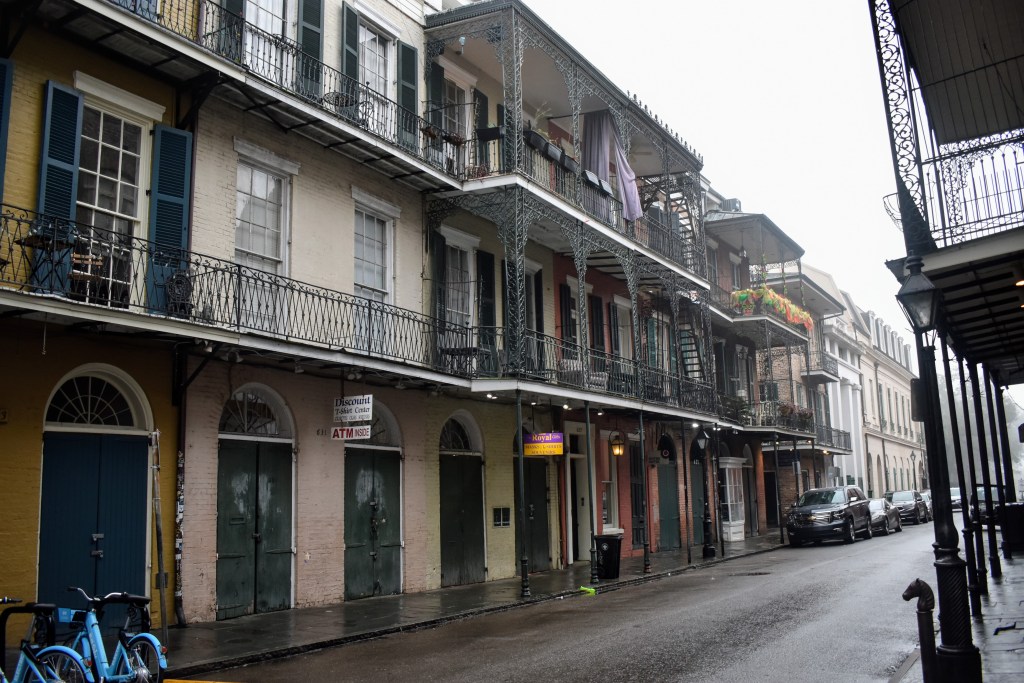

St Peter Street, French Quarter
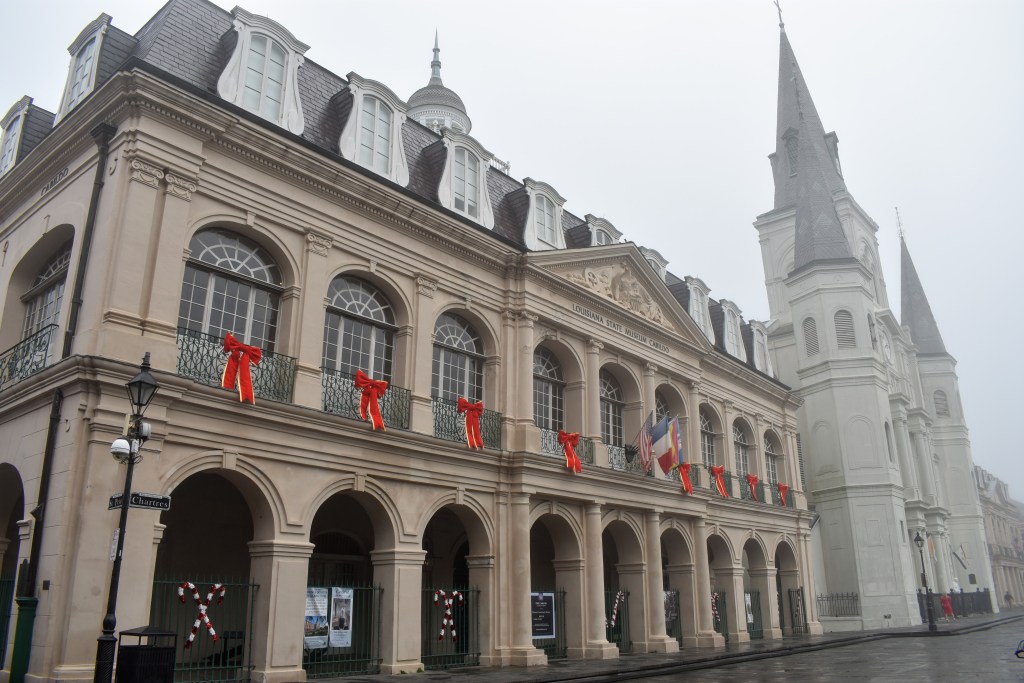
Jackson Square, French Quarter
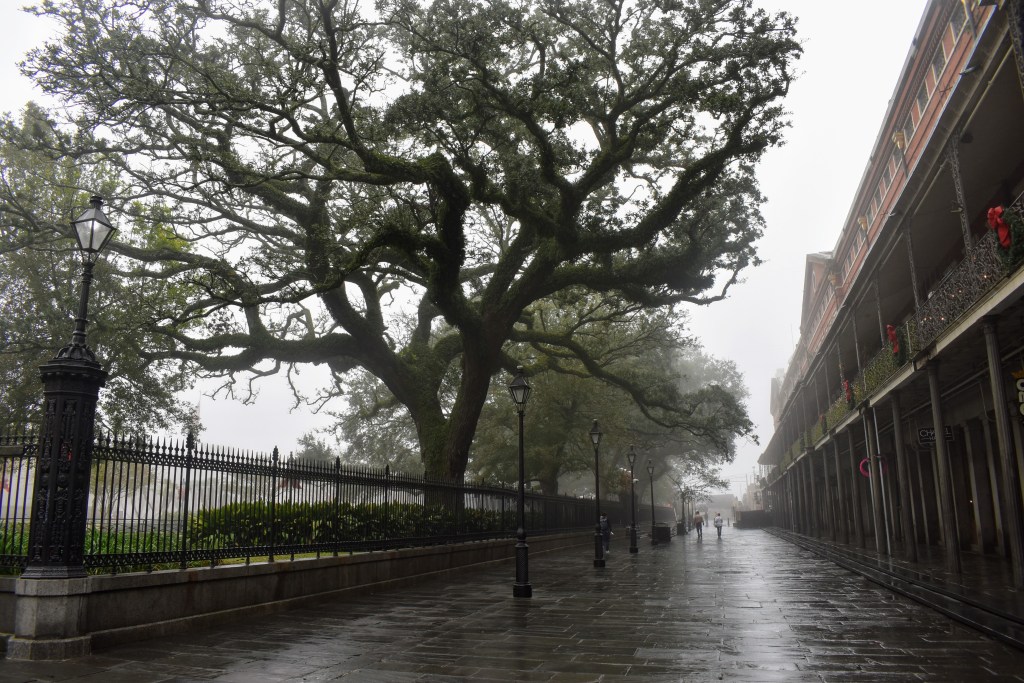
Jackson Square, French Quarter

Jackson Square, French Quarter

Decatur Street, French Quarter
We walked past, noting that the building was part of the larger structure of the French Market. A couple of more blocks and we found where we would be meeting the tour group later in the morning, and not having seen any more likely places for breakfast, we walked back behind the French Market where there was some artwork and got in line at the café. When we had been standing in line for a few minutes, we realized that there were two separate lines: the one we were in was for take-out orders and the other line was to get into the café itself. Well, that was fine because there was plenty of outdoor seating. It took about 10 or 15 minutes to get to the front of the line, and we were able to get our order pretty quickly. Two bags of three beignets, a coffee (the house special) and orange juice for Mom, and a hot choccie for me. We sat in the covered porch area and munched our way through our powered sugar allotment for the next 10 years.
After breakfast, we still had time, so we wandered down the sidewalk outside the front of the French Market and window-shopped. Our tour was supposed to start at 10, so we went ahead to the small visitor center where the Legendary Walking Tours had their base. We only had to wait for a few minutes—long enough to look at brochures, get a simple map, and sit down—before the guide was there and checking our names off the list. The walking tour was of the French Quarter specifically and began just outside at a statue of Joan of Arc. Our guide, Robin, walked us by the French Market, over to the riverfront, down different streets, and over to Jackson Square while regaling us with the history of the city. She kept things mostly to the early history of the city, with some mentions of her own life growing up in the area and how locals go about their lives. Mom and I both found it very interesting that on one hand the Catholic church had such a hold on the area when Europeans were first colonizing there, but that on the other hand women and people of color had a little more freedom compared to other areas. One woman sued her husband three times and finally got control of their plantation, which she then sold off (much of which became part of the French Quarter) before moving to France. She had been running the business while he was off doing some “engineering” (wink, wink) but she wasn’t able to do anything with the profits she was bringing in. Louisiana didn’t allow women to buy property outright, but they could inherit it or go through legal loopholes and become landowners. And Louisiana always had free people of color, which I hadn’t realized. In fact, New Orleans had a kind of caste system among the free people of color, which later included the freed slaves, of course. Apparently, Homer Plessy, along with other civil rights activists of the time, was mixed-race but white-passing, which caused some confusion to politicians in Washington. We also learned about quadroon balls, which was part of the plaçage system of concubinage. Mixed-race young women (and they were typically very young) were presented at these balls for rich white men to choose (ew), except instead of taking them as wives they’d take them as mistresses. However, the women (or, more often, their mothers) could demand certain compensation, which could include monetary compensation, housing, a European education for any children, as well as an inheritance for those children.
The tour ended in Jackson Square, home of several of the oldest buildings in the city, where we learned that the red brick Pontalba Buildings, built by the Baroness Micaela Almonester Pontalba, on either side are the oldest continuously-occupied apartments in the US. The galleries (not balconies) on the buildings were made with wrought iron rather than the more-common cast iron. Apparently, Andrew Jackson, for whom Jackson Square was named, had an affair with the Baroness and that’s why his statue is tipping its hat in the direction of one of the buildings (where she would have stood on the gallery waving back).
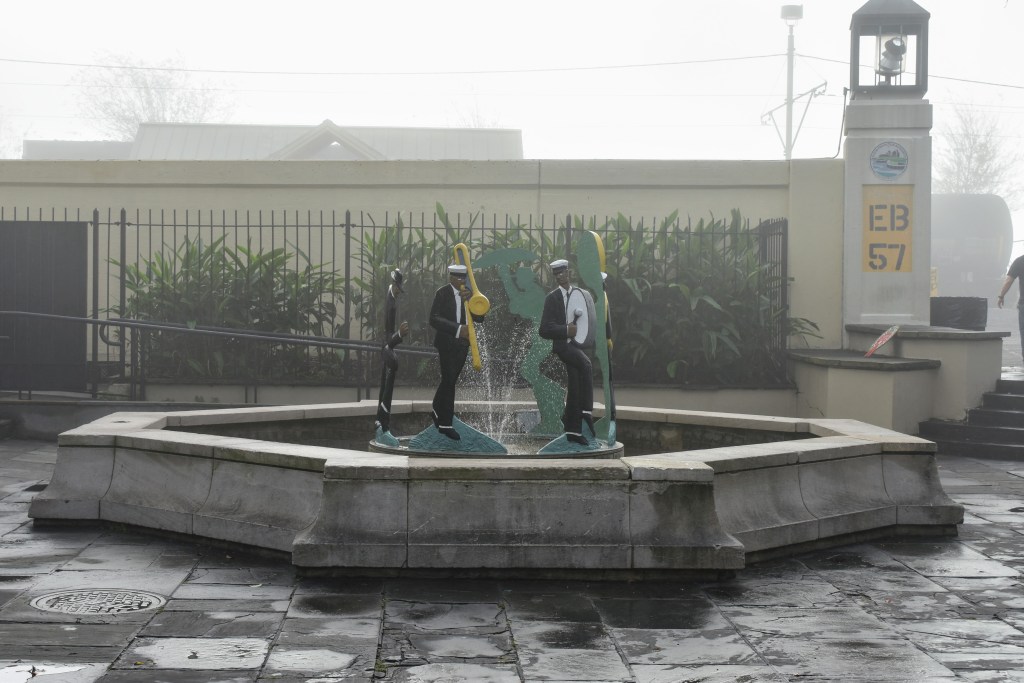
Decatur Street, French Quarter
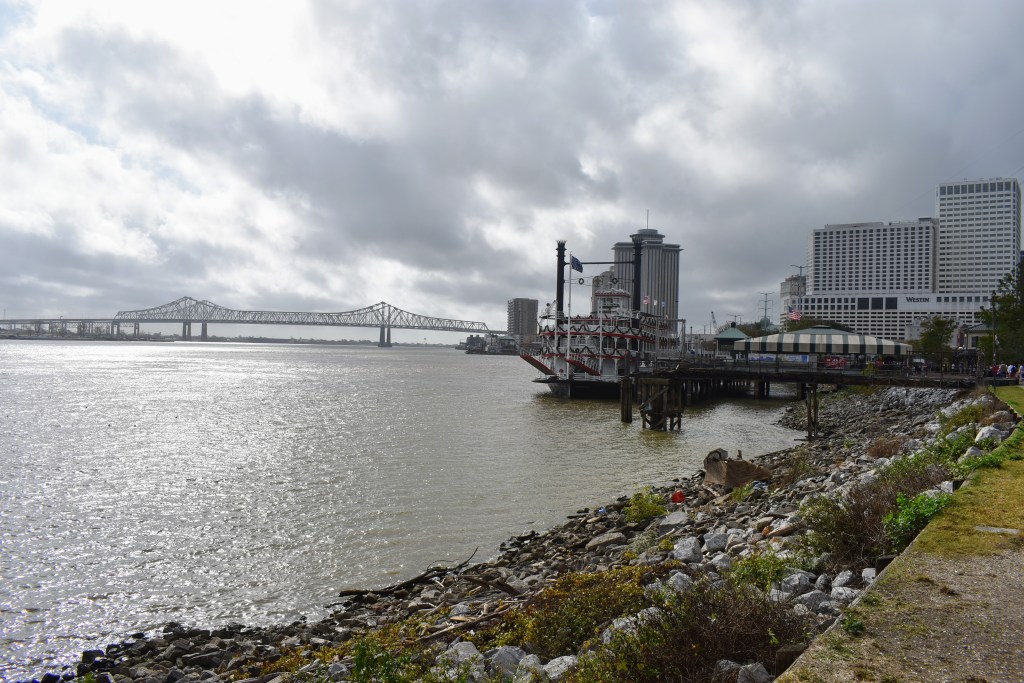
Woldenberg Park Riverfront, French Quarter
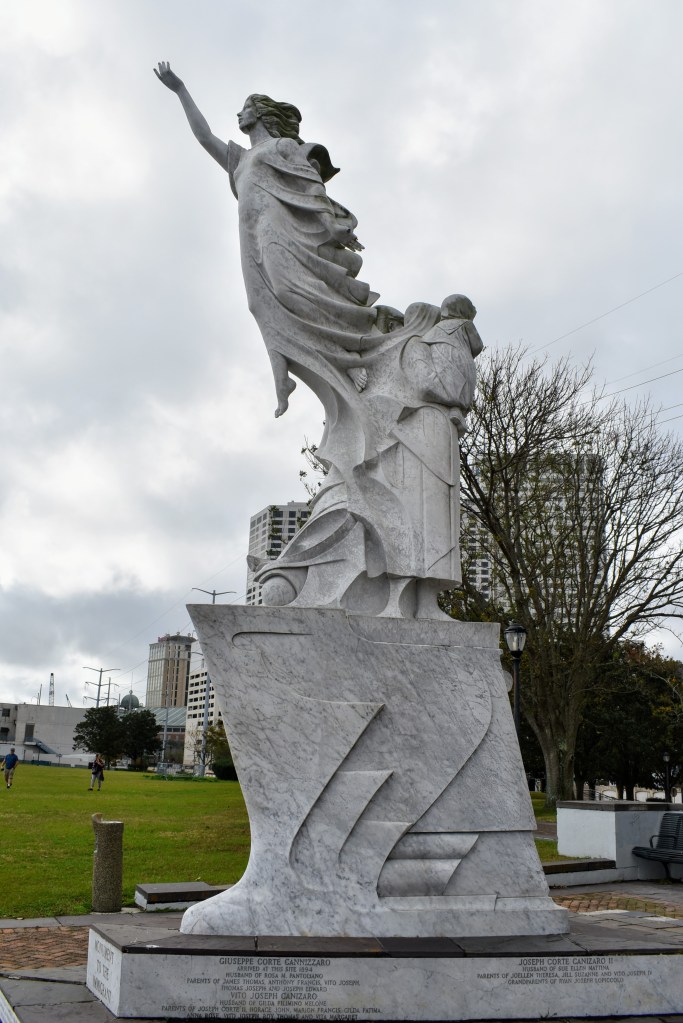
Woldenberg Park Riverfront, French Quarter
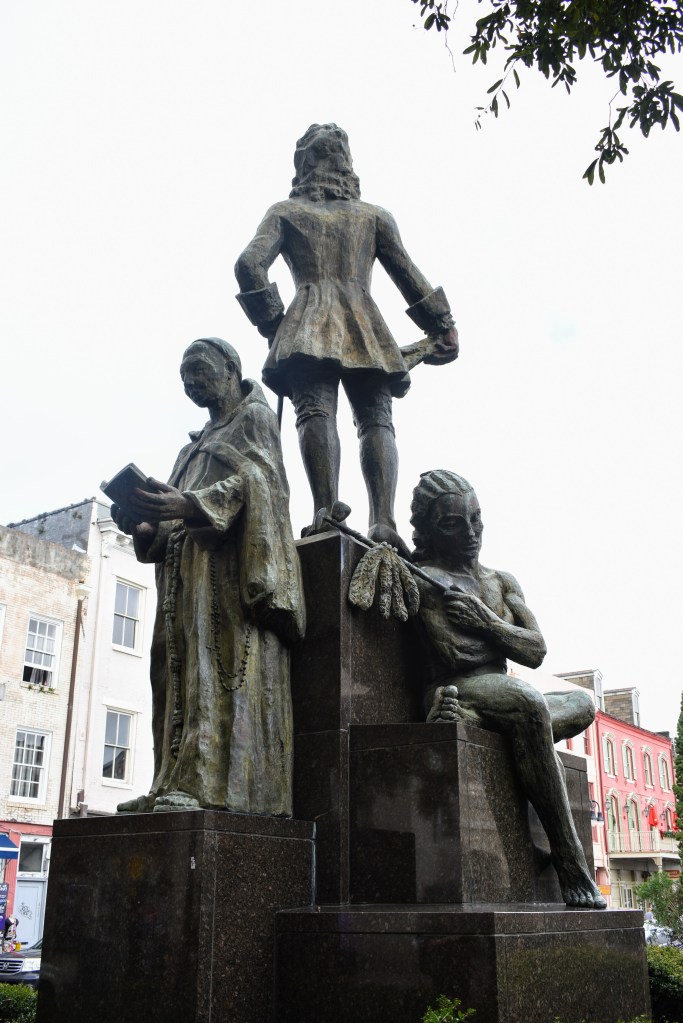
Bienville Place, French Quarter


Jackson Square, French Quarter
After our walking tour we headed back to the hotel for a quick pee-and-rehydration break before heading out to catch a trolley to the Garden District. Despite what the trolley website said, the Walgreens next to our hotel didn’t have any day passes for purchase, so we walked over to the trolley stop and made sure we had enough small bills and quarters to pay the exact fare. We did, but it didn’t help because the trolley never showed up. We waited a bit, but our tour was due to start in less than an hour and we were getting rather nervous that getting the trolley would take longer than that. Fortunately we live in an age where a car ride is but a couple of jabs at your phone away (we got a Lyft).
Our Garden District tour started in front of Lafayette Cemetery #1, the cemetery where any scenes that need to take place in a New Orleans cemetery are shot but that is also closed to visitors due to renovations that don’t seem to have started yet. Because we got a Lyft, we actually ended up being about 20 minutes early, so our guide, Angie, directed us to a small shopping center called The Rink where we could browse for a few minutes and use the restroom if need be. Since we had a little time to kill, we wandered over there to check it out (there was a pretty cool bookstore that we went back to after the tour) and then back to the cemetery.
We had a fairly large group, so we were split between two tour guides. Mom and I went with Angie and about 13 other people. The Garden District was larger than I had realized and quite different from the French Quarter, which was how I always pictured New Orleans (I don’t think I’m alone in this!). It was much more reminiscent of Savannah with larger houses set back from the road, mature trees, fences, yards, and a wide range of architectural styles. The big reason for this was that the French District was the “original” New Orleans, and the more people who lived there, the more compact things had to become. The Garden District was actually originally a plantation in a separate town, Lafayette, and was specifically designed to accommodate these large houses—four per block—for the richie riches.
Our first stop was Colonel Short’s Villa, which had been seized by Union forces during the Civil War. It was a wonderful example of Italianate architecture. It was also the home of Paul McCartney’s manager at one point. The cornstalk-design fence around the property was said to be Mrs. Short’s homage to the home she missed in Iowa, but apparently that’s a crock of bull since corn wasn’t grown in Iowa until the 1850’s, which was decades after she left the state. It was the most expensive fence in the catalog at the time, so that’s the one that they ordered. There were three other cornstalk-design fences in New Orleans at the time, but these days the only other one still remaining is at the Cornstalk Hotel.
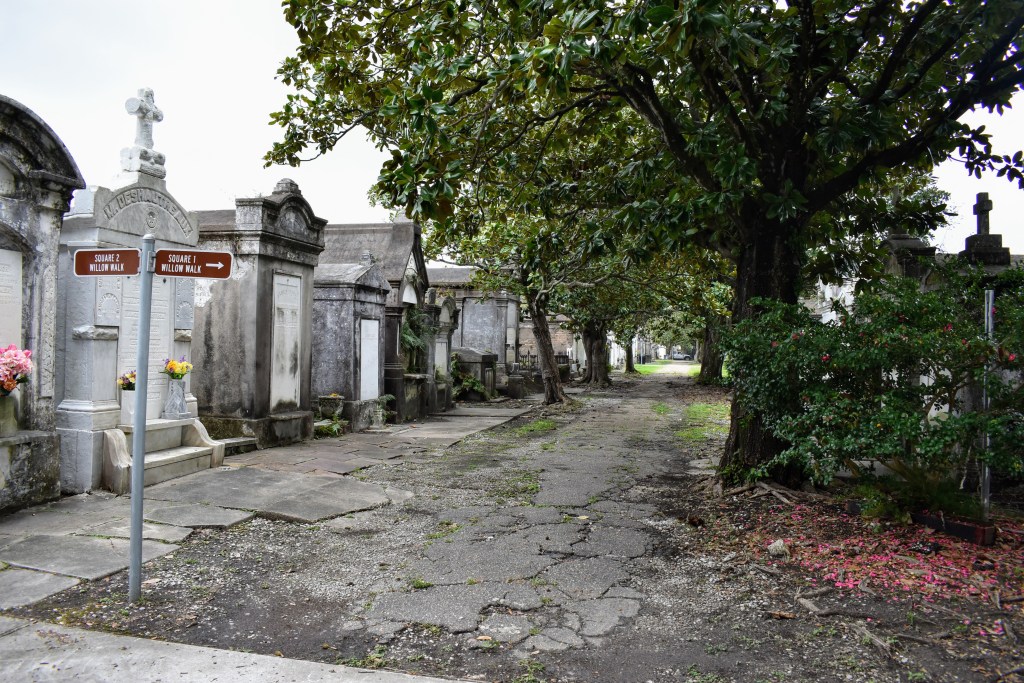
Washington Ave, Garden District
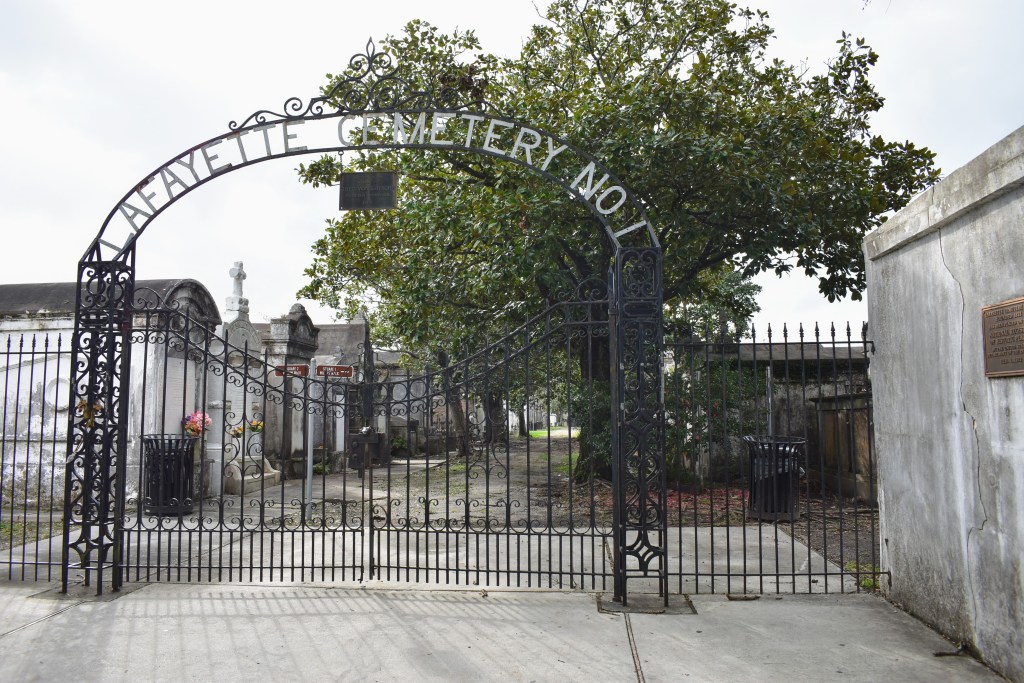
Washington Ave, Garden District
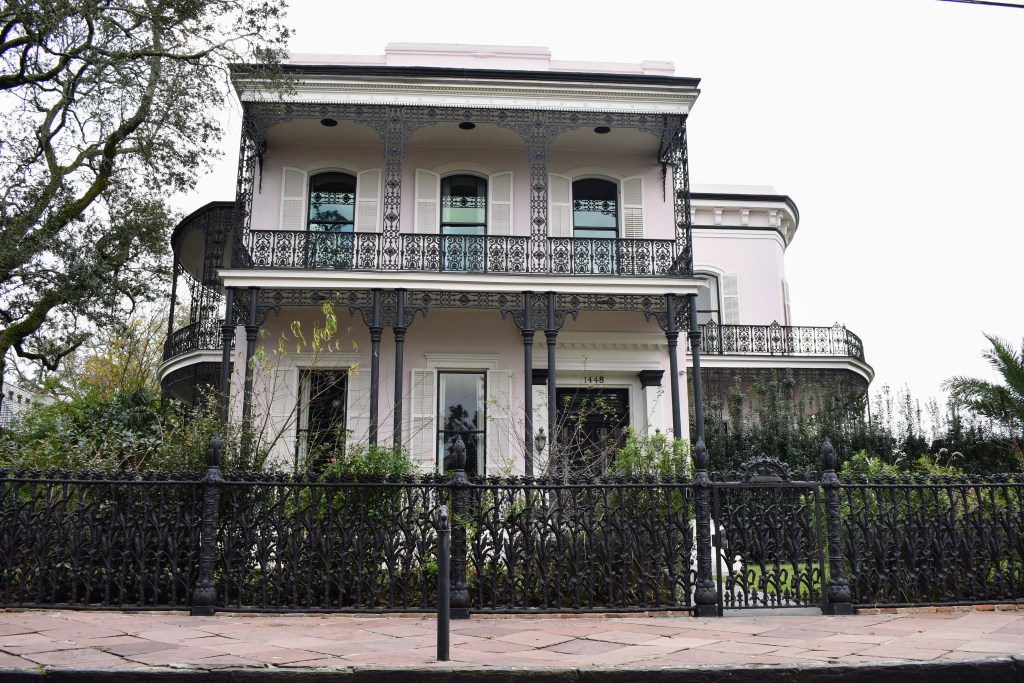
Fourth Street, Garden District
We also saw examples of Gothic Revival, German Chalet, and lots of Greek Revival. Often the houses we saw would have examples of several styles mixed together, sometimes with some 50’s or 60’s Americana slapped on since the neighborhood didn’t become a National Historic Landmark until 1971, which prevented further modifications to the homes’ exteriors. We also saw the homes or former homes of several celebrities: Ann Rice, who lived in four different homes in the Garden District, the Manning family, John Goodman, and Sandra Bullock. I’ve decided that John Goodman and Sandra Bullock probably have a Garden District Gang War whenever they’re both in town. They seem like the type!
We also enjoyed gawking at the Carroll-Crawford House. Apparently, the first owner of the house, Joseph Carroll, was good friends with Mark Twain. But when Twain would visit, they quickly devolved into a “boys will be boys” state. One day they had been drinking a lot and decided it would be a good idea to have target practice. They got the bottles all set up in the carriage house and started shooting. Of course, this wasn’t the Wild West and hearing gunshots in town, and most especially in the bougie Garden District, was. Not. Normal. So, of course, the police were called out pretty quickly and issued them both with citations. Well, our guide had had a rather accidental opportunity to see inside the home a couple of months before when she happened to meet the architect who was in charge of the renovations that the new owners wanted to do. She told him this story while he was giving her a tour of the house and they immediately went to look for the bullet holes. Dear reader, they found them.
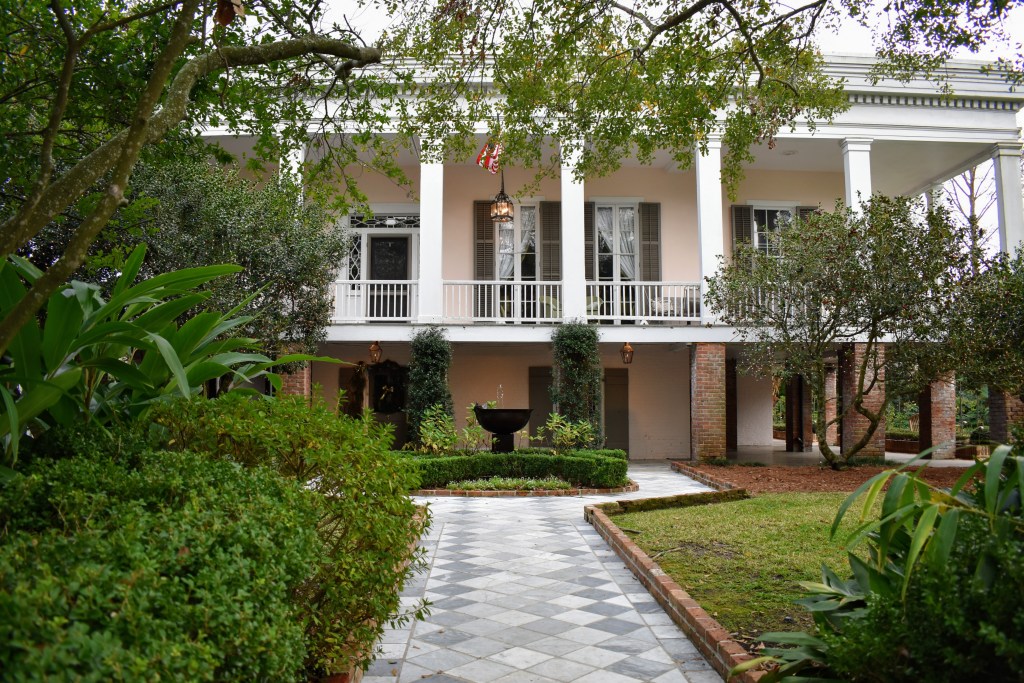
Prytania Street, Garden District
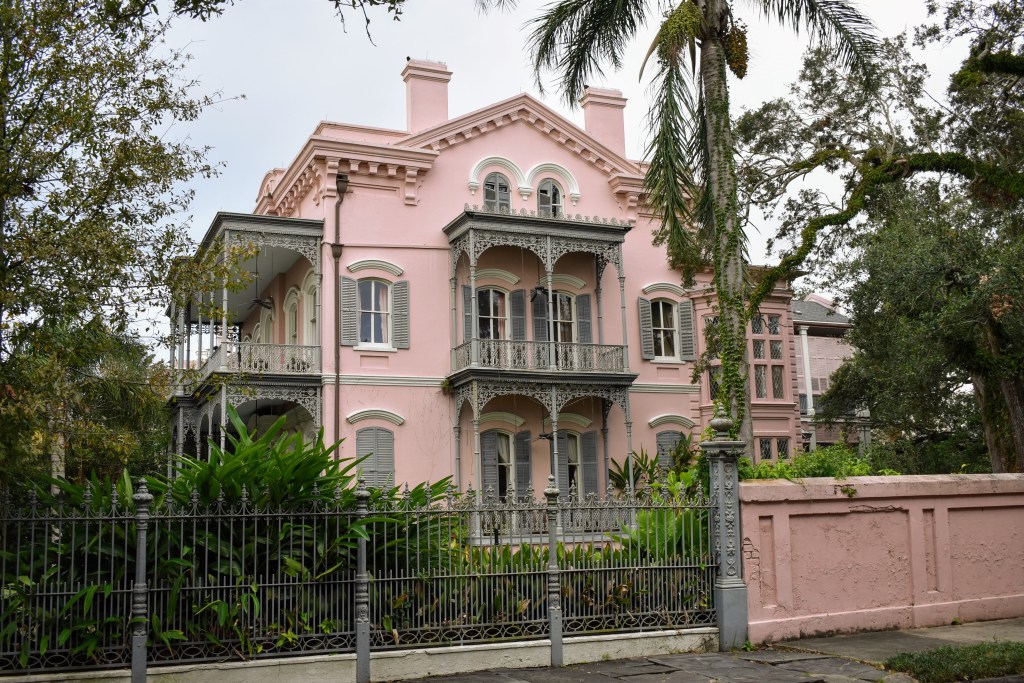
First Street, Garden District
Our tour ended back at the cemetery, where we got a rundown of how the burials work. The idea that New Orleans has the crypts for which it is so famous simply because of the water table isn’t really true. It’s a factor, but the practice also stemmed from diseases that swept through the area (think yellow fever, especially) and that were not very well understood. Since people weren’t sure exactly how the diseases were transmitted, they didn’t want them leaking into the water supply from freshly-buried corpses. The crypts are very much still in use today, and in fact you can buy one if you have a spare $300,000 lying around. The practice goes something like this: someone dies, the family has a wake and façade of the crypt is removed by the cemetery workers, the casket is borne to the cemetery from the church and the body is removed before being placed on a stone slab in the crypt that runs almost the length of the structure. The procession out of the cemetery is often when the jazzy music is played, if the family has arranged for a band to accompany the mourners in order to celebrate the life of the deceased (called a second line, or more specifically, a jazz funeral). The crypt is sealed back. A year and a day must pass before someone else can be put in the crypt (if someone in the family dies before then, they have to chill out in a wall rental). When the next person is set to be interred, part of the preparation of the crypt is that the cemetery workers take a long pole with a flat piece on the end and push the remains of the last person to the back of the crypt, where they fall between where the stone slab ends and the back wall of the crypt. Under the crypt is a caveau (French for “cave”) where the remains all kind of mix together. Then the next, um, occupant can be put on the stone slab.
After the Garden District tour, and quick look at the bookstore in The Rink, we had enough time to try for the trolley again. With success this time! It was quite crowded, so Mom and I ended up getting separated. And two stops later, everyone had to get off because the trolley wasn’t going any further due to work being done on the tracks. Instead we all trooped over to a waiting bus and went the rest of the way.
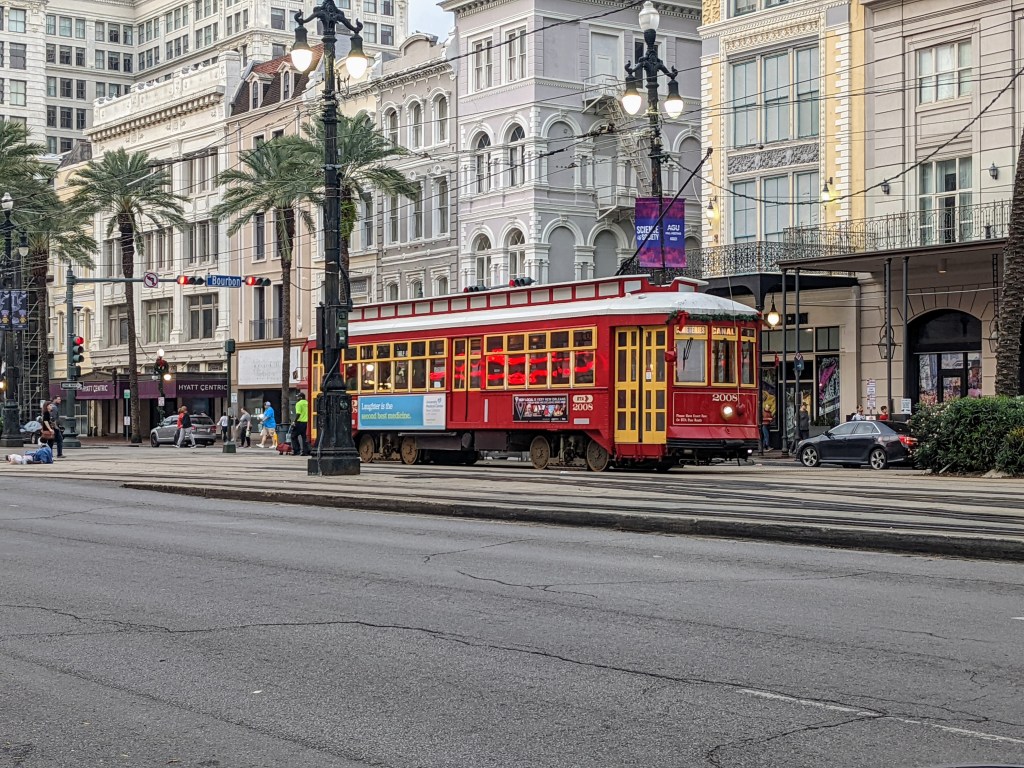
St Charles Ave
Once back at the hotel, we had time for a quick breather while we decided where to go for dinner. In the end, we just walked back into the heart of the French Quarter. Based on a recommendation from our morning guide, we found ourselves at Original Pierre Maspero’s. Mom got a blackened redfish, while I went with the Crescent City Sampler and tried a bit of gumbo, jambalaya, red beans and rice, and etouffée. Yum! While we were waiting for our food a second line went down the street—a second line is a mini-parade for many different occasions when a jazz band accompanies a group in a procession. It can be a jazz funeral, a wedding, tourists whoopin’ it up, whatever. I went outside to look!
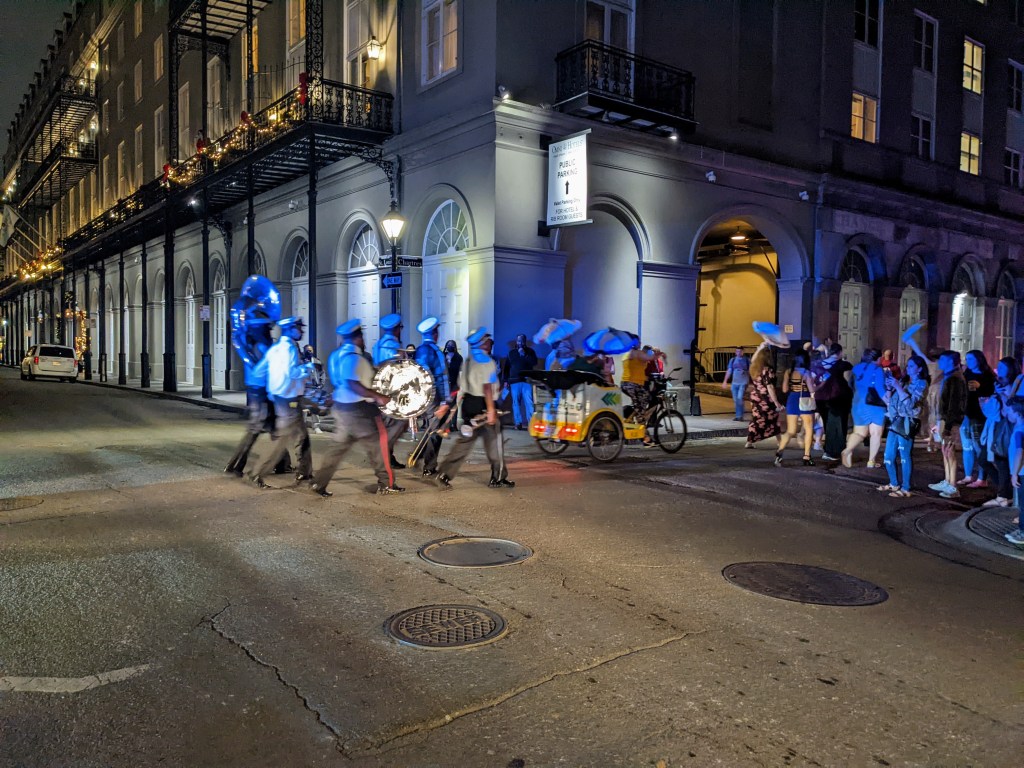
Original Pierre Maspero’s
St Louis Street, French Quarter
Even taking our time over dinner, we had time to stop for some dessert before I was due to meet my final tour of the evening. I had gotten the last ticket, and Mom said she was fine sitting that one out. We had passed a gelato shop on the way to dinner, so we went back there for dessert. I got raspberry sorbet and lavender London fog, while Mom got a lemon pie sorbet. I dropped most of my stuff at the room and headed out for my Killers and Thrillers tour! I had looked for ghost tours, but all of them seemed to be “family friendly,” which I definitely didn’t want. I found the perfect thing when I search for true crime walking tours!
I met up with the group in Jackson Square and met the guide, Michael, who had a real eyepatch. He was also a historian at the WWII Museum and an instructor at the University of New Orleans, which certainly confirmed his credibility. We had a lot to get through, much of which would be right at home in a late-night or streaming-only true crime series. He told us about Zackery Bowen, who leapt to his death from the roof of the Omni Hotel in the French Quarter in 2006 after strangling and dismembering his girlfriend several days before. He had been a smoking buddy of our guide’s, so that was quite a personal story to share. Michael was sure to give us a minilecture on Marie Laveau and how she was the Voodoo queen, yes, but also an extremely savvy businesswoman. We also heard about more historical crime, like the Axman of New Orleans, and stood outside the apartment where the Trunk Murders took place while Michael recounted the grisly details.
Of course, no NOLA ghost/crime tour is complete without a stop at the Lalaurie Mansion. It was here that I really appreciated Michael’s attention to detail. Many people have heard the story: Marie LaLaurie tortured and murdered her slaves, but this wasn’t discovered until 1834, when a fire broke out in the mansion’s kitchen and when the firemen arrived, found a slave shackled to the stove. The slave then directed them to the third floor or attic area, where they found slaves flayed alive and one female slave kept in a 3’x3’ box, with her arms and legs broken and reset at odd angles in order to fit. They say she could only walk like a crab. Then Madam LaLaurie fled, never to be seen again.
Well, that’s doo-hickey. Most of it anyway. Michael pointed out that most guides cite the mansion itself as the site of the crimes. Well, the third floor wasn’t even added to the house until a couple of decades after Marie had left. So there was no way she could have kept any slaves up there or chased a slave girl who had tugged at a knot in her hair while brushing it around the third floor landing until the girl fell over the banister to her death—the space simply didn’t exist at the time. And there are no historical accounts to substantiate the more colorful claims that many guides relish in making, like the crab-walking woman.
What did exist was a three-story carriage house. And, as Michael pointed out, mansions of the time didn’t have their kitchens in the main house for precisely the reason that brought the horrors of this story to light: fire. There was a fire in the kitchen, and the firemen did find a slave shackled to the stove, but it was in the carriage house. And they did search the third floor there and found slaves in horrible conditions, chained by their necks and beaten horrifically. A contemporary newspaper account described one man as having a deep wound in his head and having worms and scars all over his body. Michael also pointed out something else that many people don’t seem to mention in accounts of LaLaurie: despite having the records of ownership of 12 additional slaves, only the 8 in the carriage house were found. New Orleans required its citizens and slaves to be Catholic when it was founded, so even now a majority of people living there are Catholic. And the Catholic Church is great at record-keeping. But no records exist of the deaths or further sale of these 12 slaves. So it’s pretty clear that LaLaurie killed 12 human beings in cold blood, whether through violence, neglect, or a combination, and most likely disposed of them in a nearby swamp.
With that, Michael let us go with our heads full of blood and gore. The LaLaurie mansion sits on the corner of Royal St and Governor Nichols St, so I had a straight shot down Royal to the hotel. I was back by about 9:45. I still had to repack my carry-on and suitcase and take a shower, so I got on with it since I was a bit tired and wanted to get to bed!

 Strom Travel Diaries
Leave a comment