-
A Venue of Vultures
Day 14—Thursday, December 30, 2021
One nice thing about train travel is that you don’t have nearly the lines you do at the airport. So you don’t need to be at the station more than 30-60 minutes in advance, and that’s mostly if you need to check a bag or if you’re worried about traffic. Did that stop Mom from wanting to get to every station with at least 90 minutes to spare? No. So we got up about 7, finished the last of our packing, went to the Walgreens next door to get a little snack (no free continental at any of our hotels: boo!), and checked out. I ordered a Lyft and apparently, it wasn’t allowed to pick us up at the hotel. So we had to go down the street to meet it and wound up blocking traffic a bit when we were getting in. Oops!
When we got to the train station, we found out that there was a waiting area for sleeping-car or business class passengers, we just hadn’t seen it when we’d come in on Tuesday night! So we felt comfortable eating our little snacks—the waiting room even had packaged muffins and cinnamon rolls! I also took the opportunity to get some photos of the murals around the station.
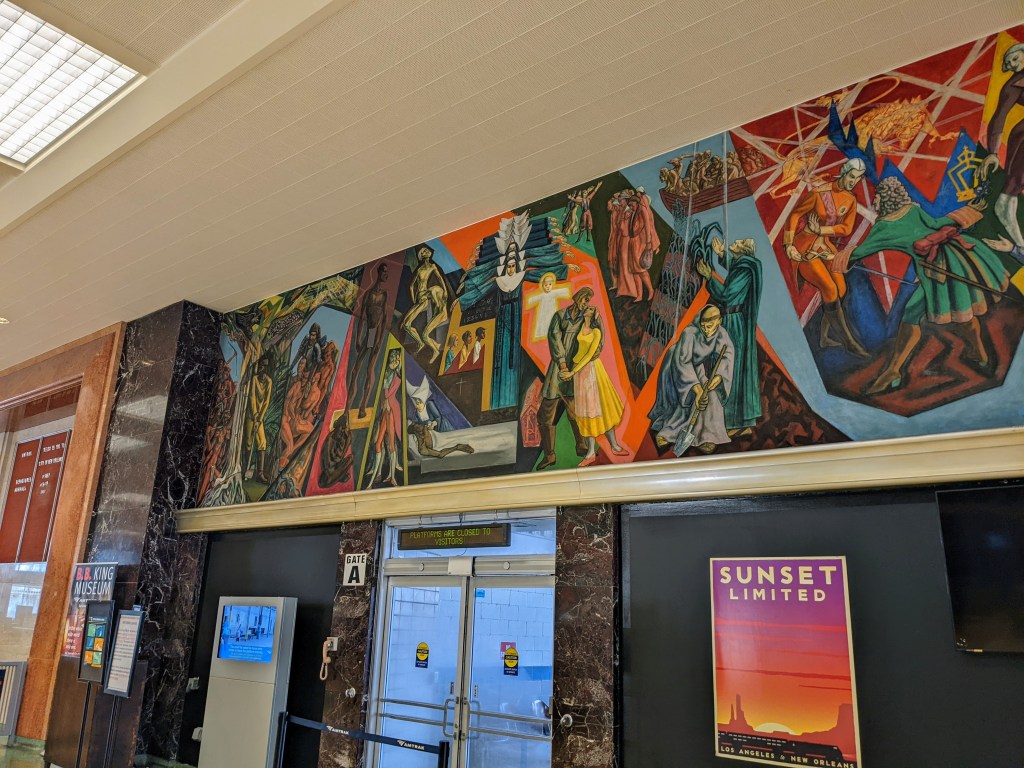
Union Passenger Terminal Mural 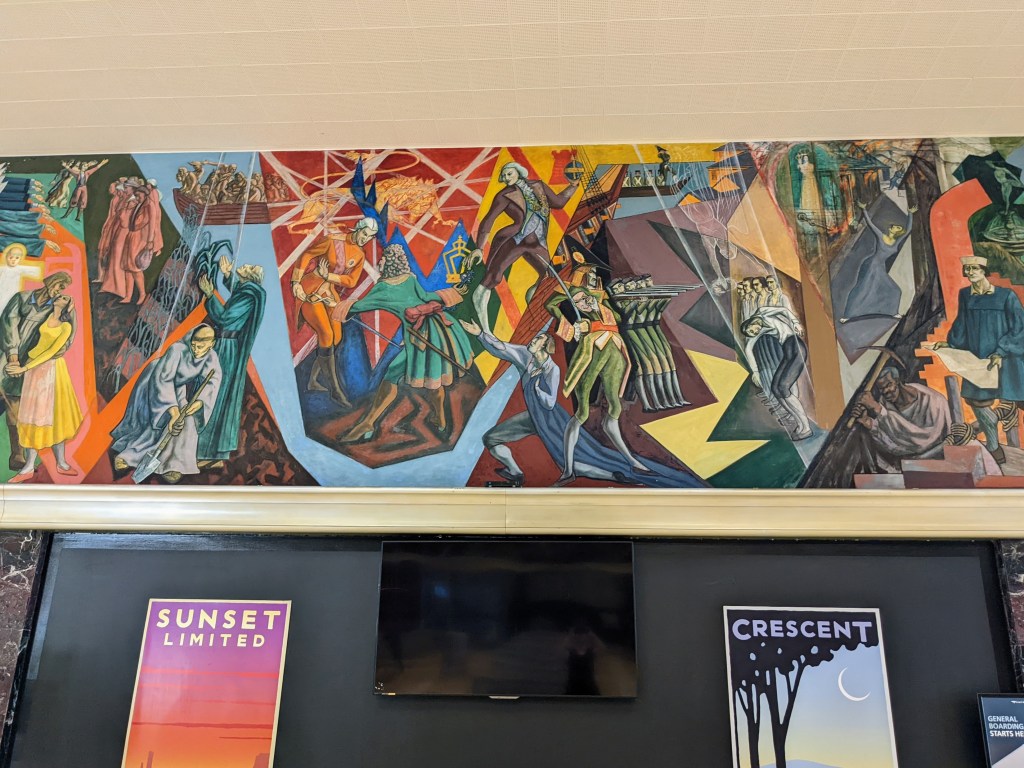
Union Passenger Terminal Mural 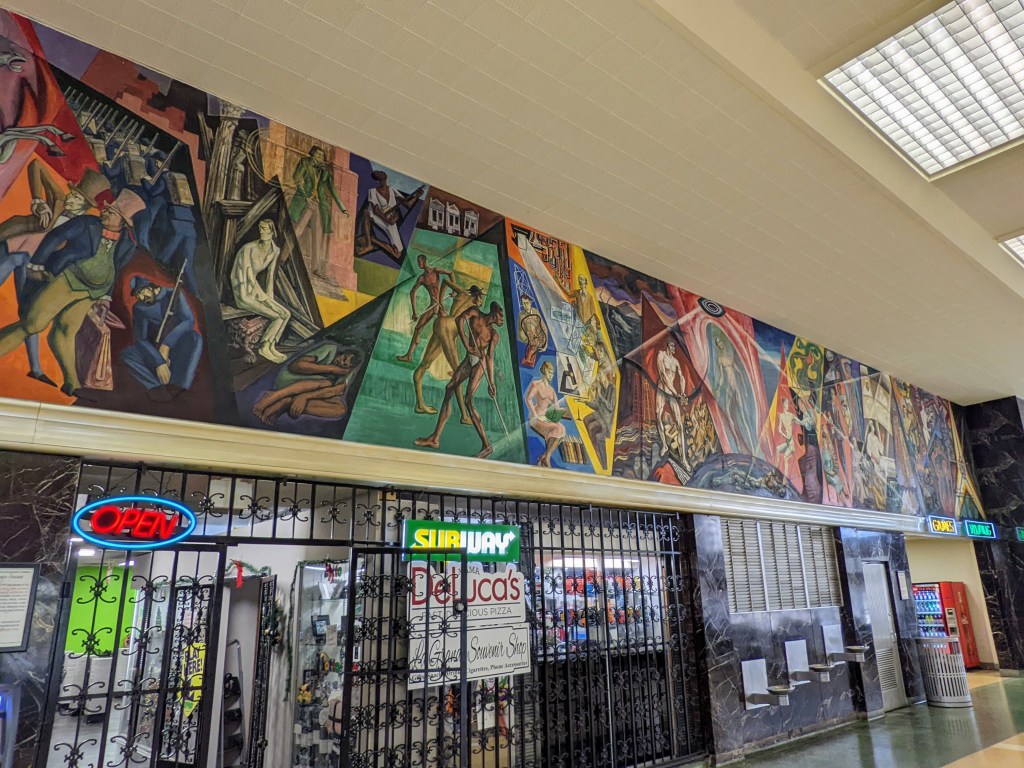
Union Passenger Terminal Mural The train left pretty much on time, around 9:15, and our sleeping-car attendant came around to offer breakfast. We decided to forgo breakfast on the train since we’d had the muffins in the station. On the way out of town, we passed the ritzier of the New Orleans cemeteries: Metairie Cemetery. It was pretty fancy: very green and manicured.
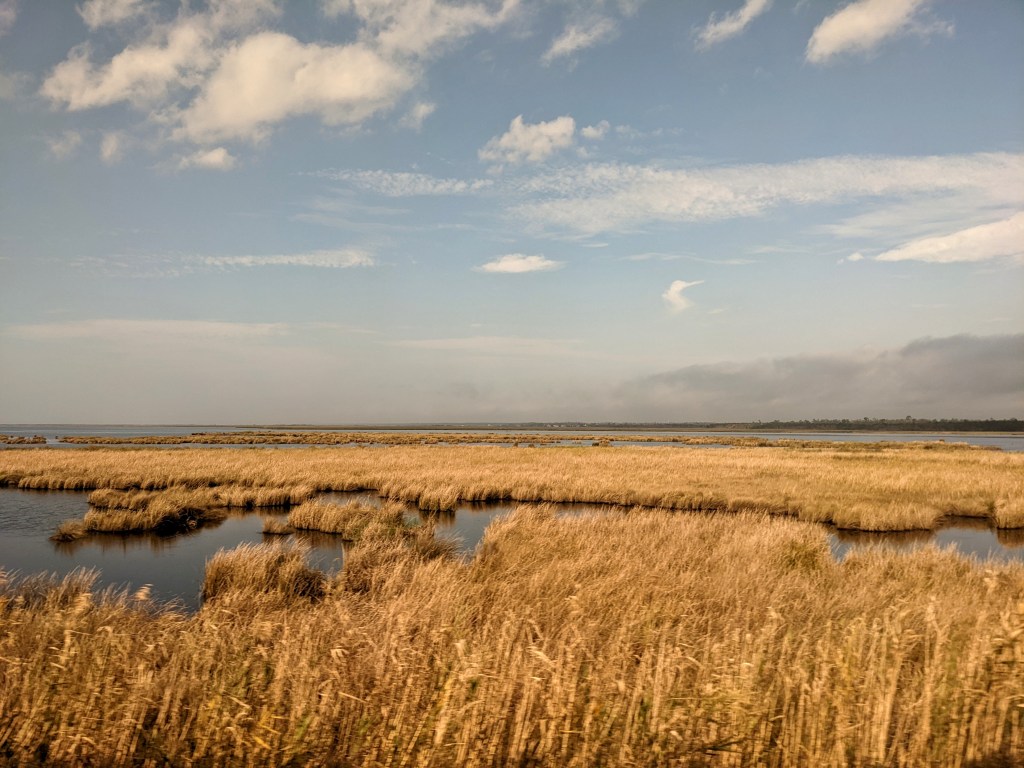
Lake Pontchartrain The morning passed quickly between naps, word puzzles, reading, and admiring the scenery. The train between New Orleans and Charlotte isn’t a double-decker, so we had more headroom and a small toilet area in the cabin (both good and bad!). This also meant that the train didn’t have a dedicated observation car. So we just chilled in the room the whole time.
One of the most memorable moments of this leg, besides going through Laurel, MS, and looking for Ben and Erin from “Home Town,” was seeing a huge group of vultures sitting in several trees beside the tracks. I looked it up and there are a few collective nouns for a group of vultures: a volt, committee, or venue. Huh.
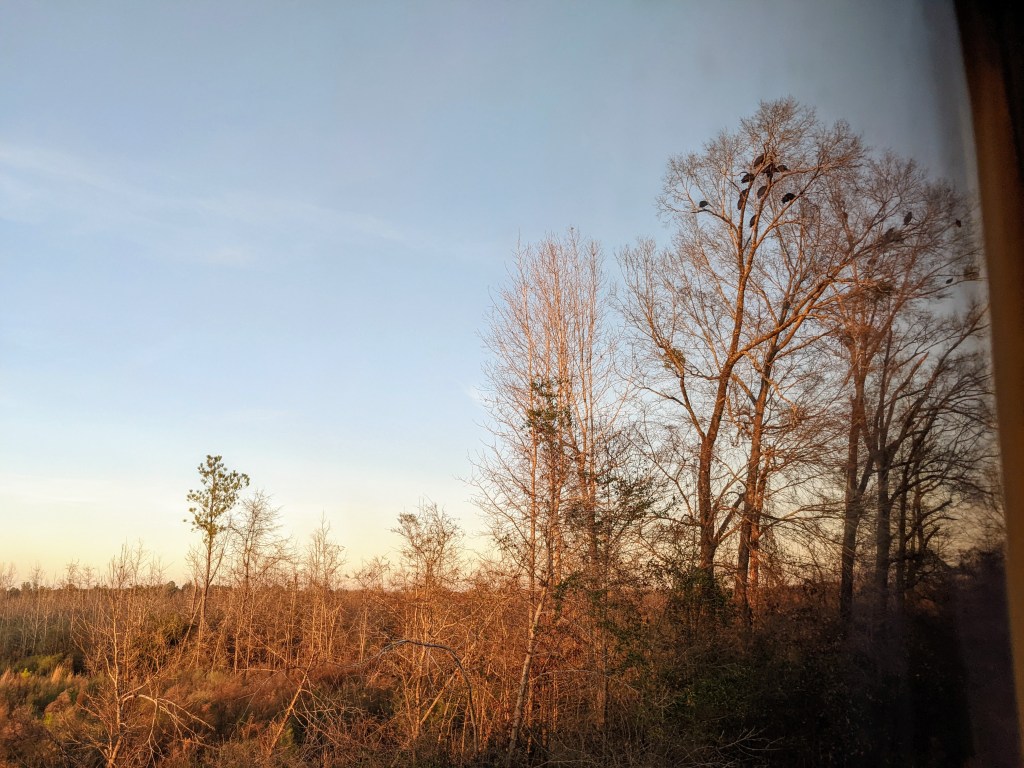
A venue of vultures We had a very late lunch. Something had gone wrong in the dining car and they were running very behind, so despite ordering our lunch around 12:40, Kevin, our car attendant, wasn’t able to bring it to us until almost 3. We were more than a bit hungry by then—the muffins from the station were a distant memory!
The rest of the afternoon and evening passed in much the same way. We did have Kevin make up the beds so we could get a little sleep before getting into Charlotte. We knew that there was going to be a bit of a delay, but we both woke pretty early so that we’d be ready. The train pulled into Charlotte at about 5:35 on Friday morning and we couldn’t believe our journey was nearly at its end. A short Lyft ride and we were home. Of course, we had some tea, dropped our bags, and took a nap! By the time we woke up a little later in the morning, it already seemed like we’d never left. It’s strange how such an adventure can turn into a memory so quickly after the return to your routine.

Getting off the train in Charlotte -
In Which Claire Gets Verbose
Day 13 – Wednesday, December 29, 2021
We woke up about 7 a.m., wanting to get an early start so we could have breakfast without feeling rushed to get to our first tour. We got ready and headed out, having decided to walk in the direction of Jackson Square and the place we were supposed to meet up with the tour group. We passed a couple of places, but most restaurants weren’t open yet or didn’t do breakfast. Nothing much appealed to us at that point, anyway. When we walked around Jackson Square we began to hear that classic: a New Orleans jazz band. The morning was a bit foggy, so we could hear it before we could see it (and I will put an aside here that if you’re ever in NOLA, definitely request a foggy morning from the gods above; it was glorious). When we did see the band, they were performing next to a building with a green awning on the side and a long line of people coming out of it. Café du Monde. Having not done my due diligence beforehand, I had no idea what the big deal was.
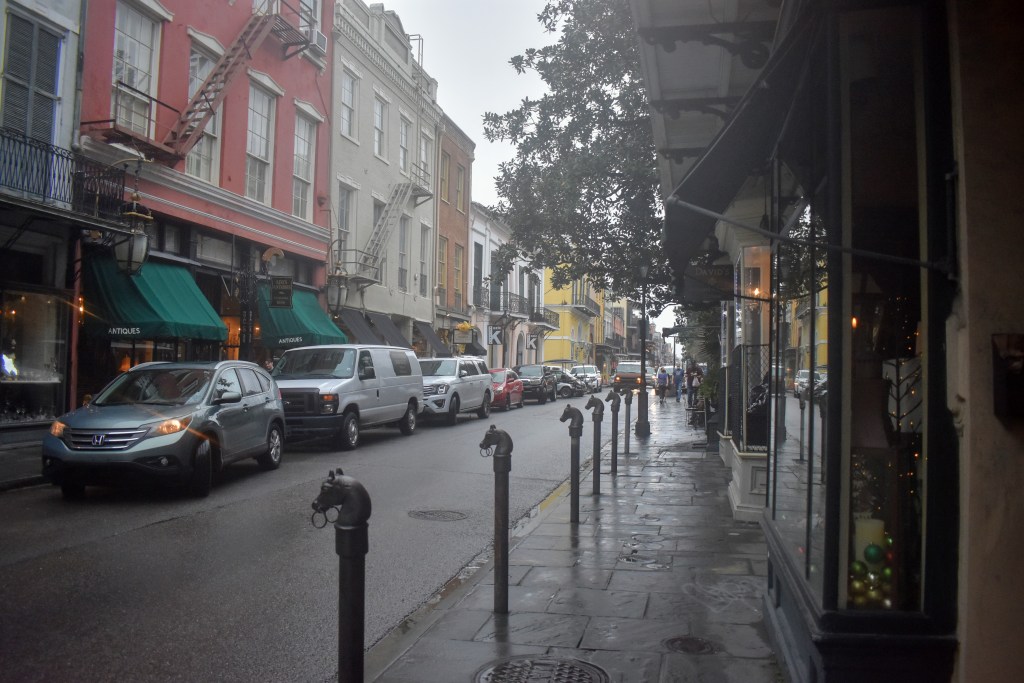
Royal Street, French Quarter 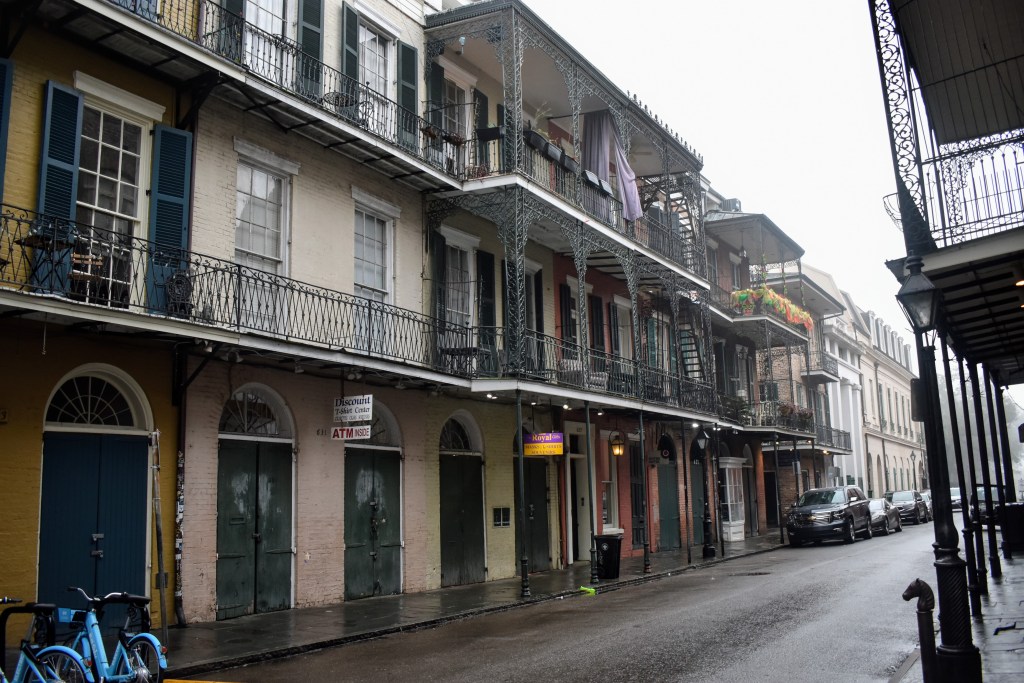
Royal Street, French Quarter 
Tour and Welcome Center
St Peter Street, French Quarter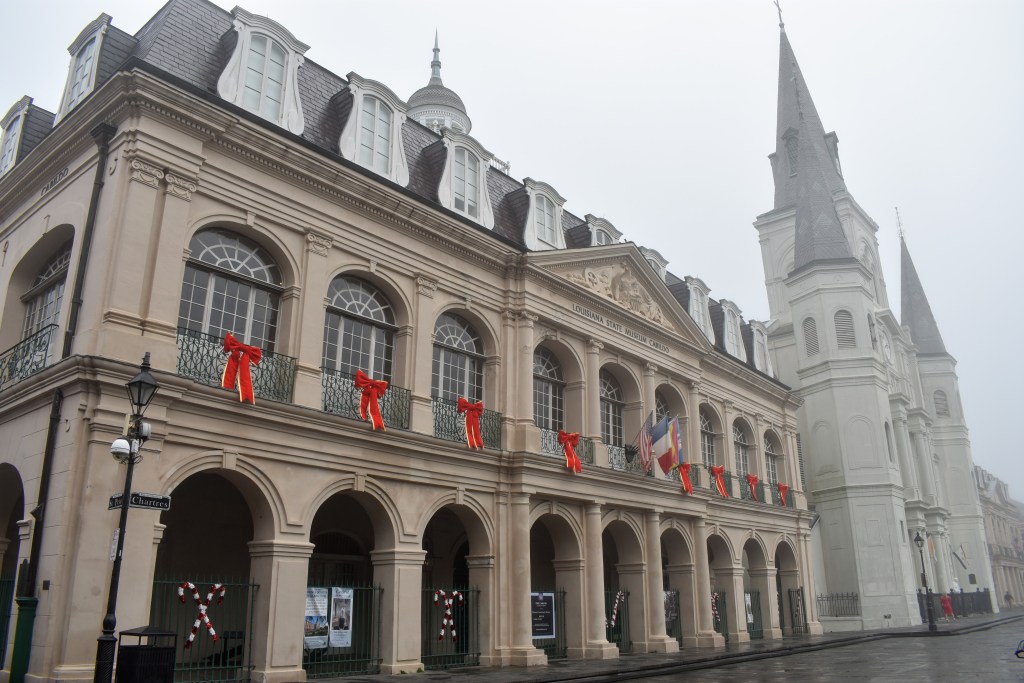
The Cabildo and St Louis Cathedral
Jackson Square, French Quarter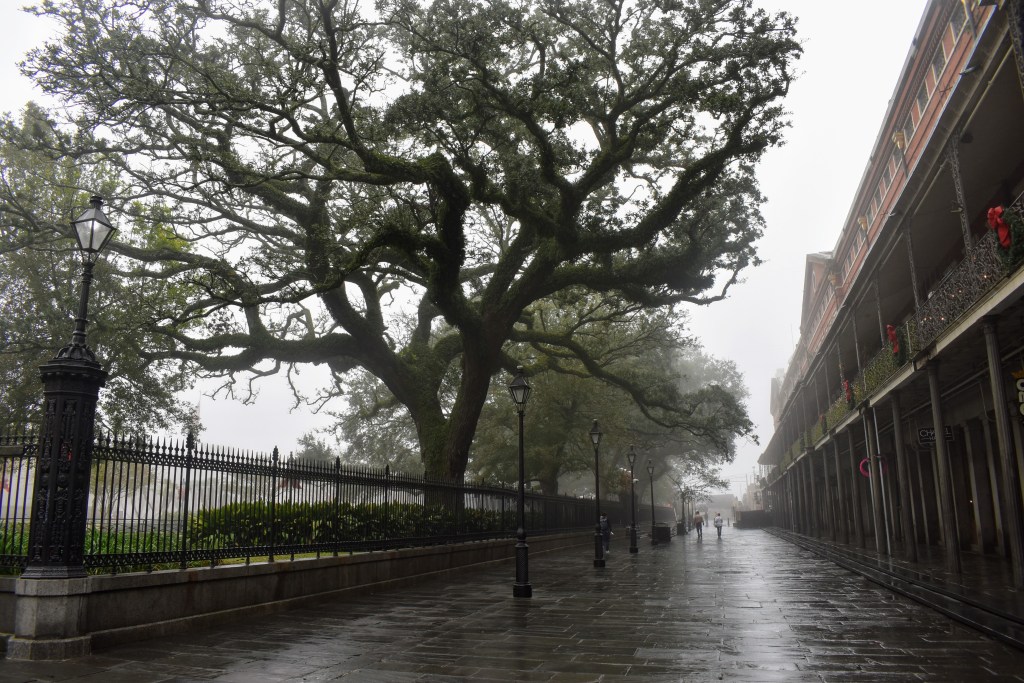
Upper Pontalba building and St Peter Street
Jackson Square, French Quarter
St Louis Cathedral
Jackson Square, French Quarter
Café du Monde
Decatur Street, French QuarterWe walked past, noting that the building was part of the larger structure of the French Market. A couple of more blocks and we found where we would be meeting the tour group later in the morning, and not having seen any more likely places for breakfast, we walked back behind the French Market where there was some artwork and got in line at the café. When we had been standing in line for a few minutes, we realized that there were two separate lines: the one we were in was for take-out orders and the other line was to get into the café itself. Well, that was fine because there was plenty of outdoor seating. It took about 10 or 15 minutes to get to the front of the line, and we were able to get our order pretty quickly. Two bags of three beignets, a coffee (the house special) and orange juice for Mom, and a hot choccie for me. We sat in the covered porch area and munched our way through our powered sugar allotment for the next 10 years.
After breakfast, we still had time, so we wandered down the sidewalk outside the front of the French Market and window-shopped. Our tour was supposed to start at 10, so we went ahead to the small visitor center where the Legendary Walking Tours had their base. We only had to wait for a few minutes—long enough to look at brochures, get a simple map, and sit down—before the guide was there and checking our names off the list. The walking tour was of the French Quarter specifically and began just outside at a statue of Joan of Arc. Our guide, Robin, walked us by the French Market, over to the riverfront, down different streets, and over to Jackson Square while regaling us with the history of the city. She kept things mostly to the early history of the city, with some mentions of her own life growing up in the area and how locals go about their lives. Mom and I both found it very interesting that on one hand the Catholic church had such a hold on the area when Europeans were first colonizing there, but that on the other hand women and people of color had a little more freedom compared to other areas. One woman sued her husband three times and finally got control of their plantation, which she then sold off (much of which became part of the French Quarter) before moving to France. She had been running the business while he was off doing some “engineering” (wink, wink) but she wasn’t able to do anything with the profits she was bringing in. Louisiana didn’t allow women to buy property outright, but they could inherit it or go through legal loopholes and become landowners. And Louisiana always had free people of color, which I hadn’t realized. In fact, New Orleans had a kind of caste system among the free people of color, which later included the freed slaves, of course. Apparently, Homer Plessy, along with other civil rights activists of the time, was mixed-race but white-passing, which caused some confusion to politicians in Washington. We also learned about quadroon balls, which was part of the plaçage system of concubinage. Mixed-race young women (and they were typically very young) were presented at these balls for rich white men to choose (ew), except instead of taking them as wives they’d take them as mistresses. However, the women (or, more often, their mothers) could demand certain compensation, which could include monetary compensation, housing, a European education for any children, as well as an inheritance for those children.
The tour ended in Jackson Square, home of several of the oldest buildings in the city, where we learned that the red brick Pontalba Buildings, built by the Baroness Micaela Almonester Pontalba, on either side are the oldest continuously-occupied apartments in the US. The galleries (not balconies) on the buildings were made with wrought iron rather than the more-common cast iron. Apparently, Andrew Jackson, for whom Jackson Square was named, had an affair with the Baroness and that’s why his statue is tipping its hat in the direction of one of the buildings (where she would have stood on the gallery waving back).
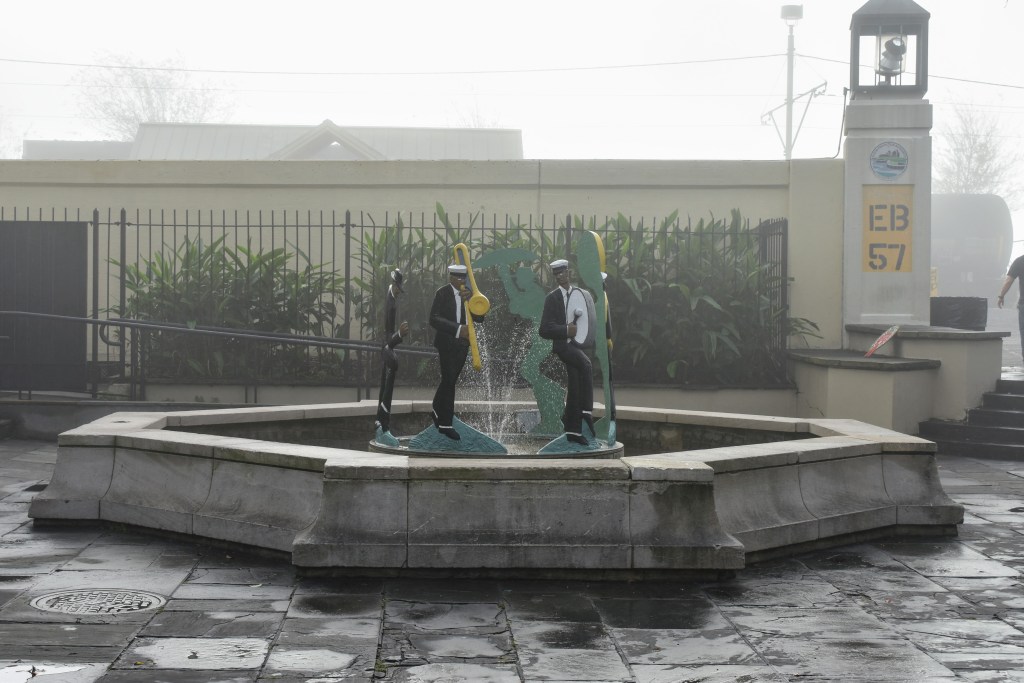
Fountain in the French Market
Decatur Street, French Quarter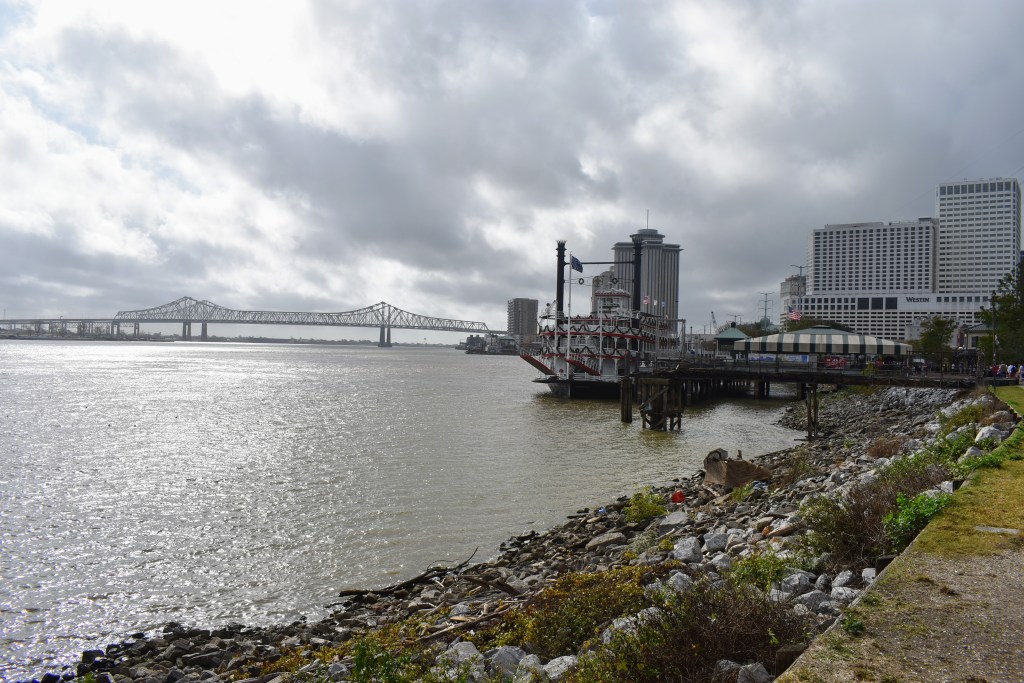
Steamboat Natchez and the riverfront
Woldenberg Park Riverfront, French Quarter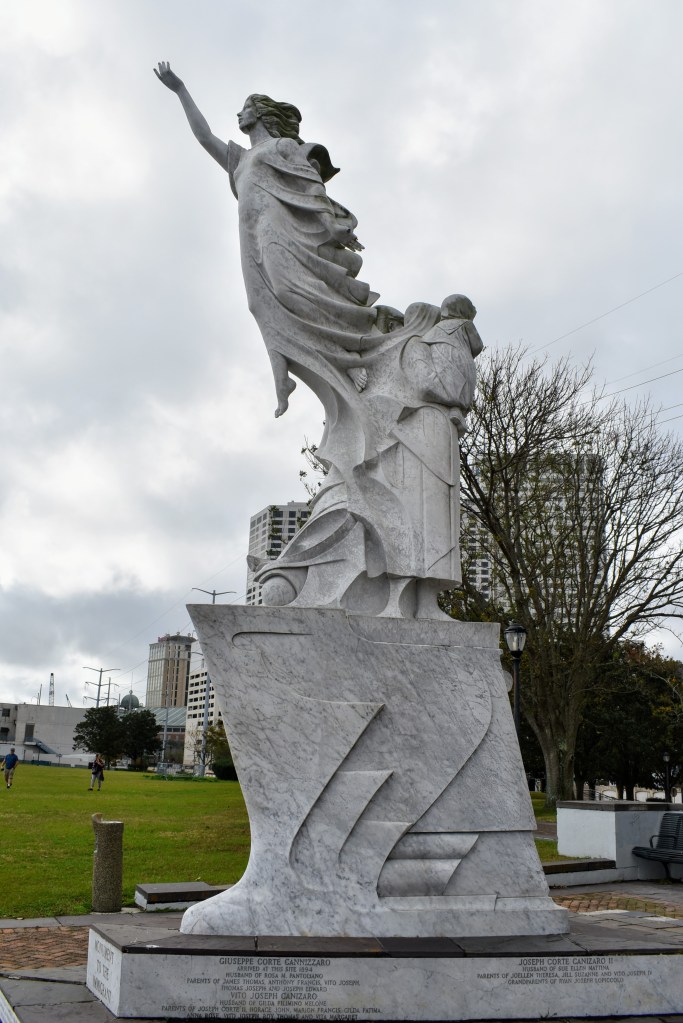
Monument to the Immigrant
Woldenberg Park Riverfront, French Quarter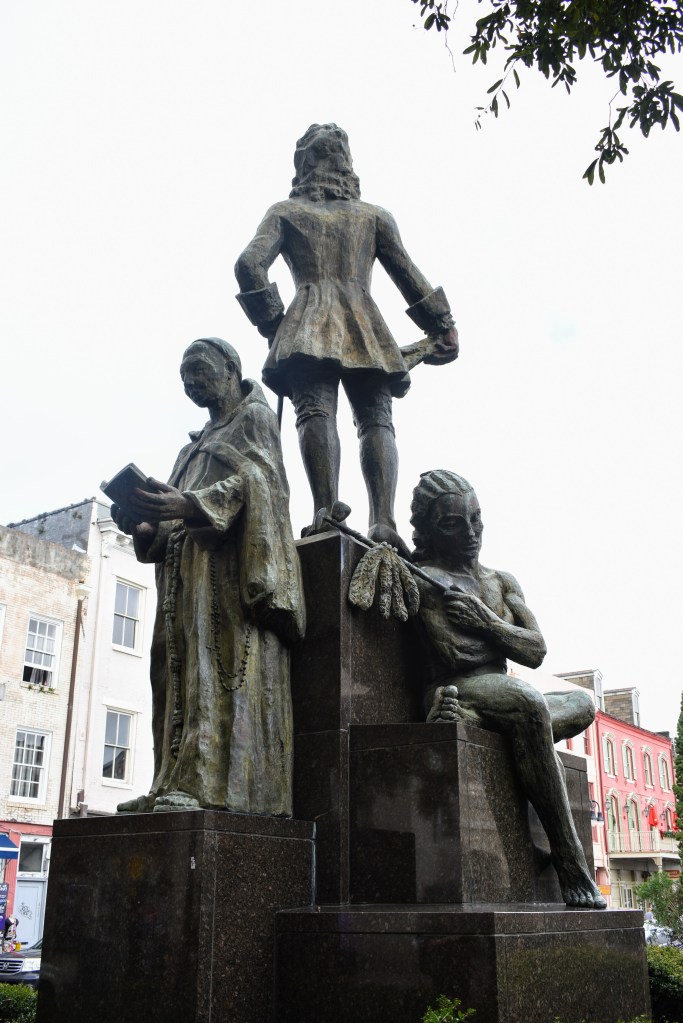
Statue of Jean-Baptiste Le Moyne de Bienville, Founder of New Orleans with Father Athanase and a Native American
Bienville Place, French Quarter
Conti Street, French Quarter 
West Pontalba House
Jackson Square, French QuarterAfter our walking tour we headed back to the hotel for a quick pee-and-rehydration break before heading out to catch a trolley to the Garden District. Despite what the trolley website said, the Walgreens next to our hotel didn’t have any day passes for purchase, so we walked over to the trolley stop and made sure we had enough small bills and quarters to pay the exact fare. We did, but it didn’t help because the trolley never showed up. We waited a bit, but our tour was due to start in less than an hour and we were getting rather nervous that getting the trolley would take longer than that. Fortunately we live in an age where a car ride is but a couple of jabs at your phone away (we got a Lyft).
Our Garden District tour started in front of Lafayette Cemetery #1, the cemetery where any scenes that need to take place in a New Orleans cemetery are shot but that is also closed to visitors due to renovations that don’t seem to have started yet. Because we got a Lyft, we actually ended up being about 20 minutes early, so our guide, Angie, directed us to a small shopping center called The Rink where we could browse for a few minutes and use the restroom if need be. Since we had a little time to kill, we wandered over there to check it out (there was a pretty cool bookstore that we went back to after the tour) and then back to the cemetery.
We had a fairly large group, so we were split between two tour guides. Mom and I went with Angie and about 13 other people. The Garden District was larger than I had realized and quite different from the French Quarter, which was how I always pictured New Orleans (I don’t think I’m alone in this!). It was much more reminiscent of Savannah with larger houses set back from the road, mature trees, fences, yards, and a wide range of architectural styles. The big reason for this was that the French District was the “original” New Orleans, and the more people who lived there, the more compact things had to become. The Garden District was actually originally a plantation in a separate town, Lafayette, and was specifically designed to accommodate these large houses—four per block—for the richie riches.
Our first stop was Colonel Short’s Villa, which had been seized by Union forces during the Civil War. It was a wonderful example of Italianate architecture. It was also the home of Paul McCartney’s manager at one point. The cornstalk-design fence around the property was said to be Mrs. Short’s homage to the home she missed in Iowa, but apparently that’s a crock of bull since corn wasn’t grown in Iowa until the 1850’s, which was decades after she left the state. It was the most expensive fence in the catalog at the time, so that’s the one that they ordered. There were three other cornstalk-design fences in New Orleans at the time, but these days the only other one still remaining is at the Cornstalk Hotel.
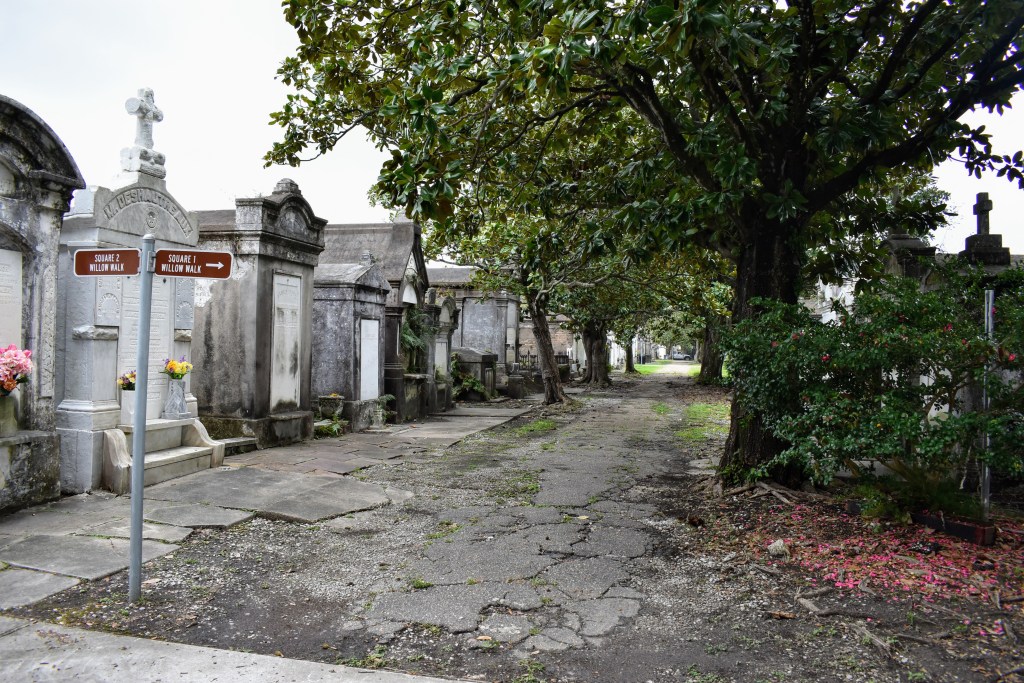
Lafayette Cemetery No. 1
Washington Ave, Garden District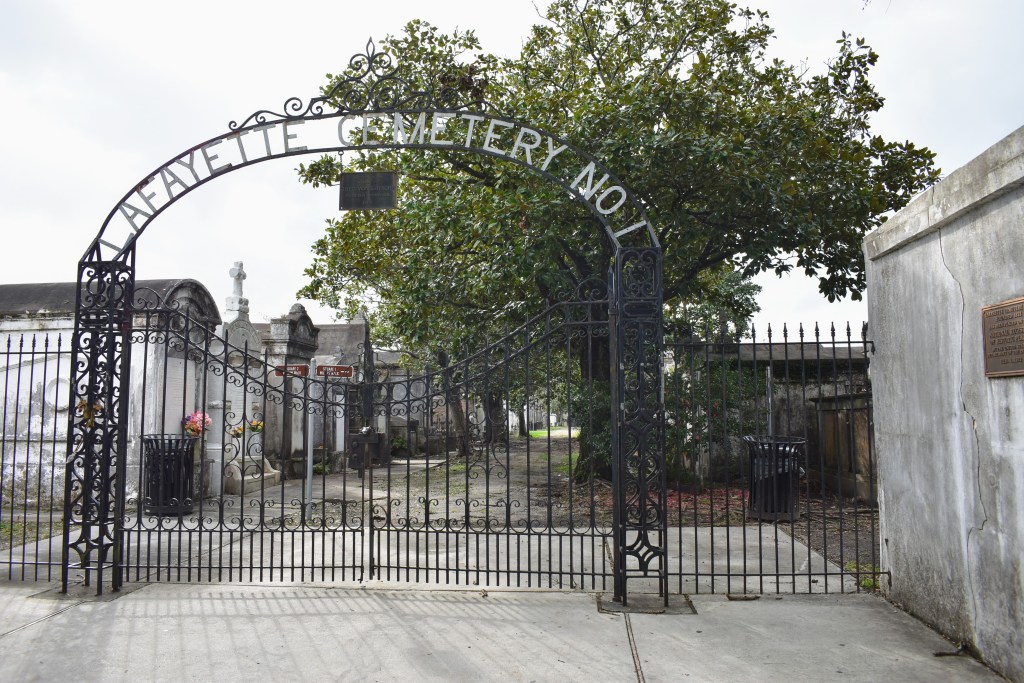
Lafayette Cemetery No. 1
Washington Ave, Garden District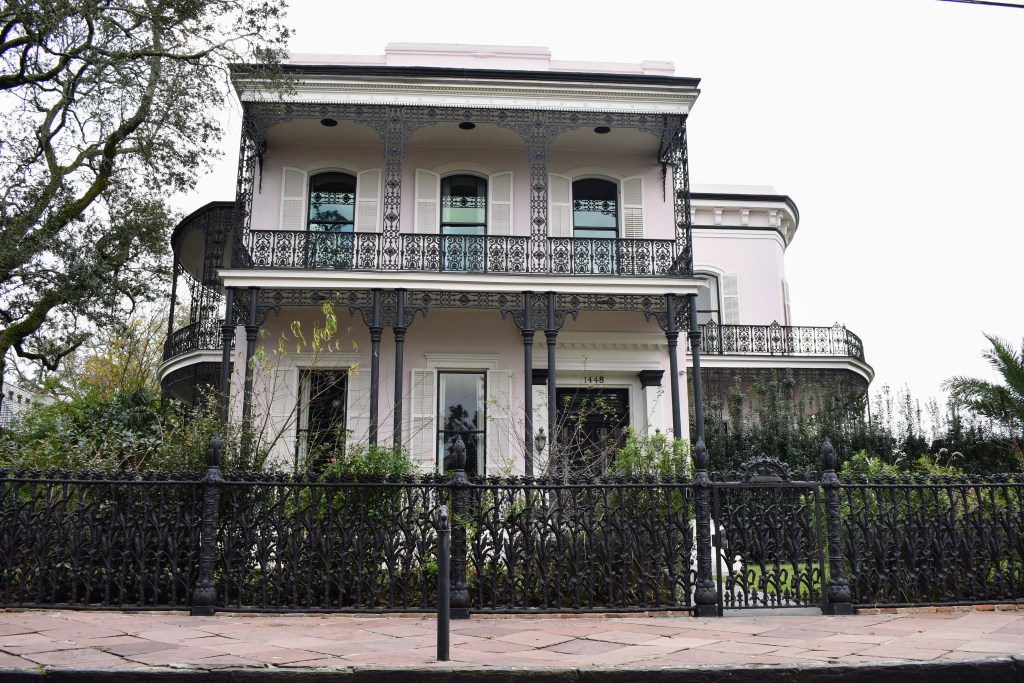
Colonel Short’s Villa
Fourth Street, Garden DistrictWe also saw examples of Gothic Revival, German Chalet, and lots of Greek Revival. Often the houses we saw would have examples of several styles mixed together, sometimes with some 50’s or 60’s Americana slapped on since the neighborhood didn’t become a National Historic Landmark until 1971, which prevented further modifications to the homes’ exteriors. We also saw the homes or former homes of several celebrities: Ann Rice, who lived in four different homes in the Garden District, the Manning family, John Goodman, and Sandra Bullock. I’ve decided that John Goodman and Sandra Bullock probably have a Garden District Gang War whenever they’re both in town. They seem like the type!
We also enjoyed gawking at the Carroll-Crawford House. Apparently, the first owner of the house, Joseph Carroll, was good friends with Mark Twain. But when Twain would visit, they quickly devolved into a “boys will be boys” state. One day they had been drinking a lot and decided it would be a good idea to have target practice. They got the bottles all set up in the carriage house and started shooting. Of course, this wasn’t the Wild West and hearing gunshots in town, and most especially in the bougie Garden District, was. Not. Normal. So, of course, the police were called out pretty quickly and issued them both with citations. Well, our guide had had a rather accidental opportunity to see inside the home a couple of months before when she happened to meet the architect who was in charge of the renovations that the new owners wanted to do. She told him this story while he was giving her a tour of the house and they immediately went to look for the bullet holes. Dear reader, they found them.
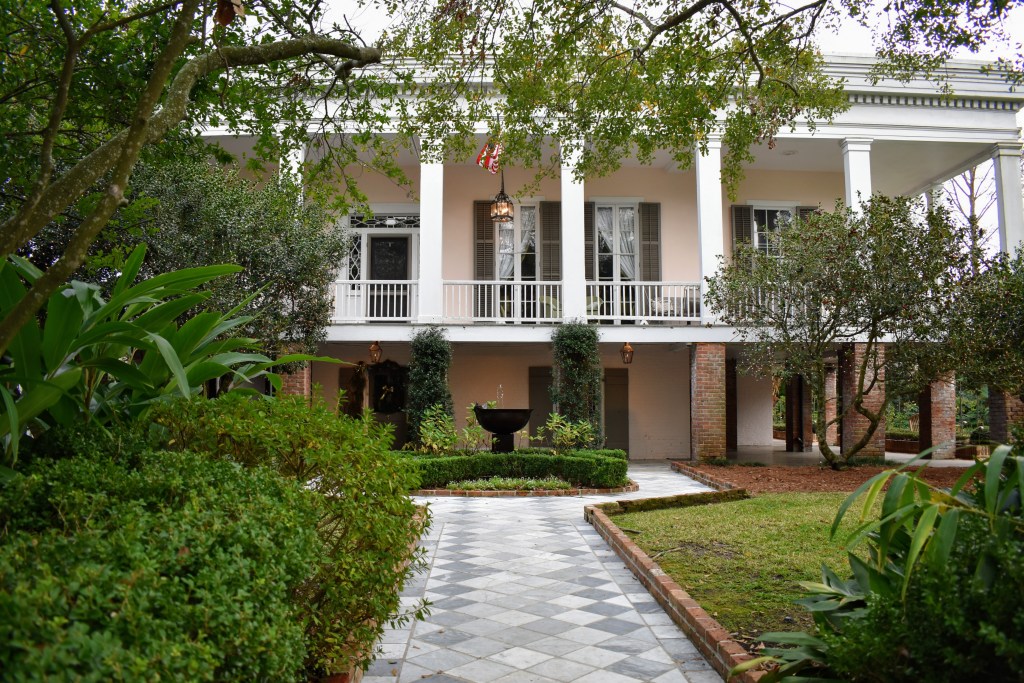
Toby’s Corner
Prytania Street, Garden District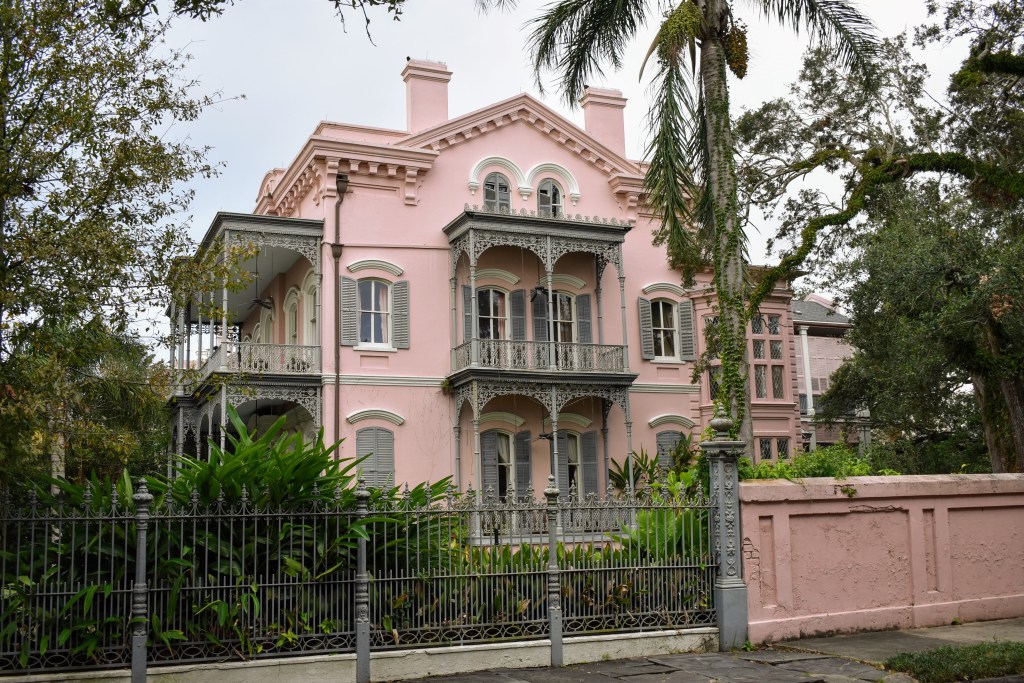
Carroll-Crawford House
First Street, Garden DistrictOur tour ended back at the cemetery, where we got a rundown of how the burials work. The idea that New Orleans has the crypts for which it is so famous simply because of the water table isn’t really true. It’s a factor, but the practice also stemmed from diseases that swept through the area (think yellow fever, especially) and that were not very well understood. Since people weren’t sure exactly how the diseases were transmitted, they didn’t want them leaking into the water supply from freshly-buried corpses. The crypts are very much still in use today, and in fact you can buy one if you have a spare $300,000 lying around. The practice goes something like this: someone dies, the family has a wake and façade of the crypt is removed by the cemetery workers, the casket is borne to the cemetery from the church and the body is removed before being placed on a stone slab in the crypt that runs almost the length of the structure. The procession out of the cemetery is often when the jazzy music is played, if the family has arranged for a band to accompany the mourners in order to celebrate the life of the deceased (called a second line, or more specifically, a jazz funeral). The crypt is sealed back. A year and a day must pass before someone else can be put in the crypt (if someone in the family dies before then, they have to chill out in a wall rental). When the next person is set to be interred, part of the preparation of the crypt is that the cemetery workers take a long pole with a flat piece on the end and push the remains of the last person to the back of the crypt, where they fall between where the stone slab ends and the back wall of the crypt. Under the crypt is a caveau (French for “cave”) where the remains all kind of mix together. Then the next, um, occupant can be put on the stone slab.
After the Garden District tour, and quick look at the bookstore in The Rink, we had enough time to try for the trolley again. With success this time! It was quite crowded, so Mom and I ended up getting separated. And two stops later, everyone had to get off because the trolley wasn’t going any further due to work being done on the tracks. Instead we all trooped over to a waiting bus and went the rest of the way.
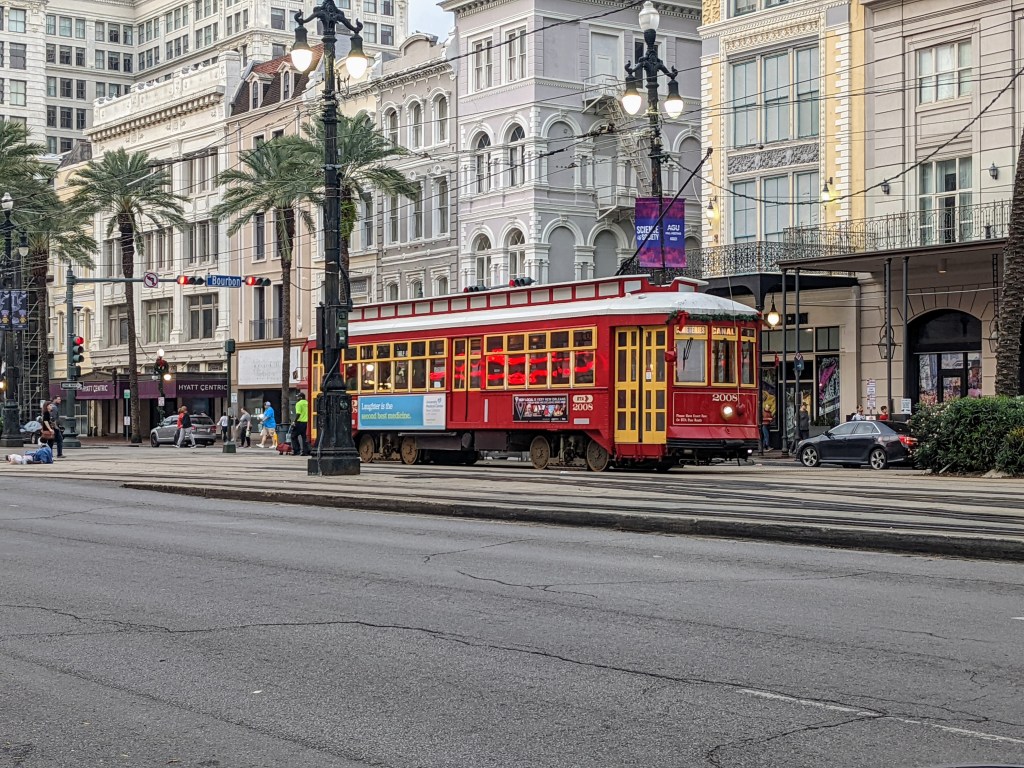
A N’Awlins trolley
St Charles AveOnce back at the hotel, we had time for a quick breather while we decided where to go for dinner. In the end, we just walked back into the heart of the French Quarter. Based on a recommendation from our morning guide, we found ourselves at Original Pierre Maspero’s. Mom got a blackened redfish, while I went with the Crescent City Sampler and tried a bit of gumbo, jambalaya, red beans and rice, and etouffée. Yum! While we were waiting for our food a second line went down the street—a second line is a mini-parade for many different occasions when a jazz band accompanies a group in a procession. It can be a jazz funeral, a wedding, tourists whoopin’ it up, whatever. I went outside to look!
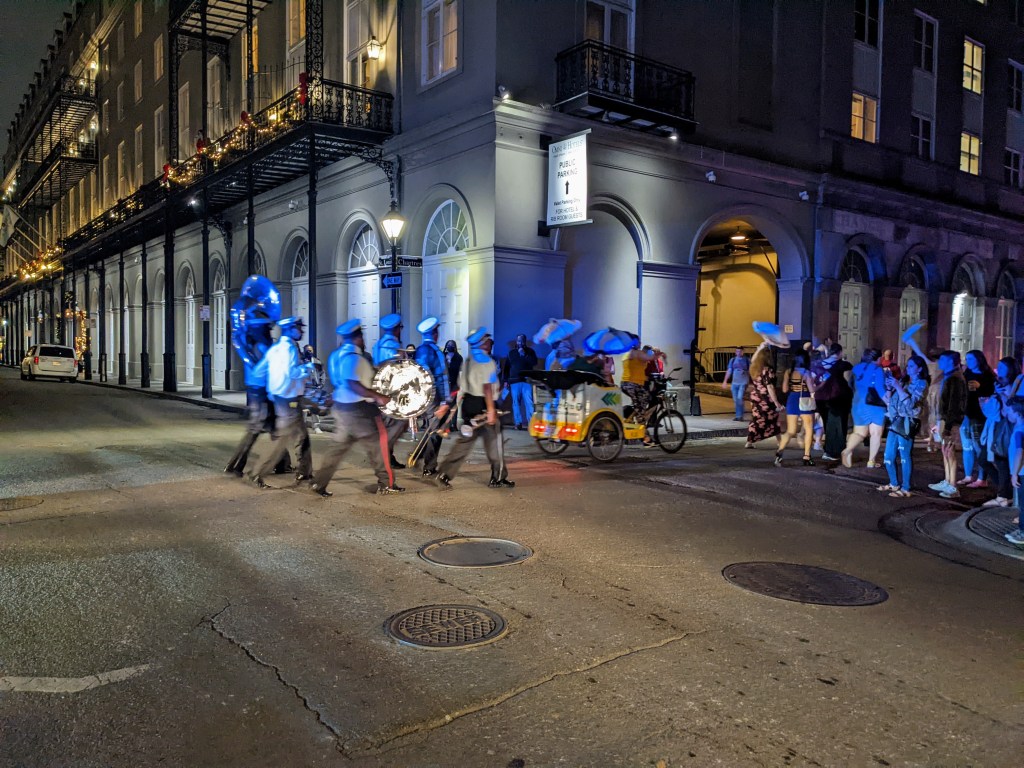
Second line
Original Pierre Maspero’s
St Louis Street, French QuarterEven taking our time over dinner, we had time to stop for some dessert before I was due to meet my final tour of the evening. I had gotten the last ticket, and Mom said she was fine sitting that one out. We had passed a gelato shop on the way to dinner, so we went back there for dessert. I got raspberry sorbet and lavender London fog, while Mom got a lemon pie sorbet. I dropped most of my stuff at the room and headed out for my Killers and Thrillers tour! I had looked for ghost tours, but all of them seemed to be “family friendly,” which I definitely didn’t want. I found the perfect thing when I search for true crime walking tours!
I met up with the group in Jackson Square and met the guide, Michael, who had a real eyepatch. He was also a historian at the WWII Museum and an instructor at the University of New Orleans, which certainly confirmed his credibility. We had a lot to get through, much of which would be right at home in a late-night or streaming-only true crime series. He told us about Zackery Bowen, who leapt to his death from the roof of the Omni Hotel in the French Quarter in 2006 after strangling and dismembering his girlfriend several days before. He had been a smoking buddy of our guide’s, so that was quite a personal story to share. Michael was sure to give us a minilecture on Marie Laveau and how she was the Voodoo queen, yes, but also an extremely savvy businesswoman. We also heard about more historical crime, like the Axman of New Orleans, and stood outside the apartment where the Trunk Murders took place while Michael recounted the grisly details.
Of course, no NOLA ghost/crime tour is complete without a stop at the Lalaurie Mansion. It was here that I really appreciated Michael’s attention to detail. Many people have heard the story: Marie LaLaurie tortured and murdered her slaves, but this wasn’t discovered until 1834, when a fire broke out in the mansion’s kitchen and when the firemen arrived, found a slave shackled to the stove. The slave then directed them to the third floor or attic area, where they found slaves flayed alive and one female slave kept in a 3’x3’ box, with her arms and legs broken and reset at odd angles in order to fit. They say she could only walk like a crab. Then Madam LaLaurie fled, never to be seen again.
Well, that’s doo-hickey. Most of it anyway. Michael pointed out that most guides cite the mansion itself as the site of the crimes. Well, the third floor wasn’t even added to the house until a couple of decades after Marie had left. So there was no way she could have kept any slaves up there or chased a slave girl who had tugged at a knot in her hair while brushing it around the third floor landing until the girl fell over the banister to her death—the space simply didn’t exist at the time. And there are no historical accounts to substantiate the more colorful claims that many guides relish in making, like the crab-walking woman.
What did exist was a three-story carriage house. And, as Michael pointed out, mansions of the time didn’t have their kitchens in the main house for precisely the reason that brought the horrors of this story to light: fire. There was a fire in the kitchen, and the firemen did find a slave shackled to the stove, but it was in the carriage house. And they did search the third floor there and found slaves in horrible conditions, chained by their necks and beaten horrifically. A contemporary newspaper account described one man as having a deep wound in his head and having worms and scars all over his body. Michael also pointed out something else that many people don’t seem to mention in accounts of LaLaurie: despite having the records of ownership of 12 additional slaves, only the 8 in the carriage house were found. New Orleans required its citizens and slaves to be Catholic when it was founded, so even now a majority of people living there are Catholic. And the Catholic Church is great at record-keeping. But no records exist of the deaths or further sale of these 12 slaves. So it’s pretty clear that LaLaurie killed 12 human beings in cold blood, whether through violence, neglect, or a combination, and most likely disposed of them in a nearby swamp.
With that, Michael let us go with our heads full of blood and gore. The LaLaurie mansion sits on the corner of Royal St and Governor Nichols St, so I had a straight shot down Royal to the hotel. I was back by about 9:45. I still had to repack my carry-on and suitcase and take a shower, so I got on with it since I was a bit tired and wanted to get to bed!
-
Everything’s Big in Texas, But Mostly, Texas is Big
Day 12 – Tuesday, December 28, 2021
It’s not easy to sleep in on a train. There are curtains, but they usually let in some light and that light will find its way directly onto your eyelids. People get off and on during the overnight stops. So Mom and I were both up and about pretty early. Of course, coming back East from the West coast, “early” can be a bit misleading!
We had rolled into San Antonio about 5 a.m. and were still there by the time Mom and I went up to breakfast. The train finally got back underway while we were eating (I finally tried the HUGE continental breakfast and was not disappointed!). It was a pretty uneventful morning, spent with word puzzles, reading, and watching the Texan landscape go by. We liked to try and spot different birds and try and figure out what they might be. At one point I saw a bald eagle! That one was pretty easy to ID. We saw egrets and herons just about any time we were near water during the whole trip, including when we went past some swampland after leaving Houston.

Houston Lake 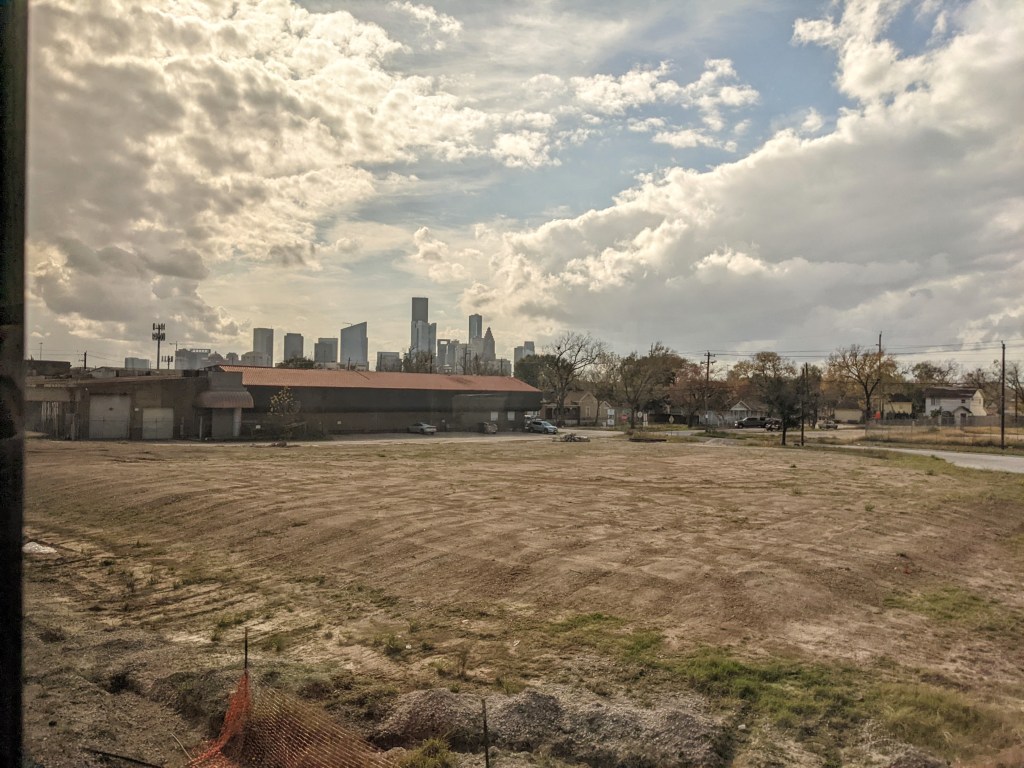
Houston skyline When we were in Houston, and again in NOLA, we came to a point where the train tracks merged and switched, so the conductor would have to go down one set of tracks and then back up and switch. And in a couple of instances on one leg the conductor had to hop out of the train and manually change the switch.
Despite being in San Antonio so early in the morning, it still took all day and most of the evening to get into New Orleans. Apparently, I was so riveted by things that I forgot to take many photos. When we were getting close to Lake Charles (still a ways to go to N’awlins), we started passing through a large refinery of some sort. And it just kept going. And going. And going. We hadn’t realized that Lake Charles was the site of a SASOL refinery and that the South African-based company was the 7th largest in the world. You’d definitely get your 10,000 steps a day working there!
We finally rolled into New Orleans at about 10:40 p.m. The station was very Art Deco and beautiful murals decorated the top half of the walls in the main station area. We were able to get our bags pretty quickly and I got us a Lyft to our hotel. We were staying in the French Quarter (the edge of it, but it counts!) on Royal St. Even though traveling on a train is a lot of sitting around, we were still pretty pooped and knew we’d have a big day on Wednesday, so once we got up to our room we didn’t waste much time getting to bed.
-
Dear Amtrak, Please Tell Us About the Burrito Lady BEFORE Lunch
Day 11 – Monday, December 27, 2021
When we woke up on Monday we were in Arizona. I was a bit annoyed because Lisa, our sleeping-car attendant, had made an announcement the night before that after 10 p.m. it was considered “quiet hours” on the train until 7 a.m., but several people got on around 5:30 or 6 a.m. and apparently decided not to abide by that idea. Mom and I got ourselves up around 7 a.m. and did our morning ablutions. We didn’t hear any announcements about the dining car, so we decided to head up there around 8 a.m. since on our previous trains breakfast had been on a first-come, first-served basis and was usually operated from about 6:30 to 9, depending on the train’s schedule. I had an omelet and Mom had a continental—of course, we both also had tea.
The morning was spent mostly in the roomette, looking at passing scenery and looking up where we were. Of course, Arizona and New Mexico (as well as a lot of Texas) looked pretty similar. Lots of scrub brush, mountains in the distance, and mystery farms. Mystery because we couldn’t figure out what they were growing.

Arizona 
New Mexico 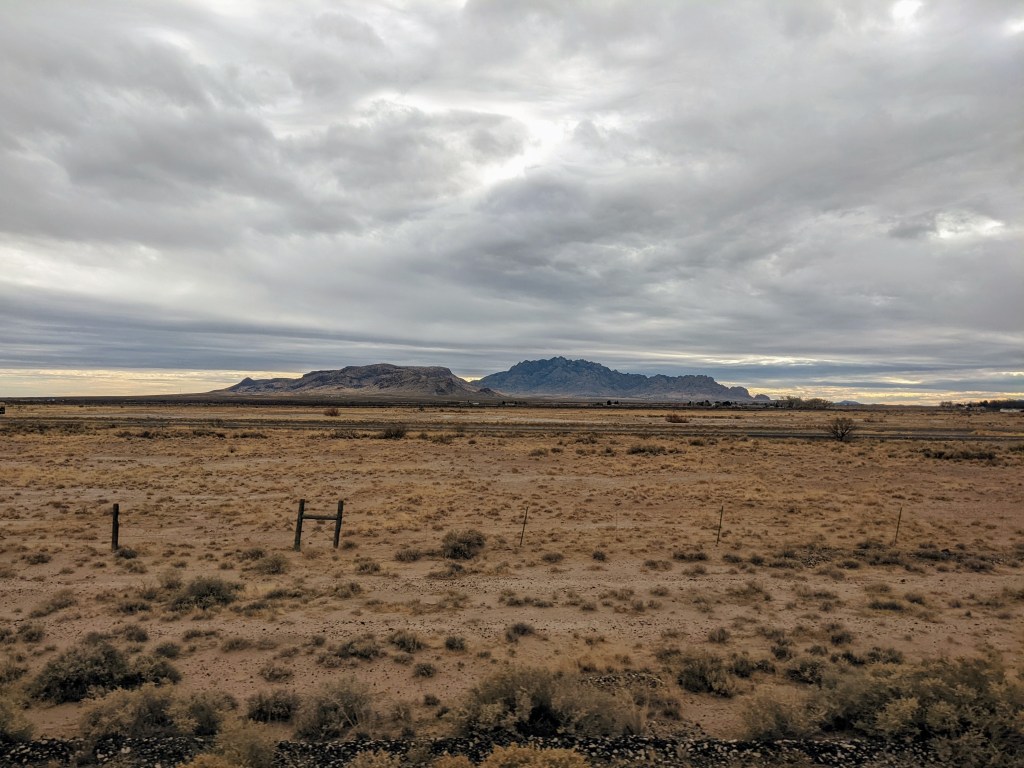
New Mexico 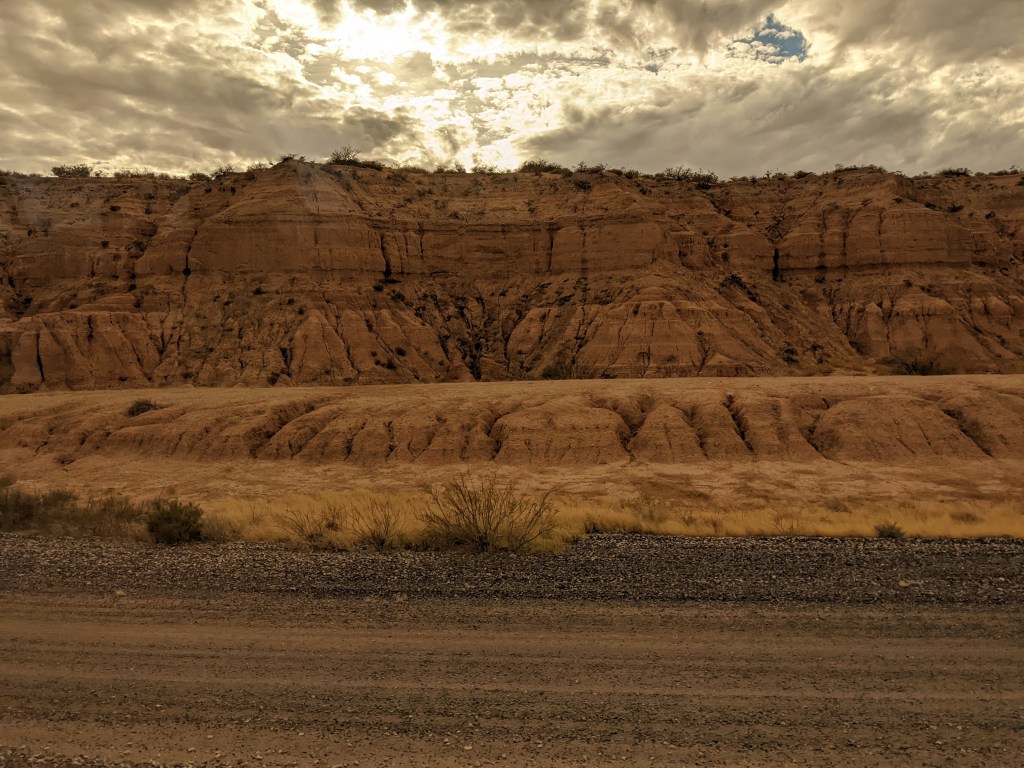
New Mexico After lunch, we headed to the observation car to pass a few hours. We saw a lot of the same type of scenery, and a large metal fence appeared as we neared El Paso. At first, I wasn’t sure what it was, but after a few minutes, I realized I was staring at the border! As we got closer to El Paso we started seeing more hints of human habitation on both sides of the fence. One thing we saw was some writing on the side of the hill on the Mexico side of the border, in Ciudad Juárez, reading “La Biblia es la verdad, leela” (which translates to “The Bible is the truth, read it”). So I did a little research online and found out that it had been put there by an evangelical group, which seems a bit obvious in hindsight.
What struck me at first, in being able to see both the US and Mexico at the same time, was how much more colorful the houses and buildings were in Ciudad Juarez—it was also pretty cool seeing all the Spanish-language advertising just across the way! El Paso itself wasn’t too shabby on the decoration, though. The bridges in particular were surprisingly artsy, with a sun motif carved and painted on each and several under-bridge or underpass areas with a kind of mountain design in the concrete. When we came to a stop at the station (another Union Station?!), the conductor announced that the burrito lady was out on the platform for anyone who wanted to buy a burrito. If I’d known that, I wouldn’t have gotten lunch!
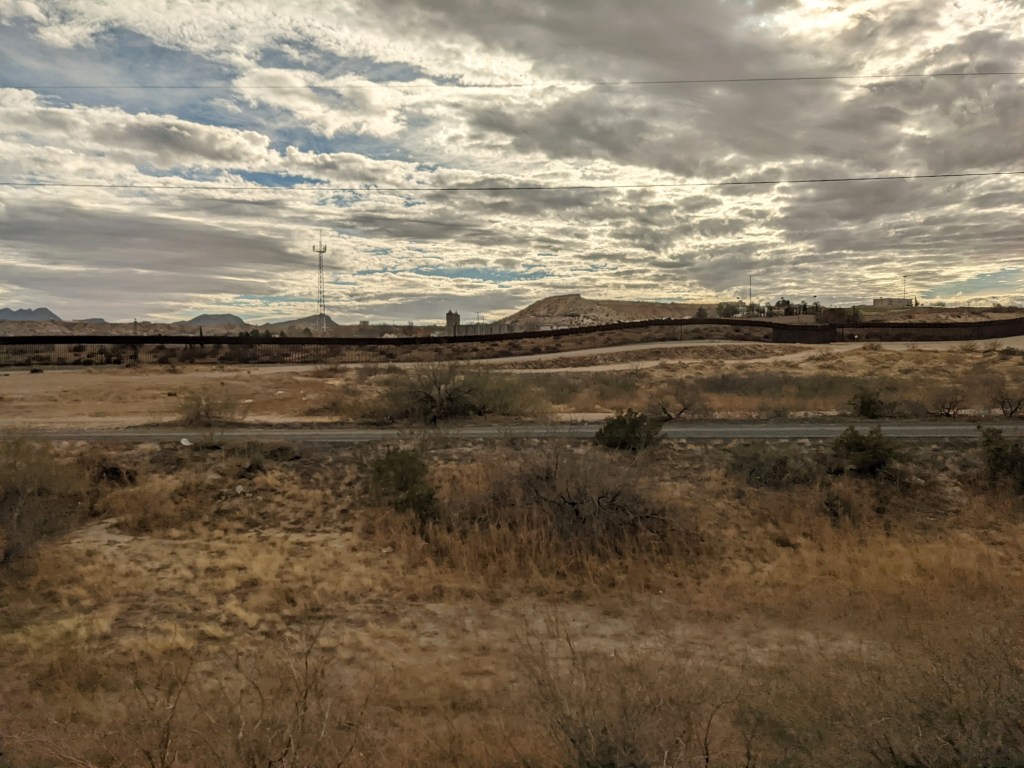
US/Mexico border
New Mexico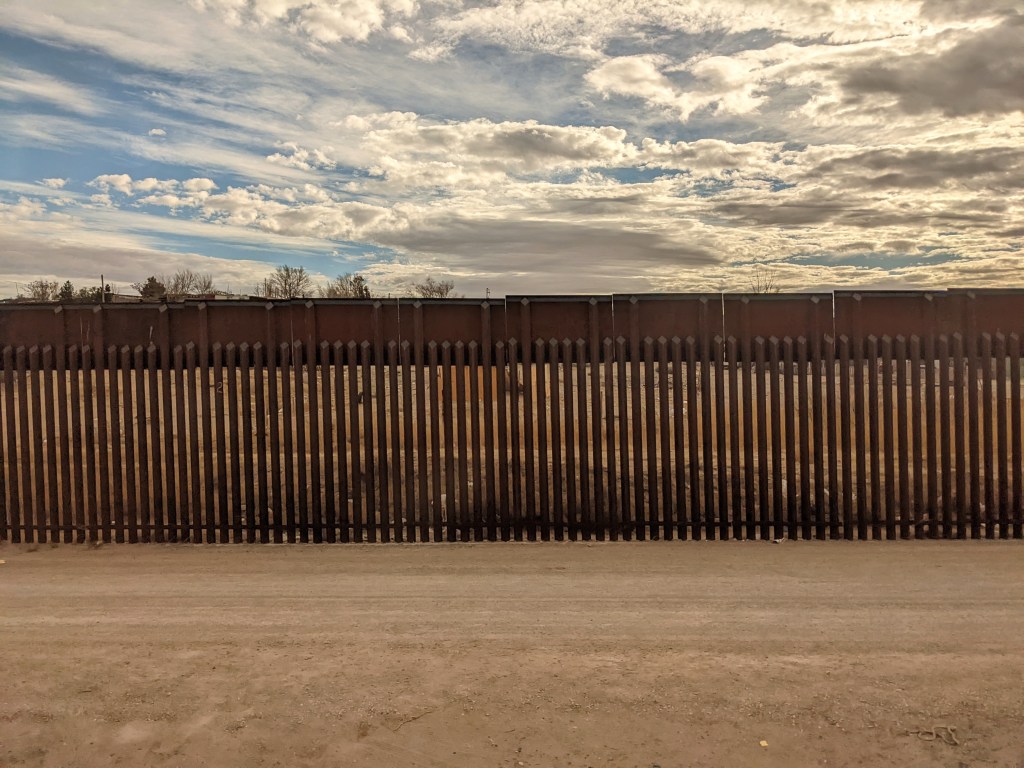
Border wall in New Mexico 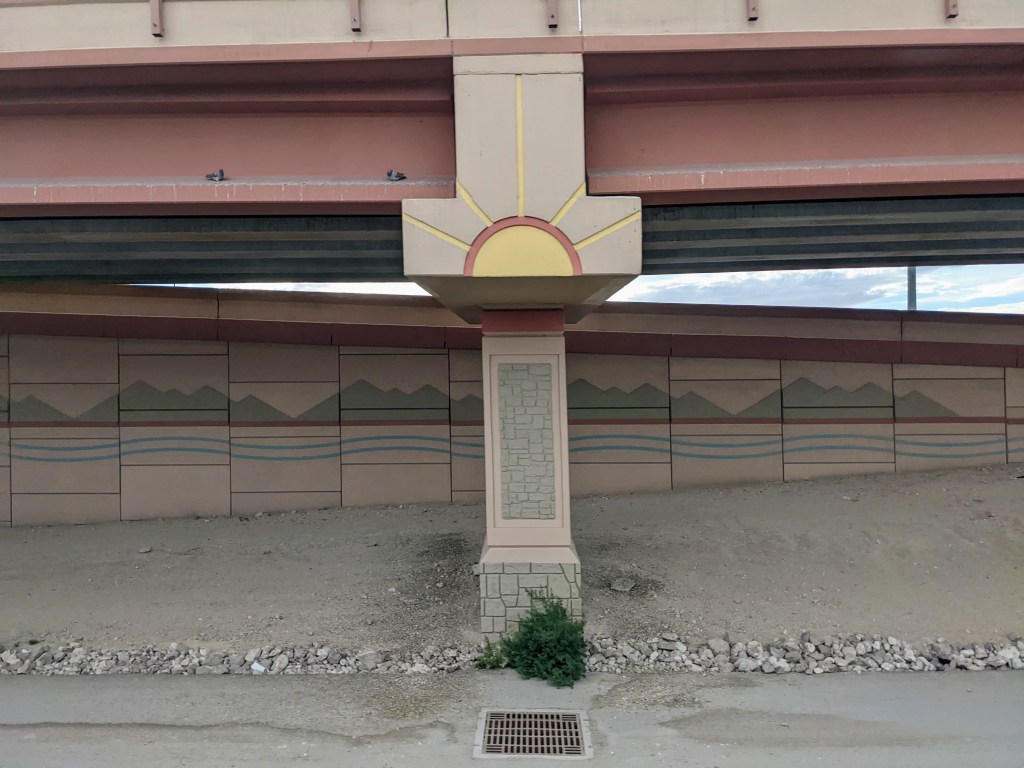
El Paso overpass 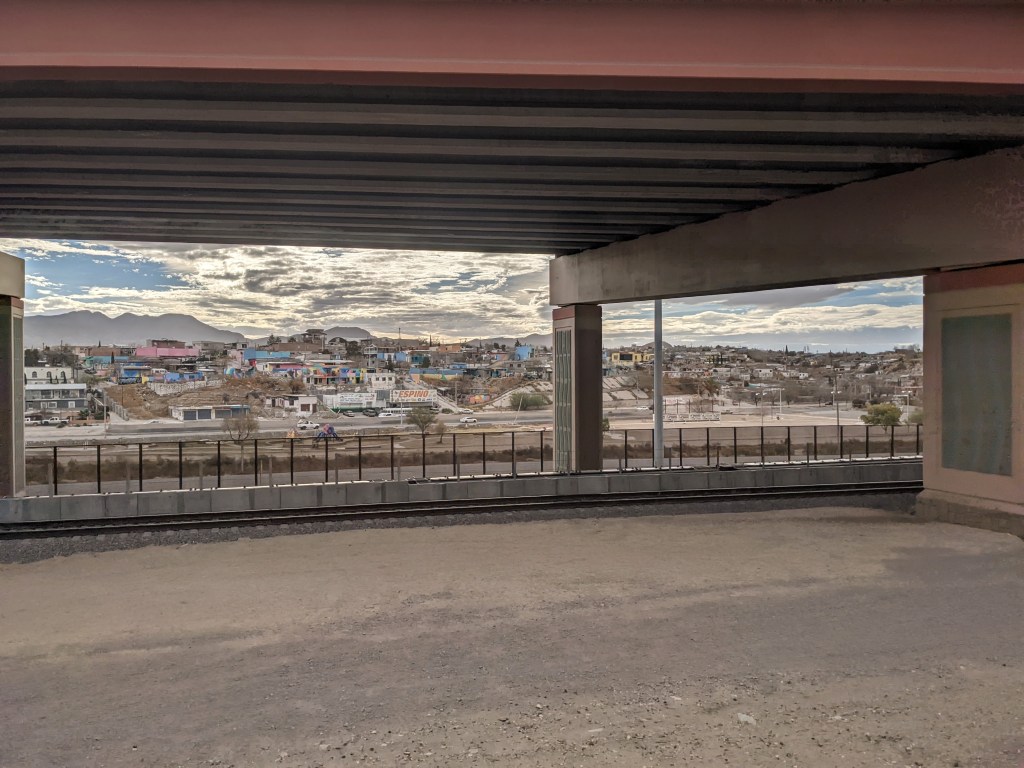
El Paso overpass and Ciudad Juárez, Mexico Once we pulled out of El Paso, Mom and I didn’t spend too much more time in the observation car. The dining car attendant would usually come by in the afternoons to set your dinner time and we didn’t want to miss her! But before we left the observation car, we saw a large, red, sculpture “X” in Ciudad Juarez. I did a little more research and found out it was symbolic of the bloodshed during the drug wars in Juárez. ¡Muy interesante!
We had a very quiet rest of the evening. Dinner in the dining car, of course. What kind of caught us off-guard was the attitude of our sleeping-car attendant. She put down our beds relatively early (before dinner) and made more than one announcement about her lack of availability during the night. Since our beds were down anyway, Mom and I mostly read after dinner and tried to see out the window every once in a while. Throughout the trip, it was fun to see the occasional flashes of Christmas decorations in the darkness. And some houses and towns really went all out!
-
Hooray for Hollywood!
Day 10 – Sunday, December 26, 2021
We took the opportunity to have a little lie-in since the only thing we had planned in L.A. was a hop-on-hop-off bus. We got up and got ourselves down to breakfast around 8 and had breakfast sandwiches at the Starbucks café that ran around the center tower base in the lobby. This was a pretty snazzy Starbucks, though, with what seemed like nicer than usual breakfast sandwiches and London Fog on the menu rather than just something you have to know to request. Mom saw the first hop-on/hop-off go by, and I looked up the schedule and realized that we’d have to get a move on if we wanted to do two of the three tours. Since we’d be heading out on the next train that evening, we got our stuff re-packed, took it downstairs to the bellhop desk, and we went out to the hop-on/hop-off stop that was just outside the hotel. It turned out that the bus actually stopped at the hotel twice: once at the beginning of the Downtown L.A. loop and once at the end. The bus, when it came around again was at the beginning of the loop.

View from the hotel room (look to the upper right!) 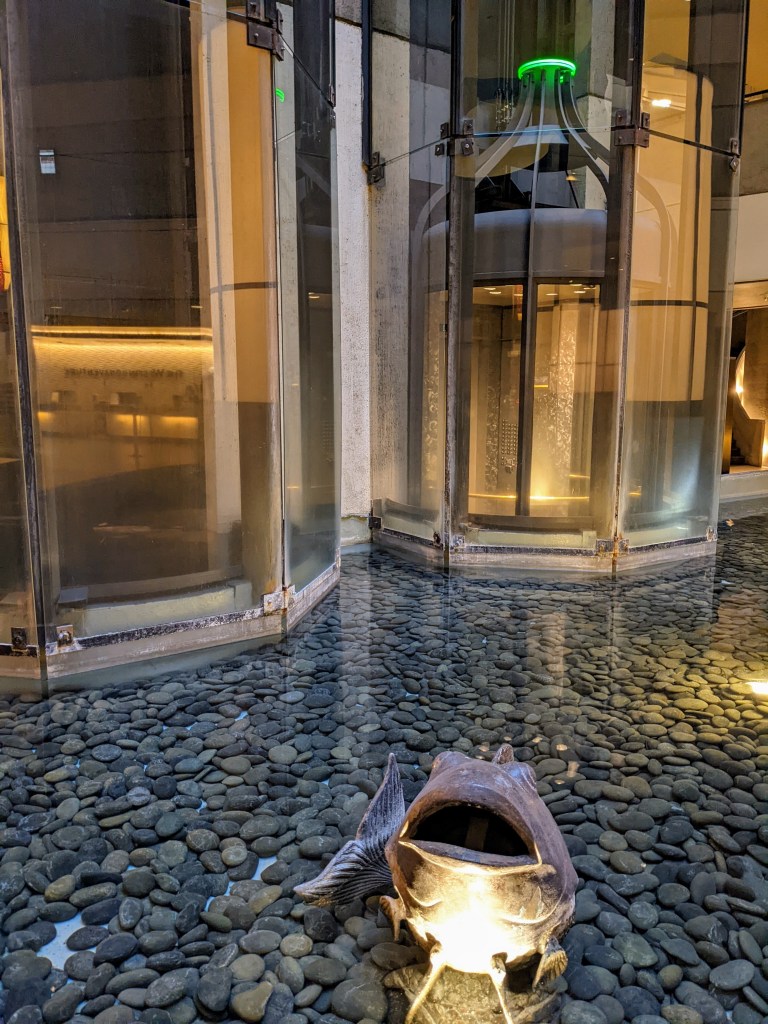
Lobby at the Westin Bonaventure Hotel & Suites The 2-hour loop took us past all kinds of recognizable landmarks from Chinatown to Olivero Street to Union Station. We went past the fashion district and the theater district and a bunch of government buildings. One thing that struck me was the sheer volume of art around the city. Just about everywhere you looked there was a statue or a mural or a fountain. The buildings themselves were more often works of art than not. Architecture in just about every style imaginable. And the commentary on the tour was much better than when we were on the hop-on/hop-off in Chicago. Just a woman narrating what you were seeing as you went by, any significance to it, and if you might recognize it from any movies or TV shows. Of course, from different vantage points we could see the Hollywood sign peeking through.
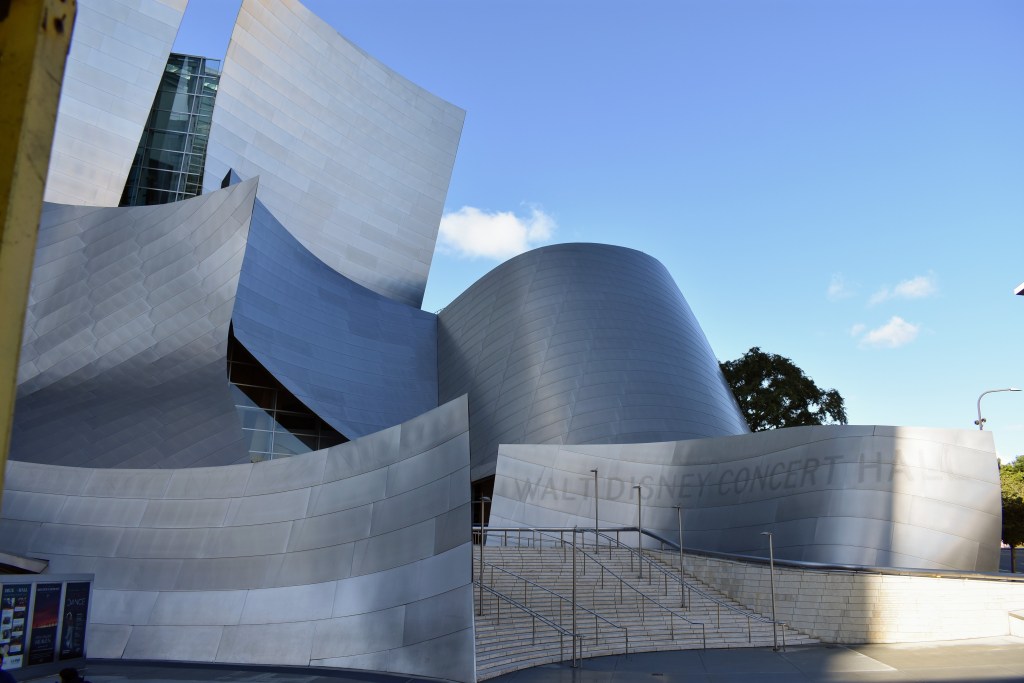
Walt Disney Concert Hall 
Ramón C. Cortines School of Visual and Performing Arts 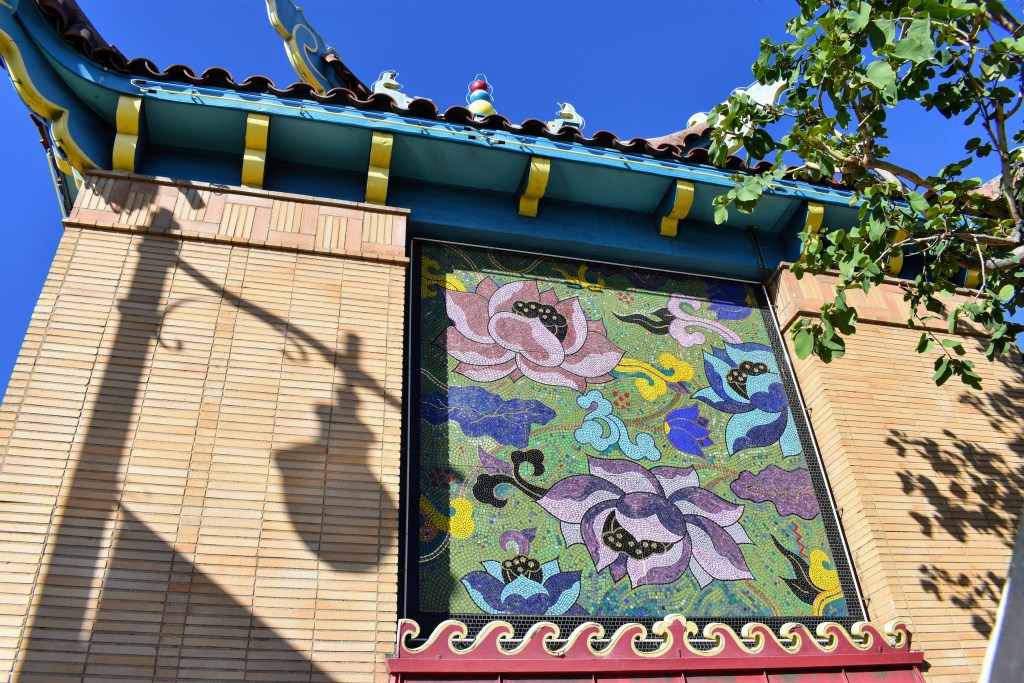
Chinatown Central Plaza, Chinatown 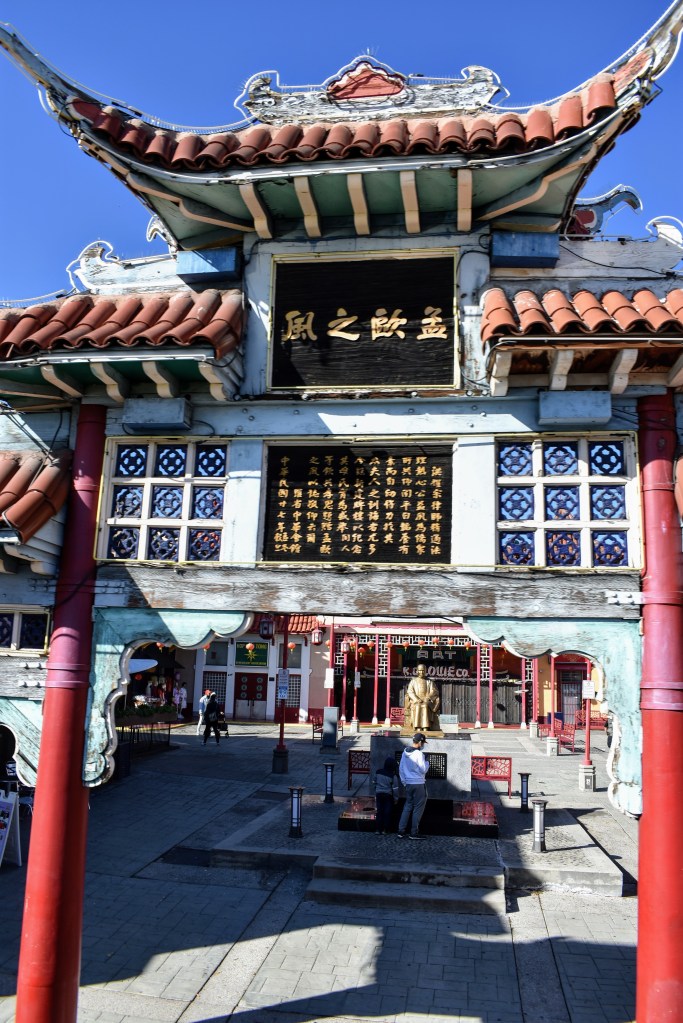
Chinatown Central Plaza, Chinatown 
Chinatown Gateway Monument, Chinatown 
Decorative Signs at W Cesar Estrada Chavez Ave 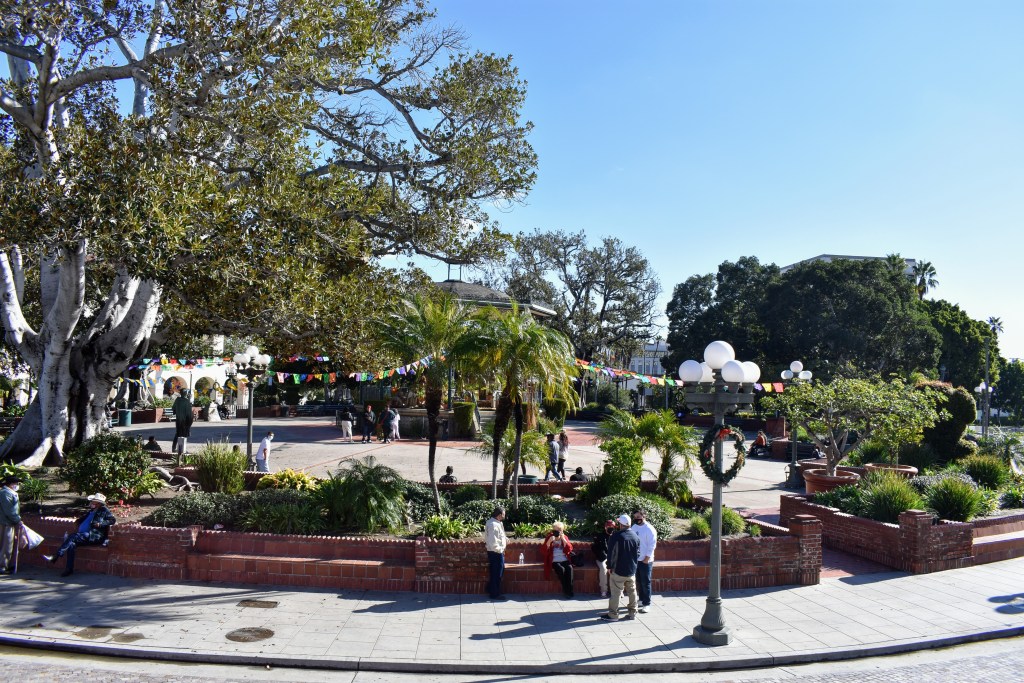
El Pueblo de Los Angeles Historical Monument 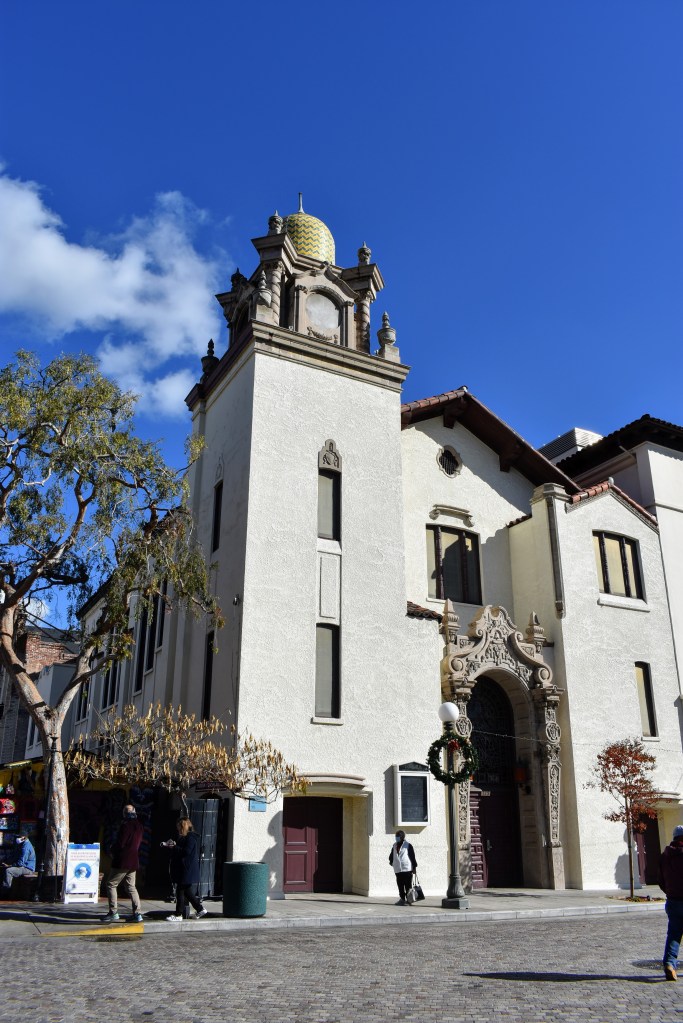
La Plaza United Methodist Church 
El Pueblo de Los Angeles Historical Monument 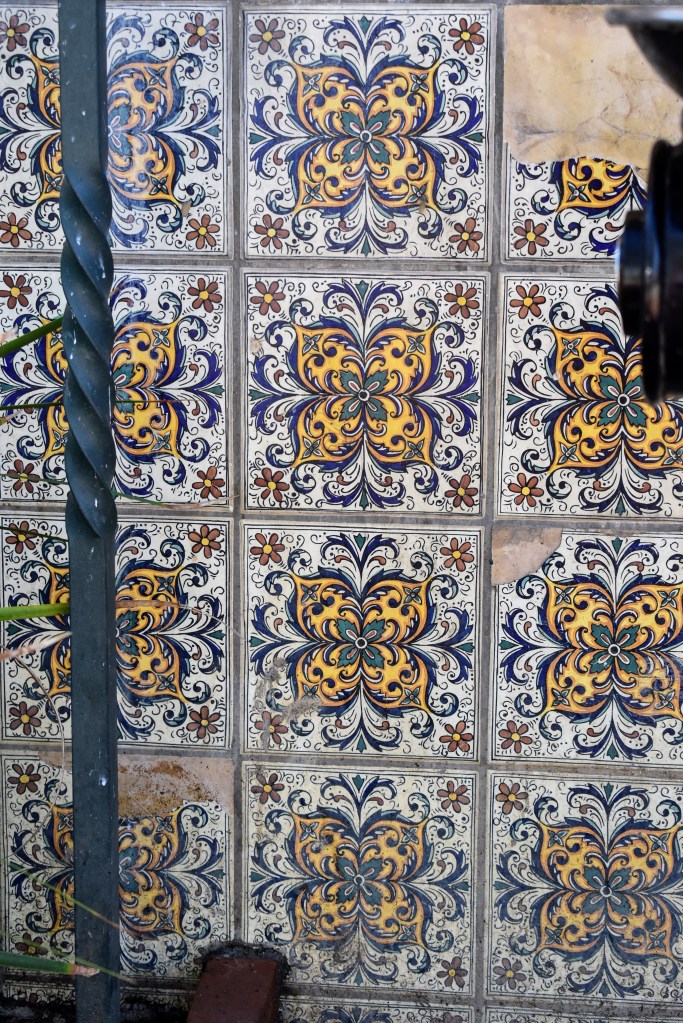
El Pueblo de Los Angeles Historical Monument, Tilework 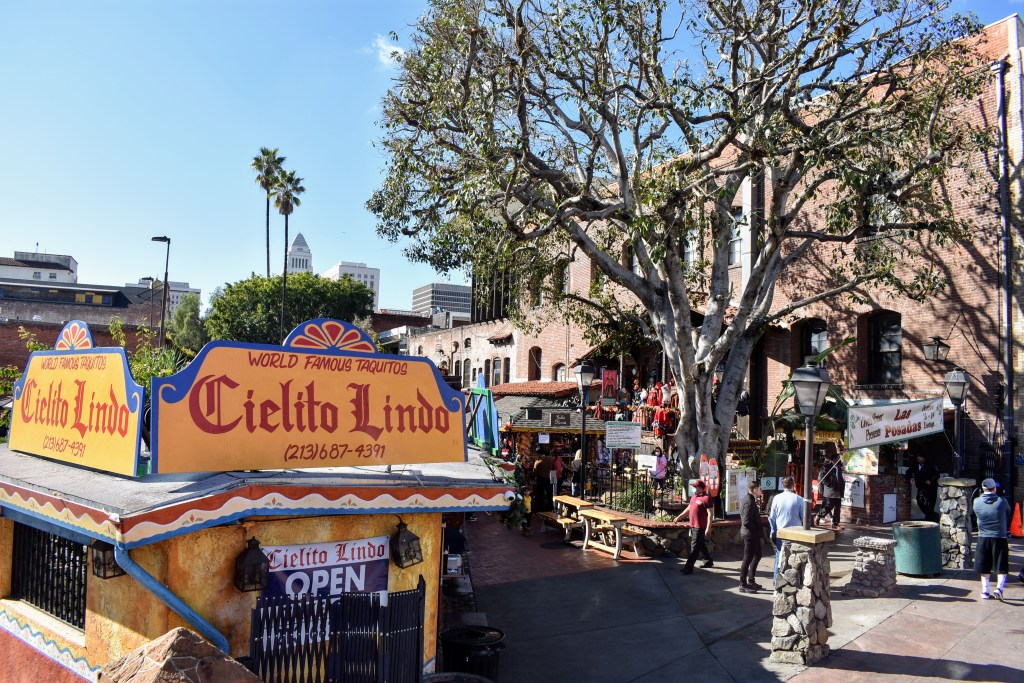
Olvera Street 
Los Angeles Union Station 
Decorative signage, Little Tokyo 
Los Angeles Times Building 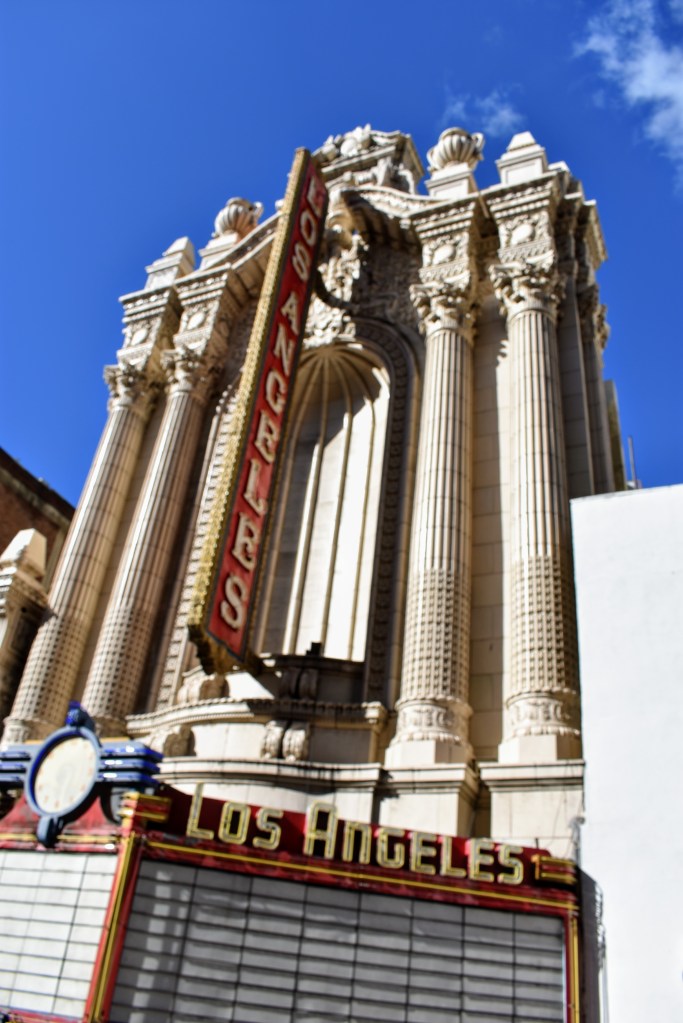
Los Angeles Theater, Jewelry District 
Herald Examiner Building 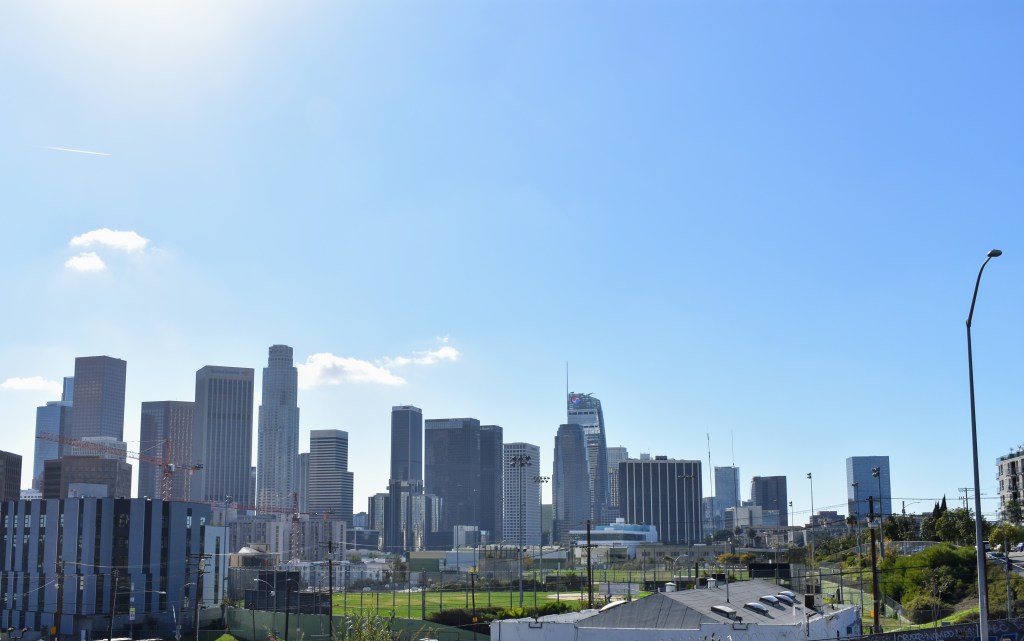
Skyline At the end of the loop, the bus went by the first two stops again before proceeding to the meeting point for the Hollywood loop. Of course, I had been on the top deck of the bus the whole time and Mom had joined me pretty soon after since the weather was so nice (though chillier than I would have expected for L.A. since it was in the mid 50s—we were definitely wearing our jackets). So we ended up going down the freeway to Hollywood on the top deck of the bus. That was an adventure!

On the bus 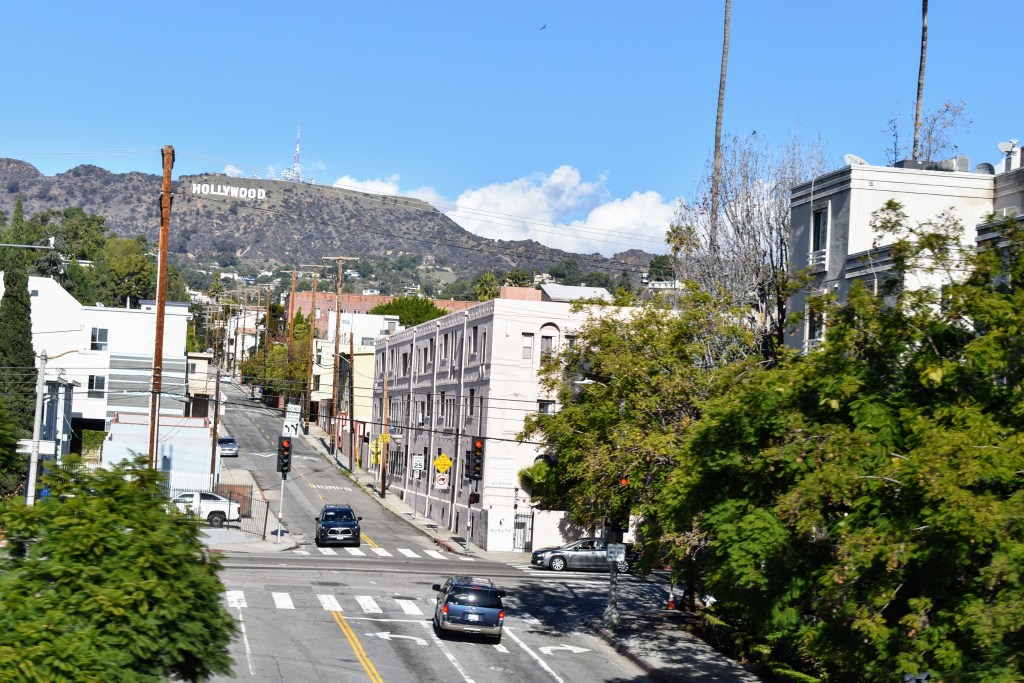
Hollywood Sign 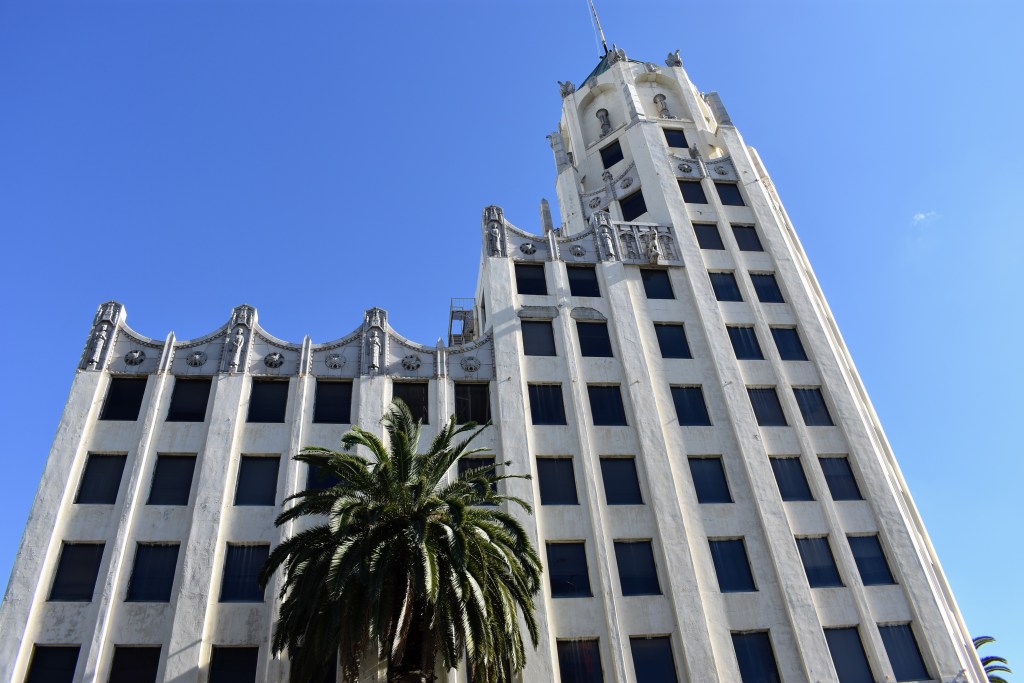
Hollywood First National Bank Building The bus dropped us off in front of the Dolby Theater, and we were told that the next bus on the Hollywood loop wouldn’t leave until about 12:45, which gave us a good 20 or 25 minutes to wander around. We were smack dab in the middle of the Walk of Fame and had already passed a souvenir shop at the corner. We used our time wisely, by-passed all of the people dressed as superheroes and other movie characters, and went to the souvenir shop as I pointed out the stars of people of interest on the way. Souvenirs bought, we went up the other side of the street, still pointing out stars of people we recognized (no I didn’t take any photos of specific stars, the crowds were making me anxious). We crossed the street ahead of where the buses were parked and walked back in that direction, past Grauman’s Chinese Theater. We got on the bus and grabbed some good seats. Our first tour of the day had been pretty quiet, just us and another family on the top deck and a few people on the bottom deck. Well, not so on the Hollywood loop. People got on and they just kept coming. I kept looking at the time on my phone wondering if we’d ever get going. The reason I was a little concerned with the time was because the last bus going back to downtown L.A. was leaving at 3 p.m. and the Hollywood loop was set to be another 2-hour tour, so we would already be cutting it a bit fine, time-wise. On the other hand, I knew that it wouldn’t be impossible to get back to our hotel, just a little more inconvenient than originally planned. So I decided to sit back and enjoy the tour.
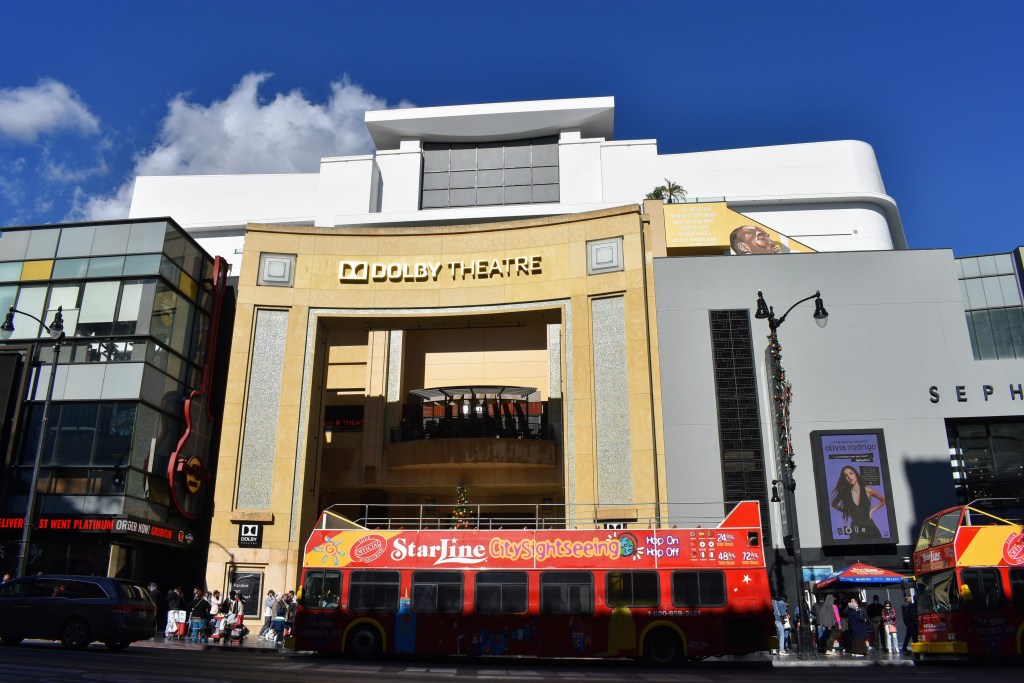
Dolby Theater 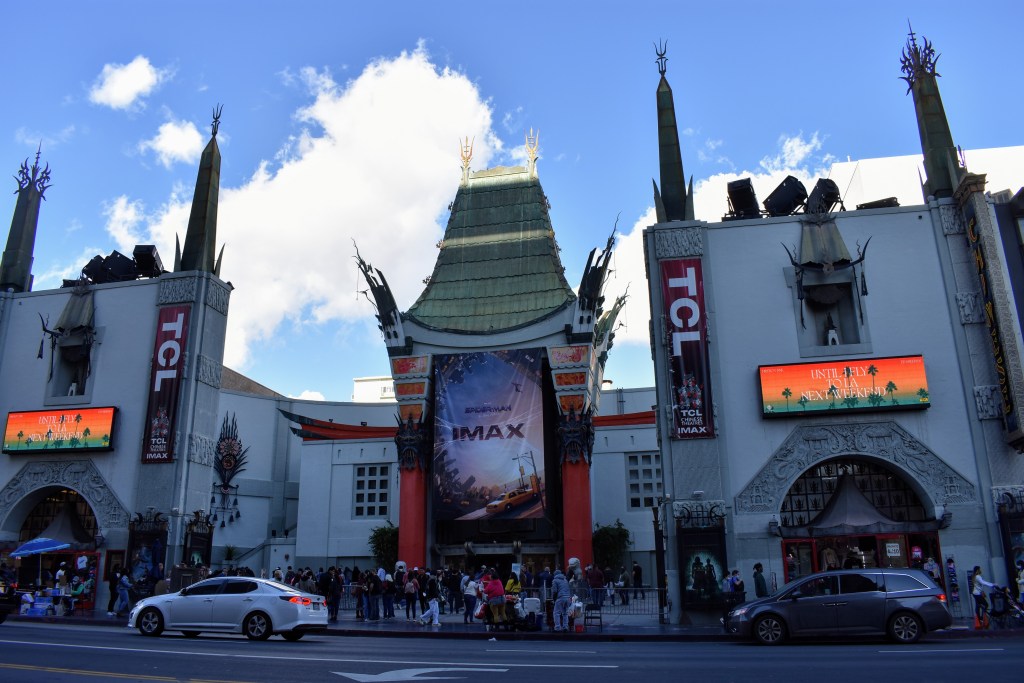
Grauman’s Chinese Theater 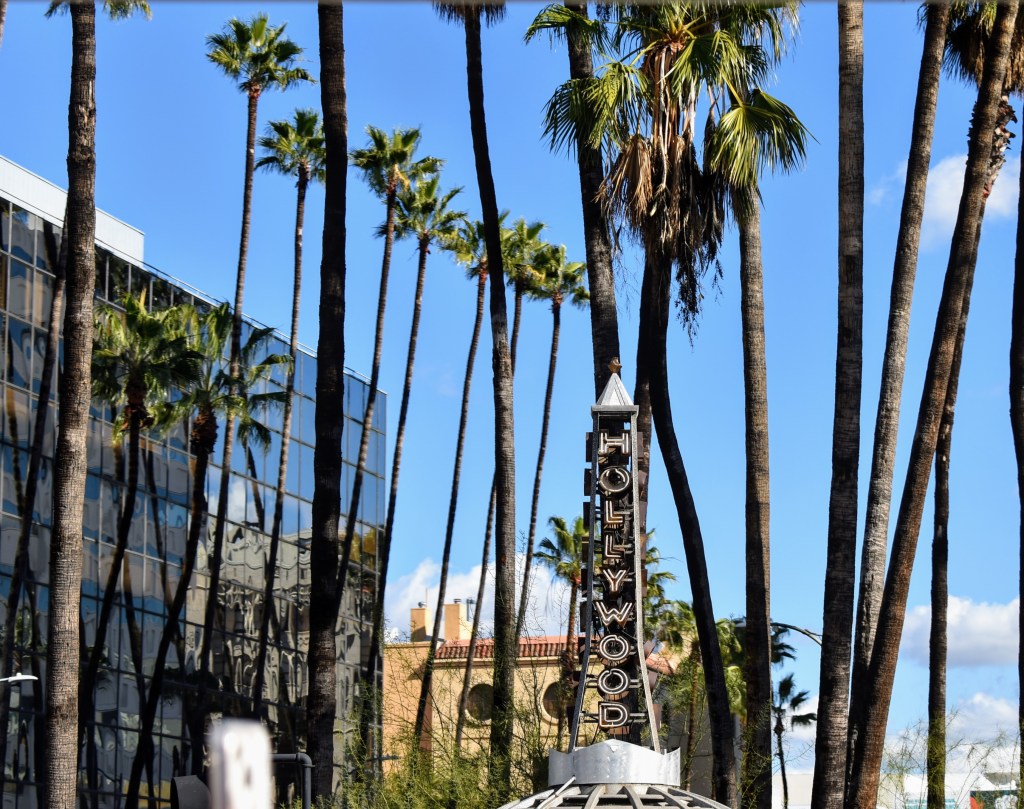
Top of The Four Ladies of Hollywood 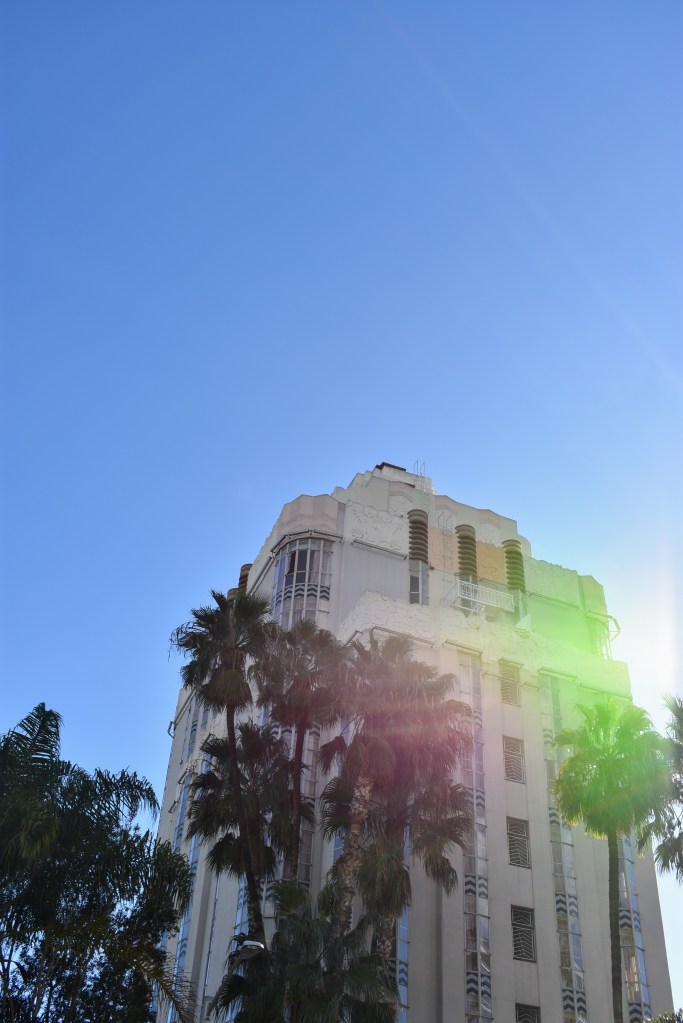
Sunset Tower Hotel, Sunset Boulevard 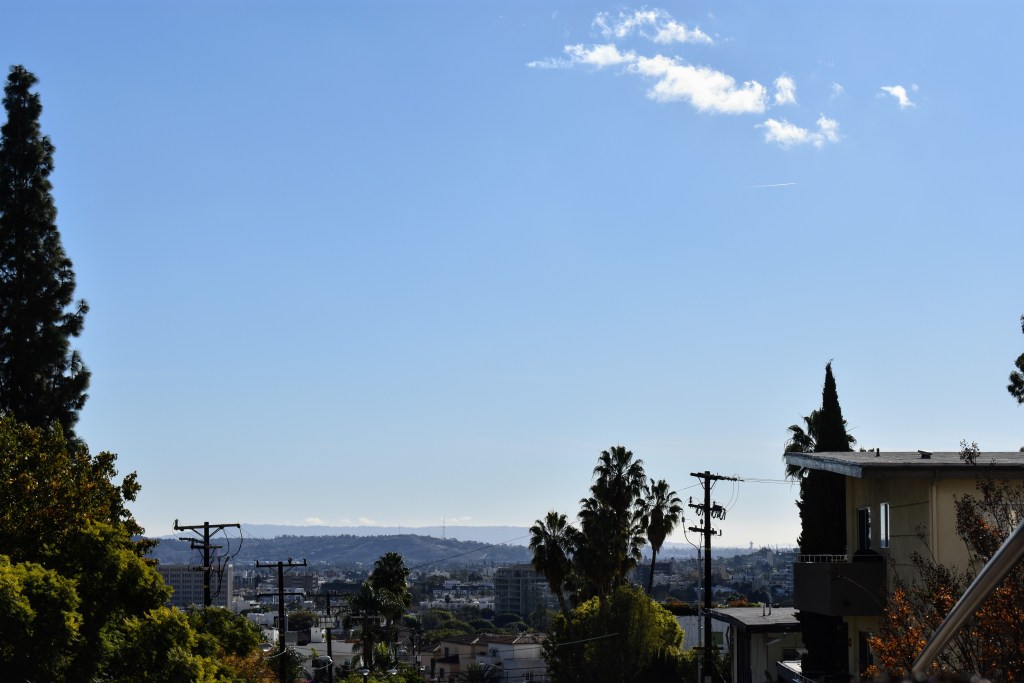
Looking down Sunset Boulevard The Hollywood route took us by yet more recognizable landmarks. Of course, one of the big parts of the loop was Beverly Hills, where they paint their fire hydrants silver and keep their trash bins in little alleys so that the garbage trucks won’t have to come down the residential streets. We went past Rodeo Drive (tour buses aren’t allowed to drive down it, apparently) and I got lots of photos of the Beverly Hills Police Department, because it was pretty snazzy. The end of the Hollywood loop went past things like the Academy Museum of Motion Pictures, the Original Farmers Market and the Grove, Melrose Trading Post (a Sunday-only bazaar at Fairfax High School), Melrose Avenue,and Capitol Records.
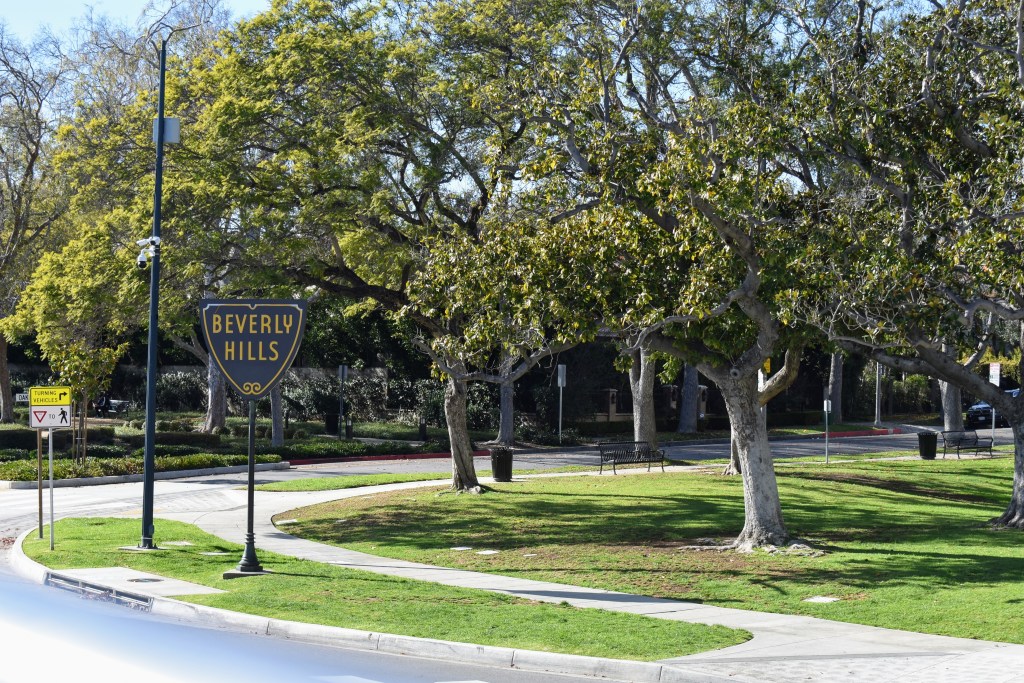
Beverly Hills Shield, Santa Monica Boulevard 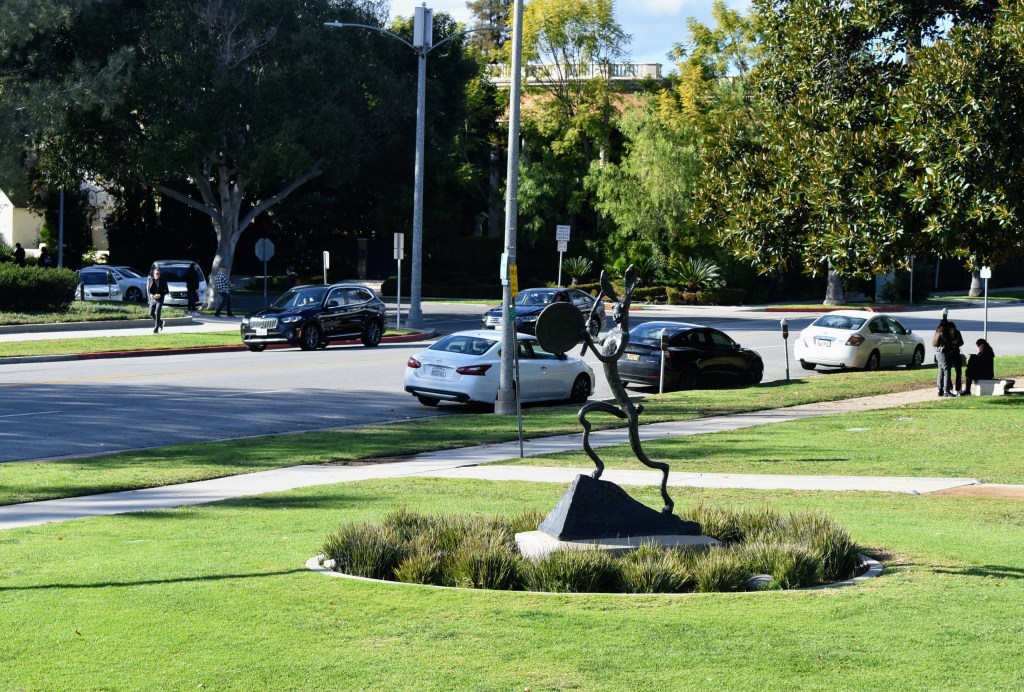
The Drummer, Beverly Gardens Park, Santa Monica Boulevard 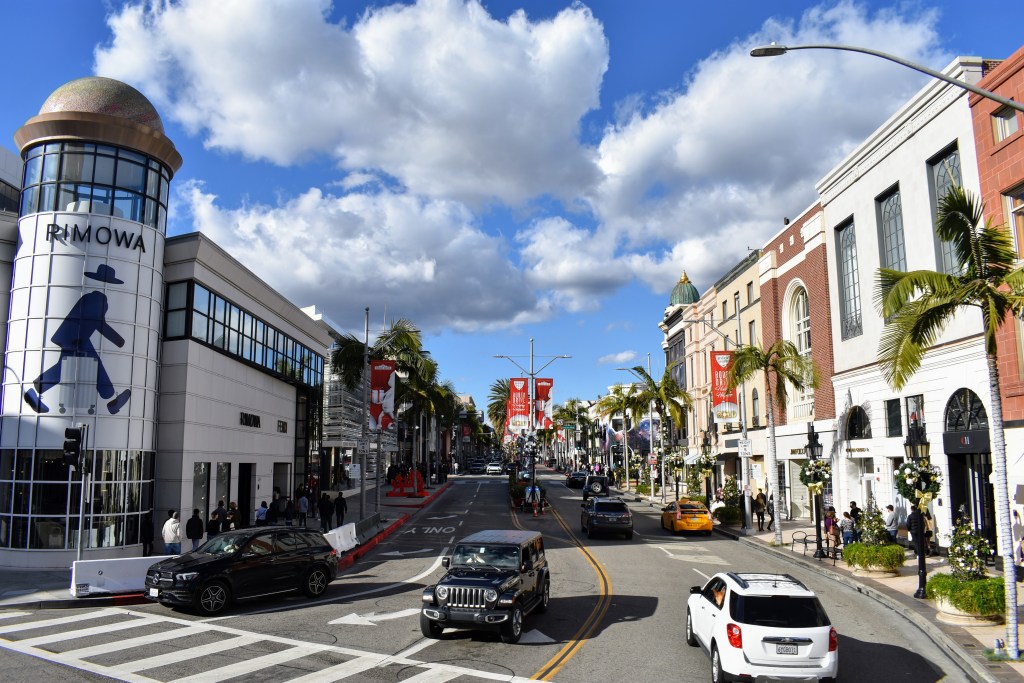
Looking down Rodeo Drive from Wilshire Boulevard 
Beverly Hills Police Department 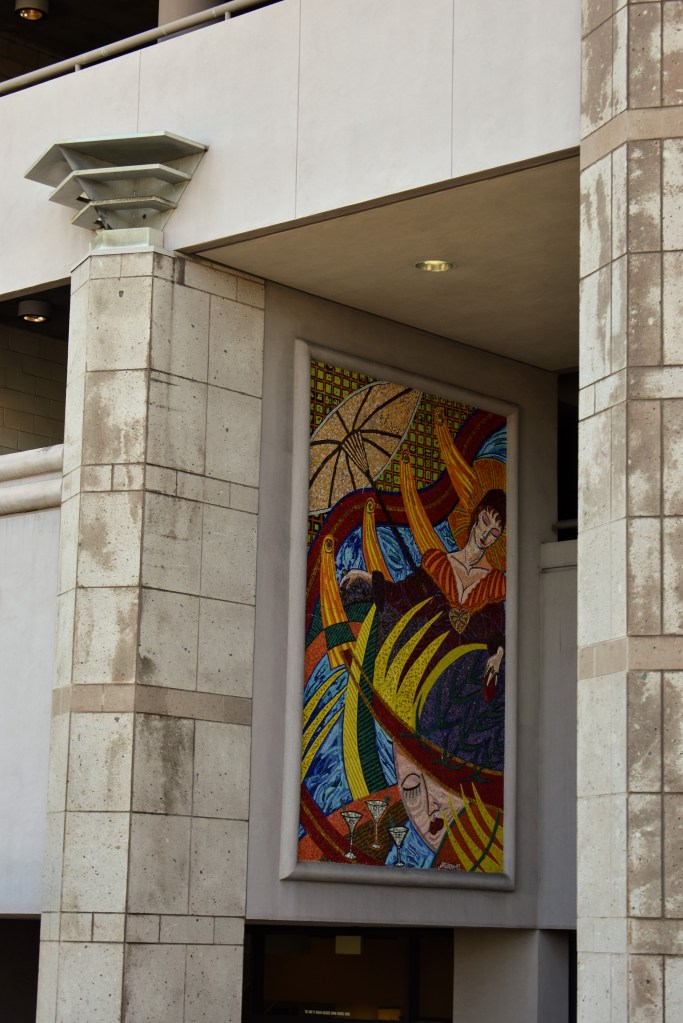
Mural at La Cienega parking garage 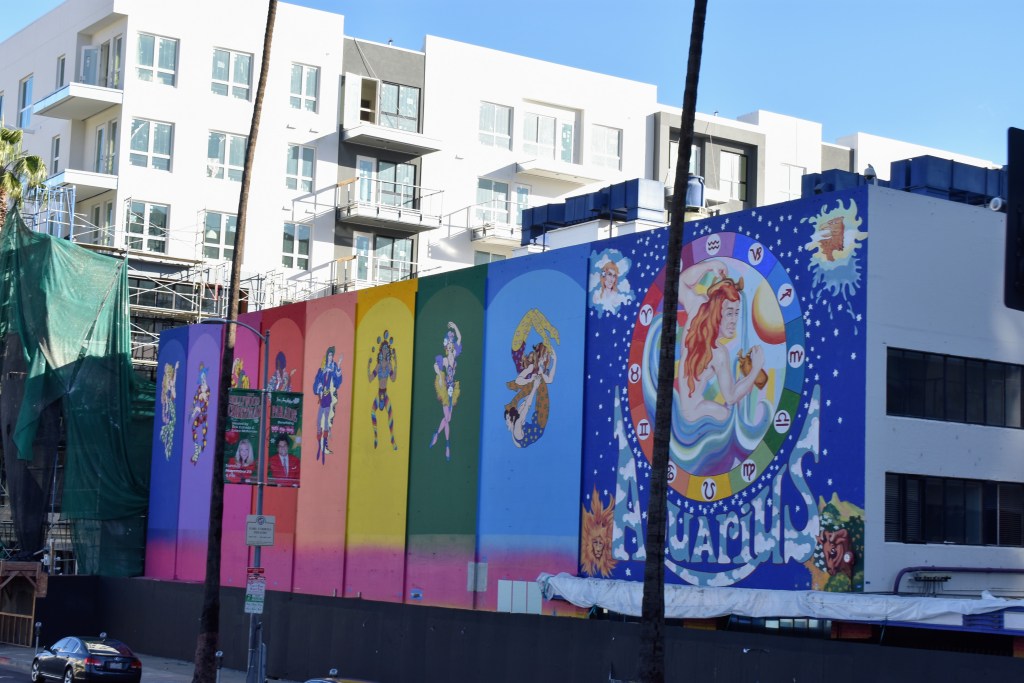
Earl Carroll Theater with Aquarius mural, Sunset Boulevard 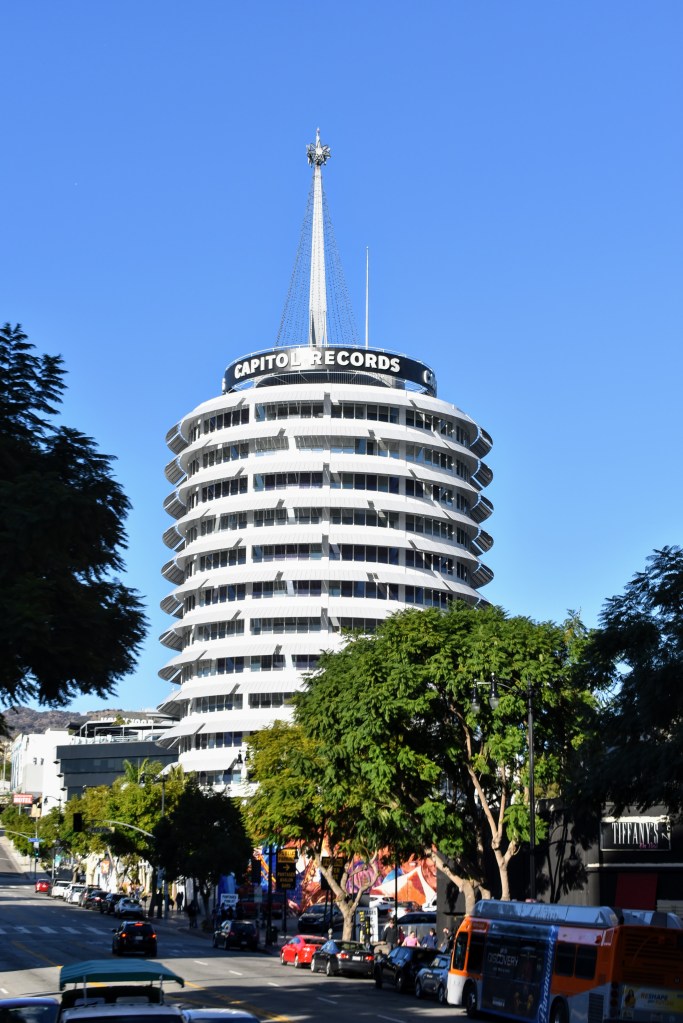
Capitol Records, Hollywood Boulevard We came back along the Walk of Fame (I saw Angela Lansbury’s star from the bus!) and ended up back in front of the Dolby Theater at just about 2:55. We ran off the bus and I flagged down one of the Starline guys, who was able to tell me that the bus back downtown hadn’t left yet and pointed out which one it was (there were about three in a row). We hurried on and decided to sit downstairs for the trip back. Of course, the drive on this leg ended up being more of a tour and didn’t go on the freeway at all, so we could’ve gone topside. But that was alright. We saw everything just fine and I was OK taking a break from turning every which way to try and get photos of as many things as possible.

Los Angeles Central Library 
The Westin Bonaventure Hotel & Suites The bus got us back to the hotel around 4 p.m., and we decided to get some linner (lunch-dinner for anyone not in the know) since we’d skipped lunch. But first we really needed to use the bathroom. The bathrooms on the second floor, where the hotel entrance was on the street and the bus had its hop-on/hop-off stop, were bolted shut. Ok, fine, we’d just go downstairs. We got downstairs and the women’s restroom was blocked off with one of those folding wet floor signs. We were getting a little desperate at that point, so we moved the sign aside. Well, it wasn’t just a wet floor. They were installing at least one toilet, as evinced by the giant hole in the floor of one of the stalls and the toilet sitting in the middle of the restroom. So we went into the men’s room, which was thankfully empty. Business done and hands washed, we came out and walked around a corner to readjust our bags and jackets. And thank goodness we did because a guy went by us and straight into the restroom. Close call!
We went back to the same café for linner (there were others, but one only did breakfast and lunch and the other was closed due to COVID had hadn’t reopened yet), which was more than just the Starbucks at that point and actually provided a sit-down service. I got pasta and Mom got the biggest club sandwich I’ve ever seen. I think it was the biggest club sandwich she’d ever seen, too. After linner, we found the hotel gift shop and wandered around there for a few minutes—I got a movie quiz book where you have to guess the movie from six hand-drawn illustrations. Then we got our bags and I called a Lyft.
Back at Union Station, which was much closer to Olvero Street than I realized, we checked our big bag and got to go up to the Metropolitan Lounge to wait. The train wasn’t due to leave until 10 p.m. so we had a little while to wait. The biggest downside to traveling in winter is how early it gets dark, which can be a bit of a deterrent to exploring things when you’ve got time between doing one thing and doing the next thing. So we sat in the lounge, drank some tea, and watched the Sunday night line-up on ABC. America really does have some funny home videos.
At the previous train stations we were asked if we needed Red Cap assistance and turned it down each time. Well, we didn’t get that choice in L.A., and it soon became apparent why. Each time we had the opportunity to use one of the first-class lounges, someone would announce when a train was ready to board and then would lead anyone in the lounge who was taking that train to the platform, often through a different door than the lounge entrance. In L.A., you exited to a ramp down to the Red Cap golf carts, which then drove the passengers about ½ a mile around the back of the terminal to the platform.
We didn’t have to wait long for the train and the Red Cap had dropped us off pretty close to where our car was on the train. It was another long train as it would split in San Antonio, with the front half going to New Orleans and the back half going up to Chicago. We were waiting for the sleeping car attendant to be ready for us to board when she got off and came around asking for the passenger in room 15. Well, that wasn’t us, and she seemed miffed when she asked me that directly and I said, no, we were in room 14. There was a little more confusion about our tickets, which did not endear her to us or us to her, but we finally got settled in our room. The beds had already been turned down, so once the train got under way and we had passed any sights of interest that we could see, we got ready for bed, read for a little while, and turned out the lights.
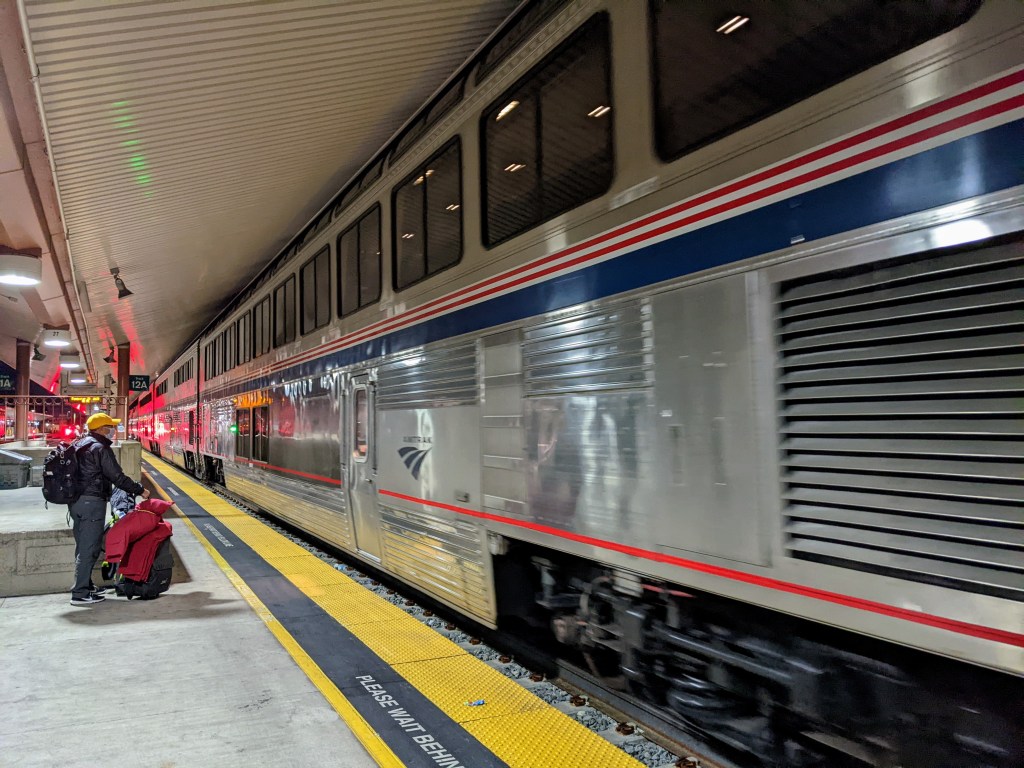
Getting on the train 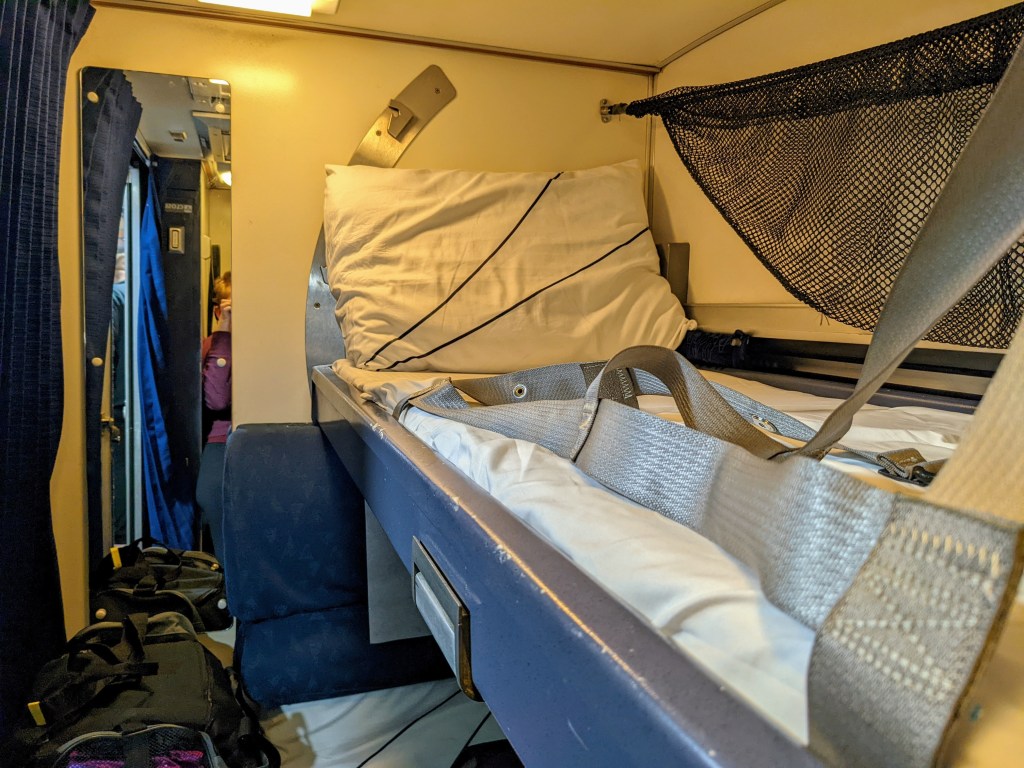
Our roomette -
Are Those Otters or Just Logs?
Day 9 – Saturday, December 25, 2021
When I woke up for good about 7 a.m., Mom had already gotten up and dressed. Once I was ready and she’d brushed her teeth, we went to the dining car for breakfast. We’d already passed through Sacramento and were heading towards San Francisco. We passed through the San Francisco Bay National Estuarine Research Reserve and saw lots of ducks. But as we went around Grizzly Bay, we saw a double rainbow!
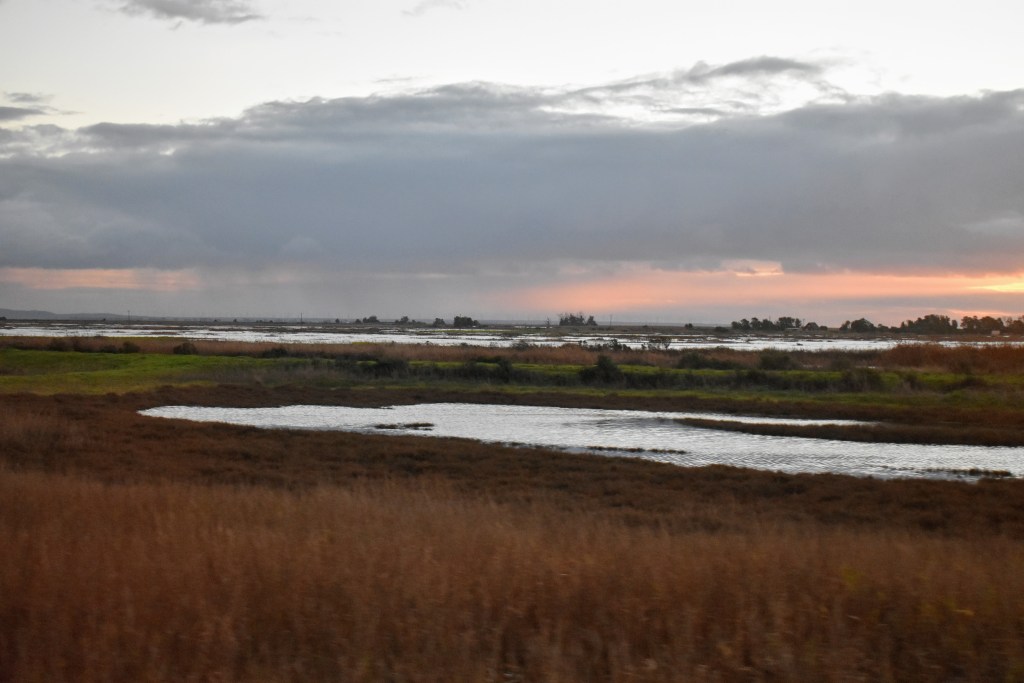
Grizzly Island Wildlife Area
Cordelia, CA
Rainbow over San Francisco Bay
Bayview-Montalvin, CAThe train didn’t go into San Fran—the closest we got was Oakland. And then it was on to San Jose. But we just seemed to see more and more birds: ducks, grebes, egrets, herons, vultures, hawks, coots, gulls, cormorants, geese, and what I’m guessing were willets. Then, just after San Jose, I think we were passing the Elkhorn Slough State Marine Reserve, and we saw a bunch of egrets, gulls, and wading birds. Then Mom said, “Is that an otter or just a log?” Dear reader, not only was it an otter but just a few feet away were a whole passel of otters, some of which we were able to watch hopping in the water! Later research found that these were sea otters as opposed to river otters.
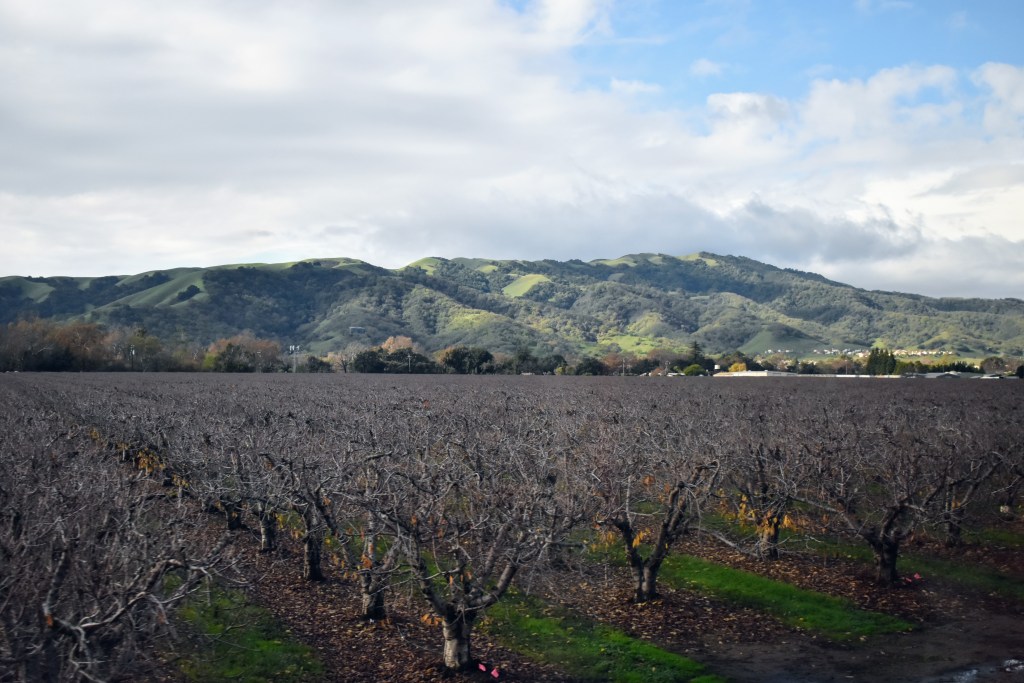
California 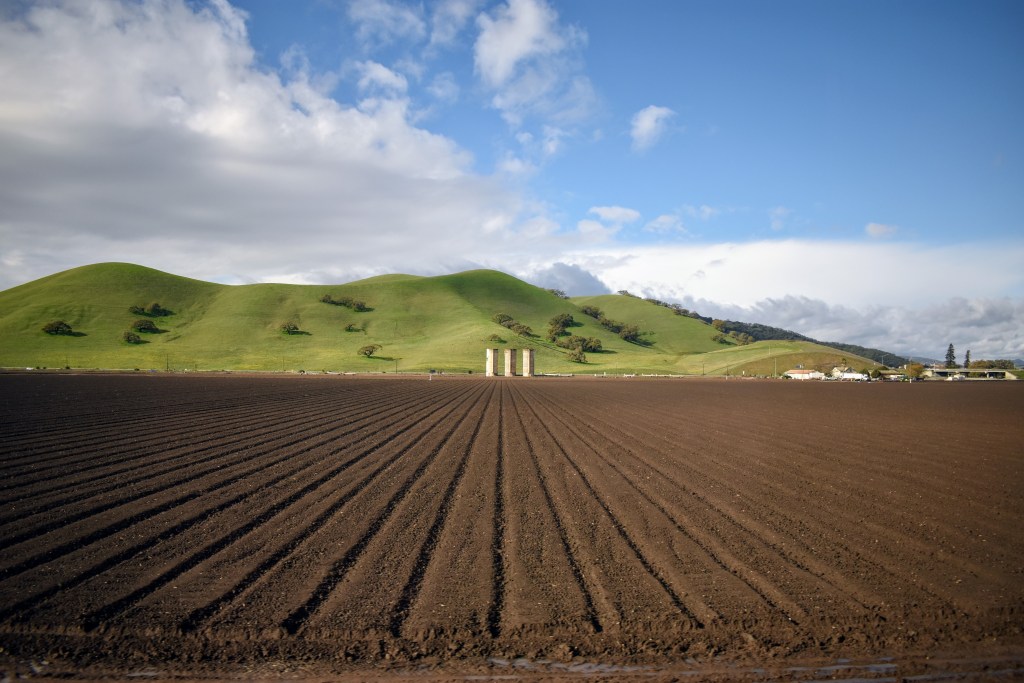
California 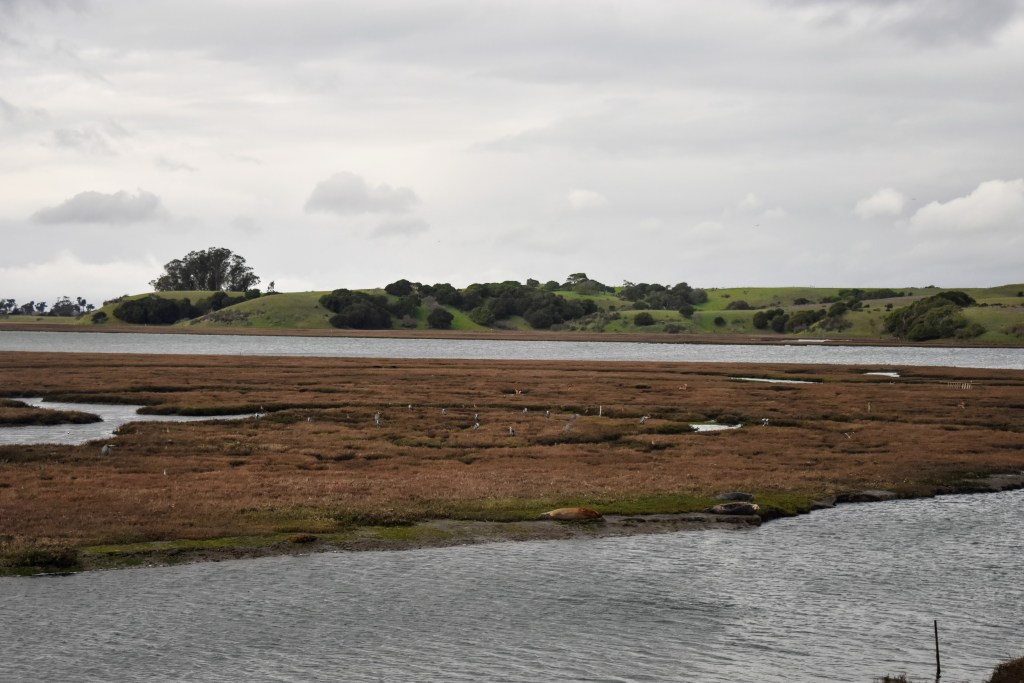
Sea Lions (probably not losers) 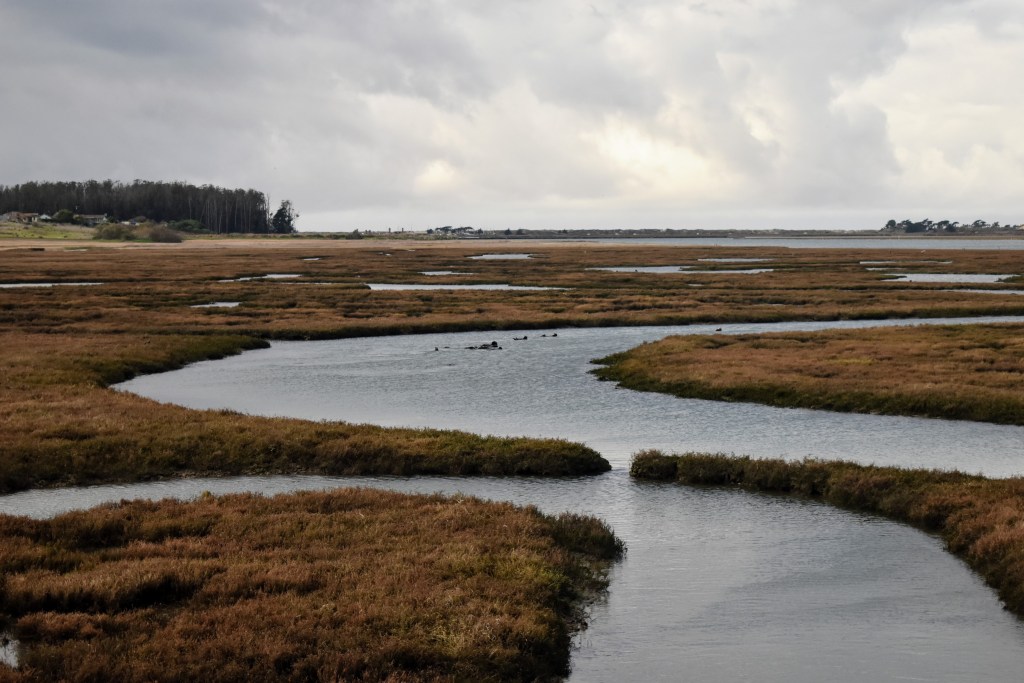
Sea otters, not logs Of course, the train doesn’t stop for otters, so we kept going, past orchards and vineyards and mountains and windmills. We went to lunch at 1:30 (Mom had a salad and I had chili on a baked potato), where we kept to a similar pattern that we had before and sat on the opposite side of the train from where our roomette was. We like to vary our view. We were glad we had done that because towards the end of lunch we saw another rainbow!
After lunch, we went down to the lounge car and sat on that side as well, and were very glad we did. From the left side of the car, we saw sweeping vistas as the train came through some mountains and around a valley, perhaps the Salinas River Valley, on the way to San Luis Obispo. We went through several tunnels on the way and were able to see both the front and back of the train as it navigated the curving rails.
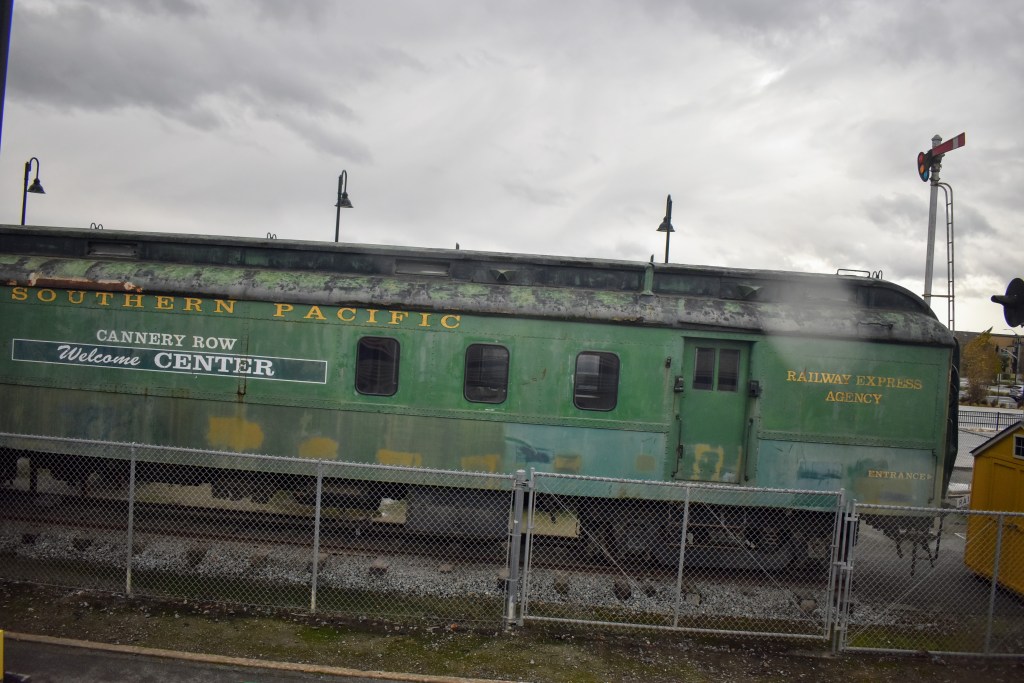
Old train 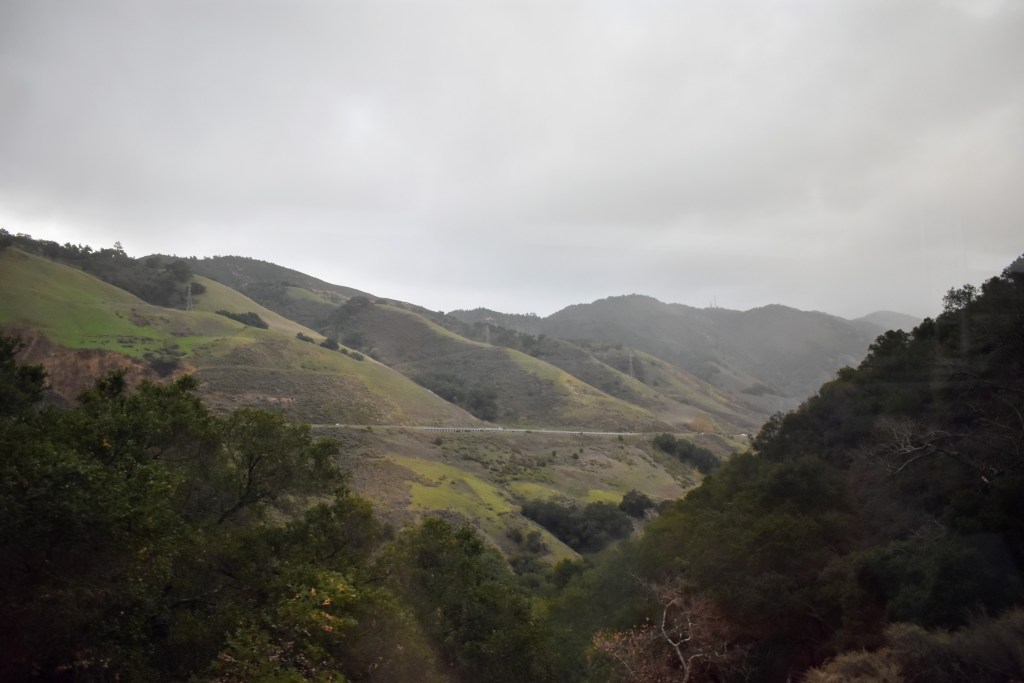
California 
California 
California 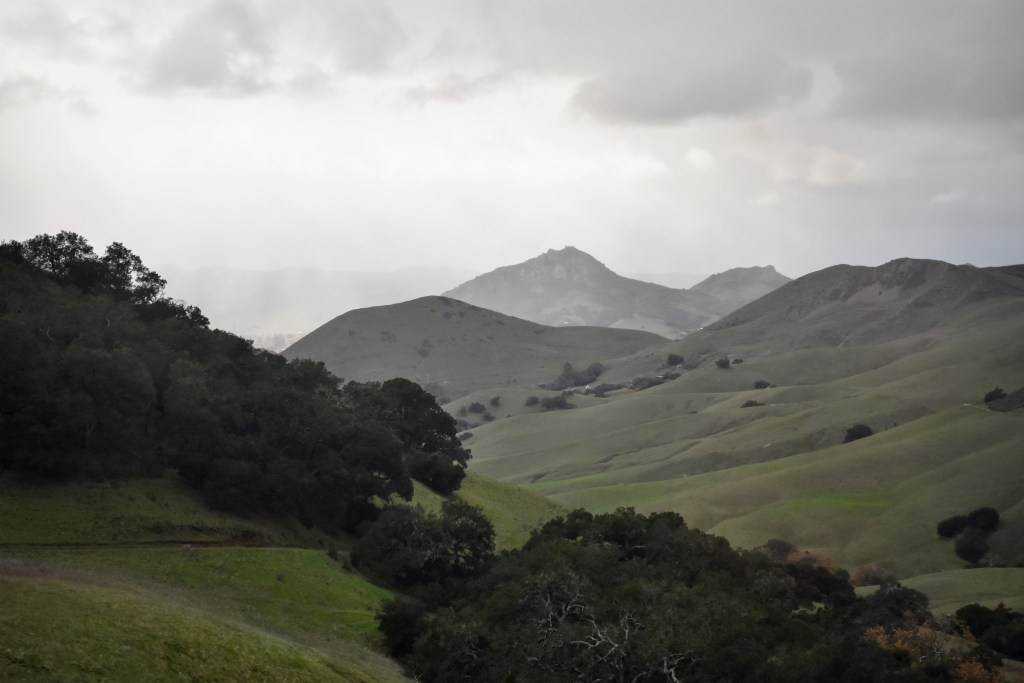
California 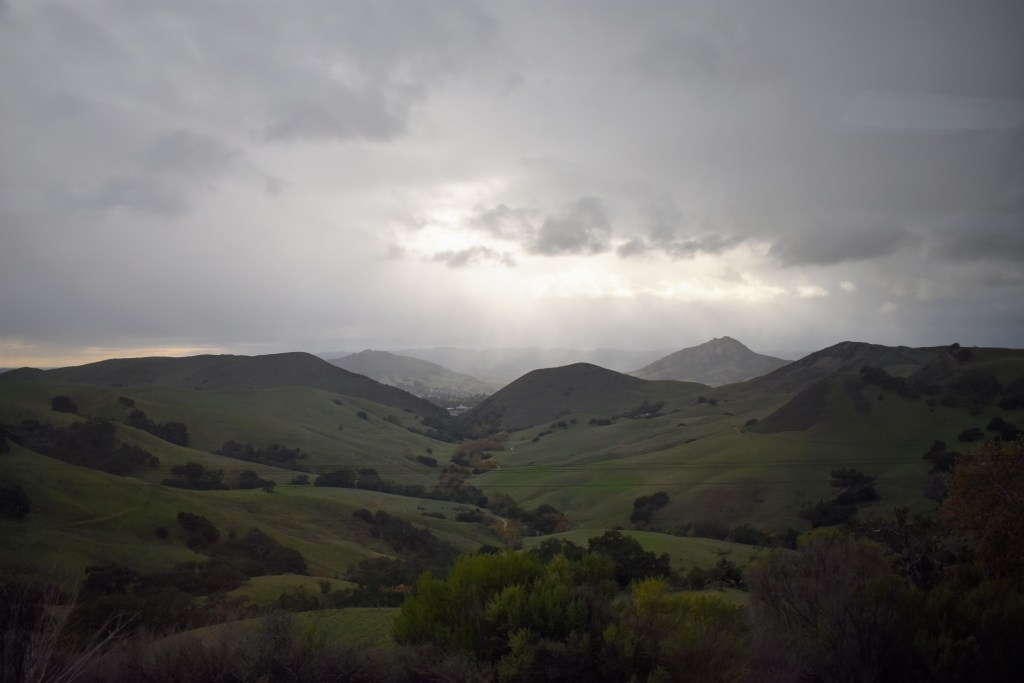
California 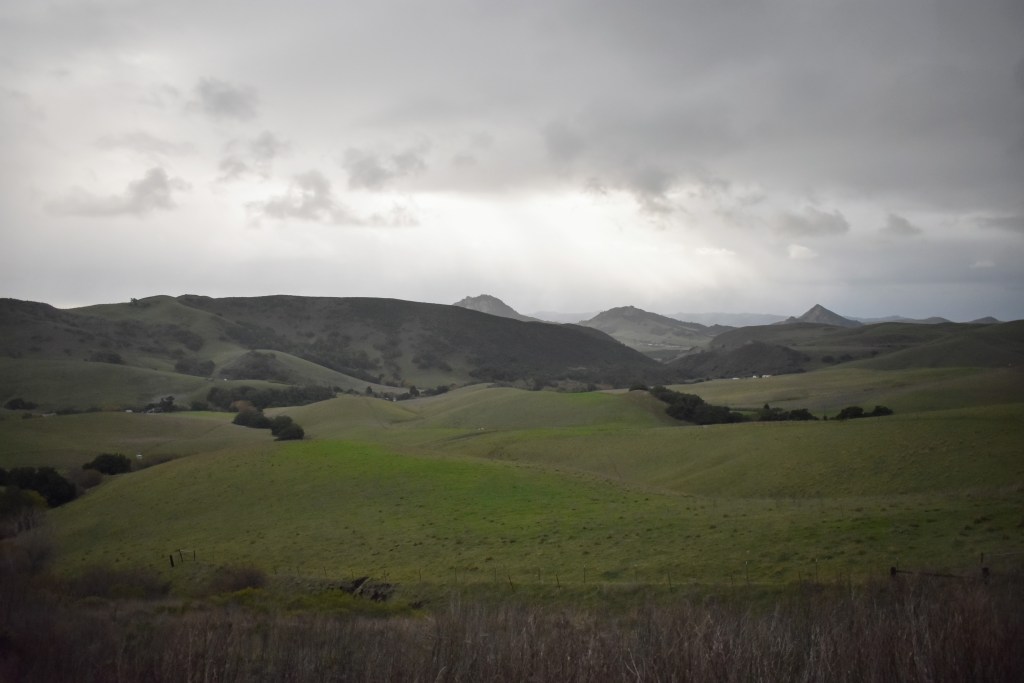
California 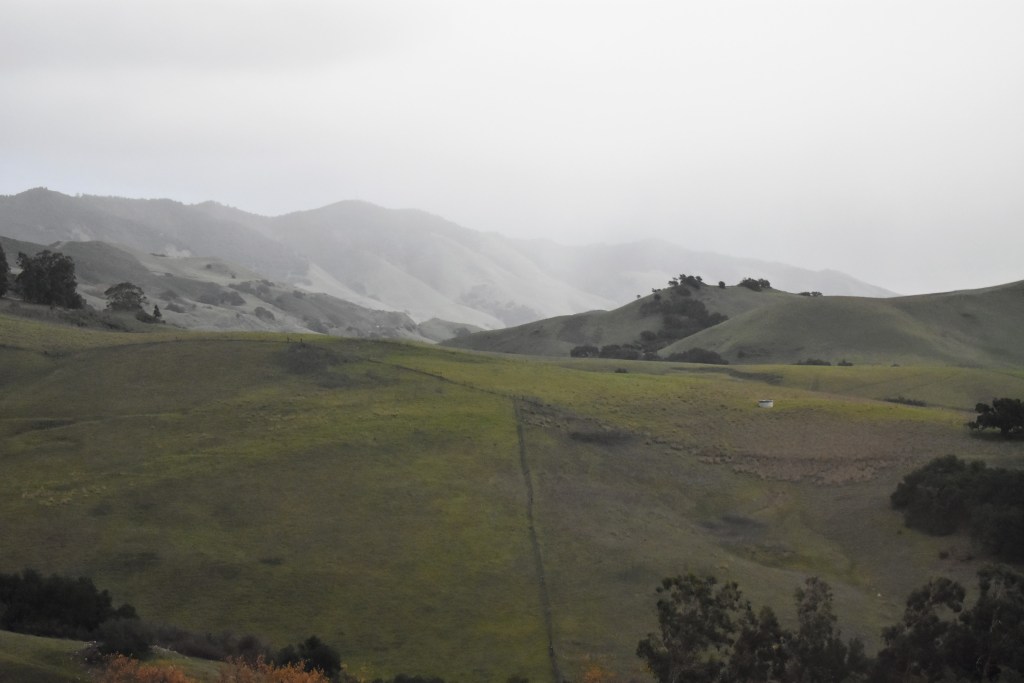
California 
California 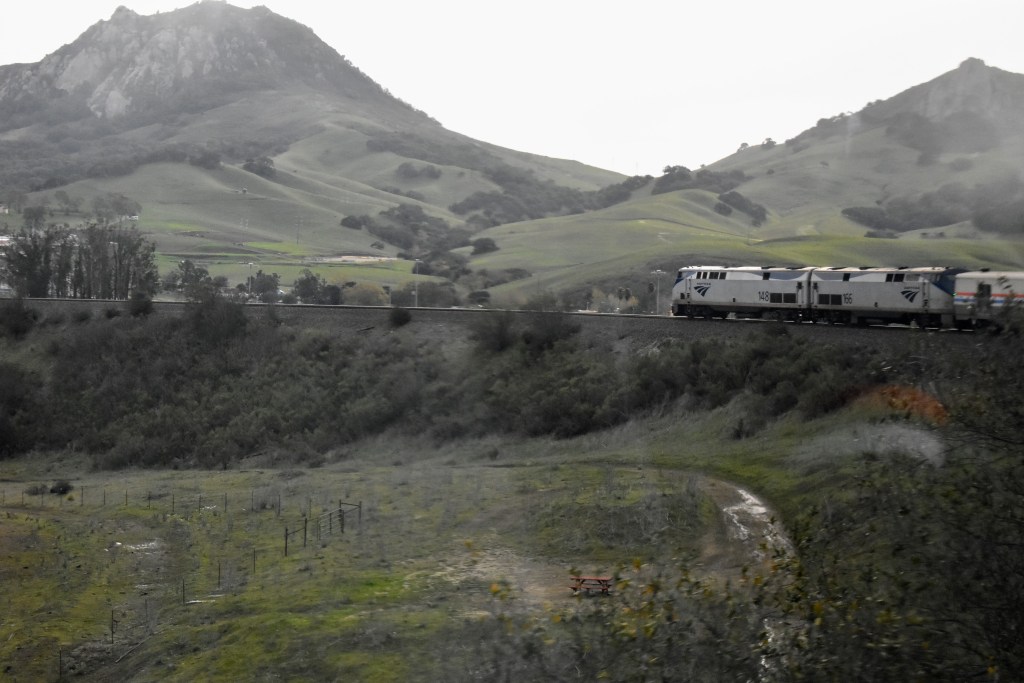
Our train, the Coast Starlight 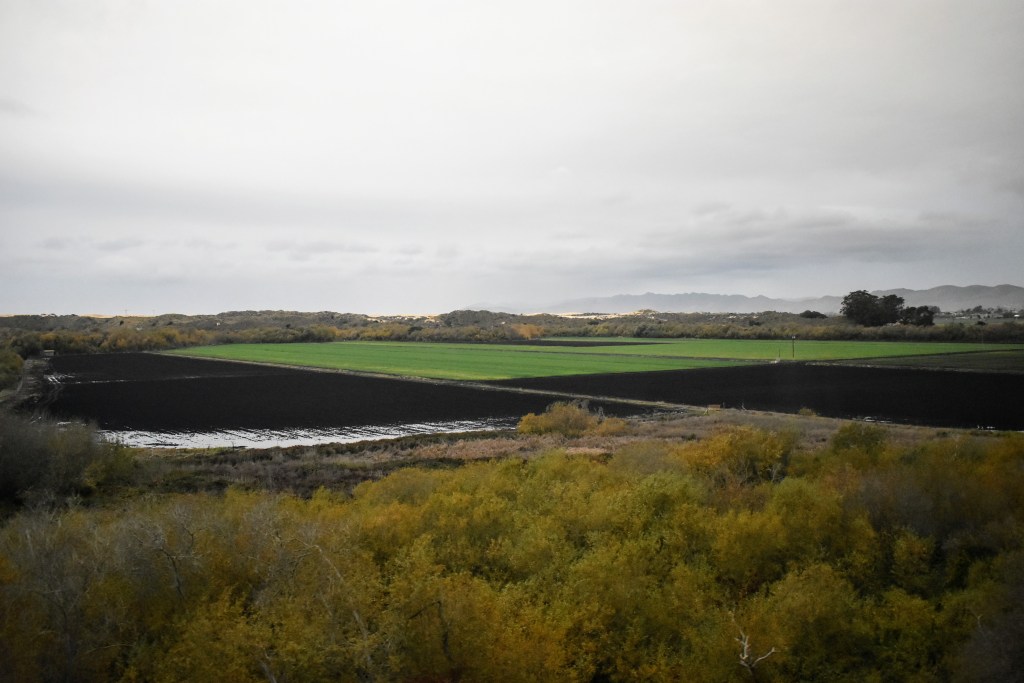
California After San Luis Obispo we made our way back to our roomette since we knew that we were on the side that would have the best views anyway. We caught some glimpses of the ocean as we sped on our way, though the train went inland for a bit and we only caught sight of dunes every once in a while. But it was all worth it once we did get closer to the Pacific. The train traveled alongside several mostly deserted beaches for a bit (they were rather rocky, though we did spy a few people scattered around) before the beaches petered out and the train was going along a cliffside that ran straight down to the ocean, with large crags sticking up out of the surf and seemed to be coming out from below the train. At one point we joked that Amtrak should offer a bungee activity off the side of the train for anyone who wanted to take a dip, it seemed that close to the edge. We could see the waves crashing against a few lone rocks that were a bit further out. We, of course, saw plenty of seagulls but also spied about four pelicans swooping along the coast as the light began to fade.

California 
California 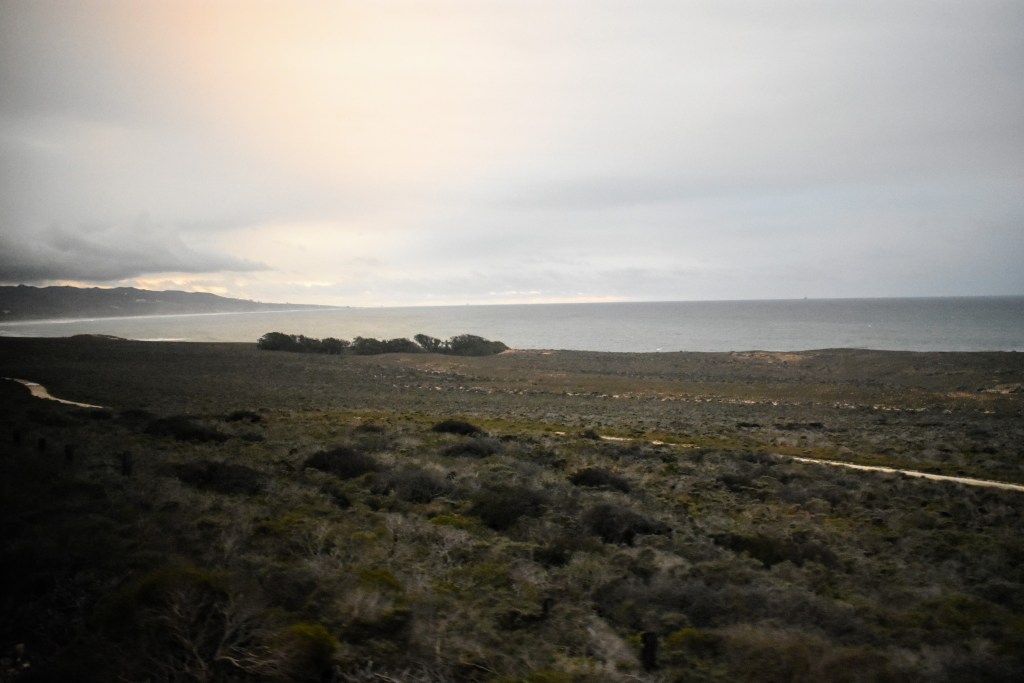
California 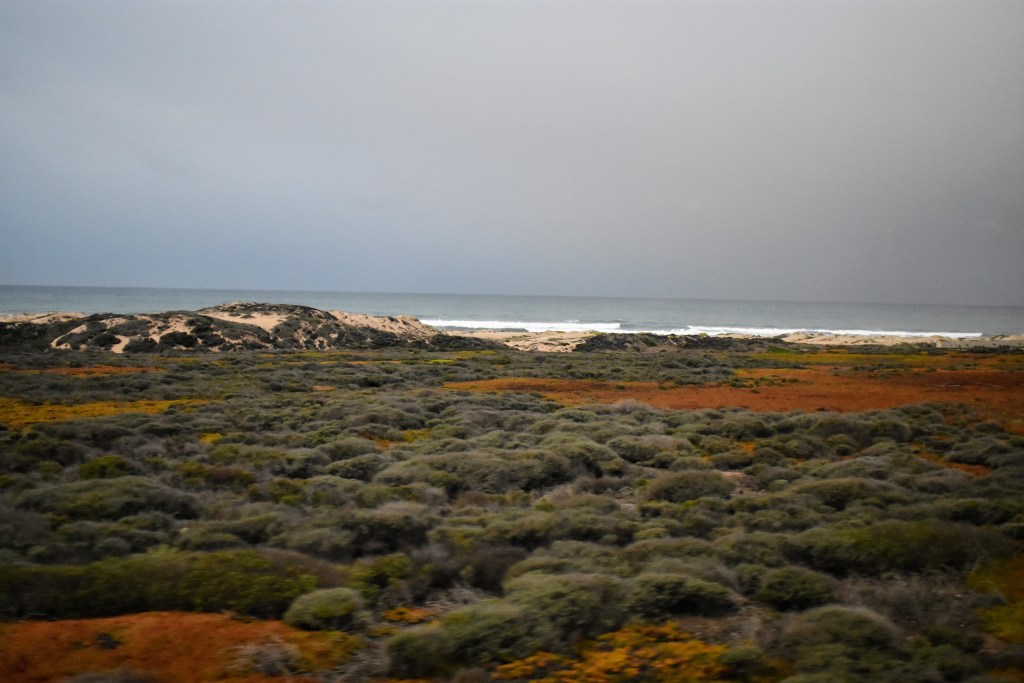
California 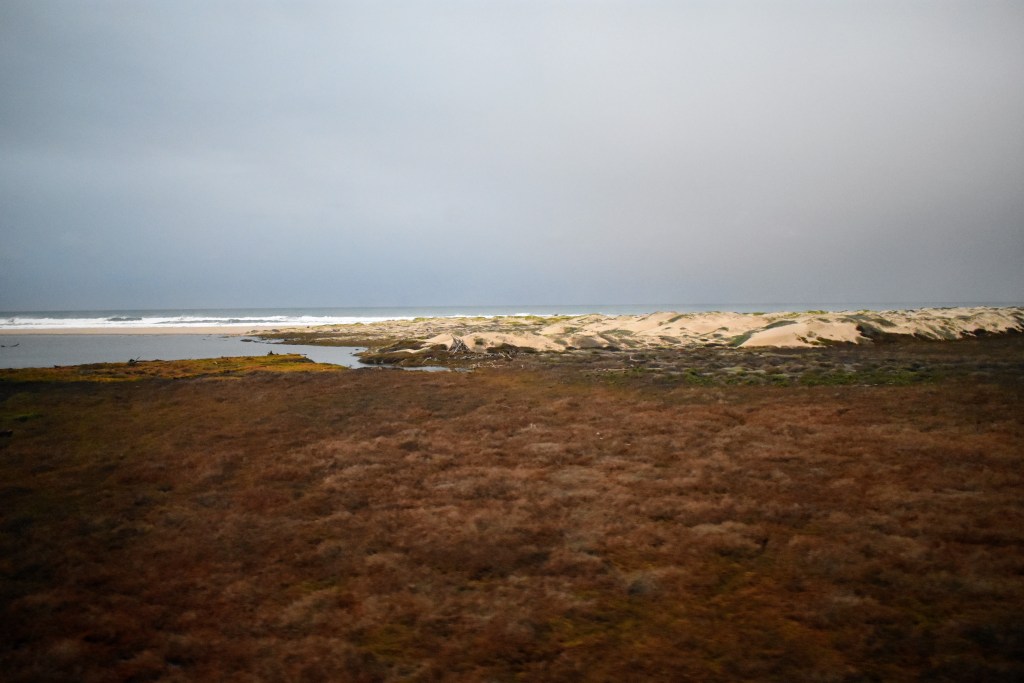
California 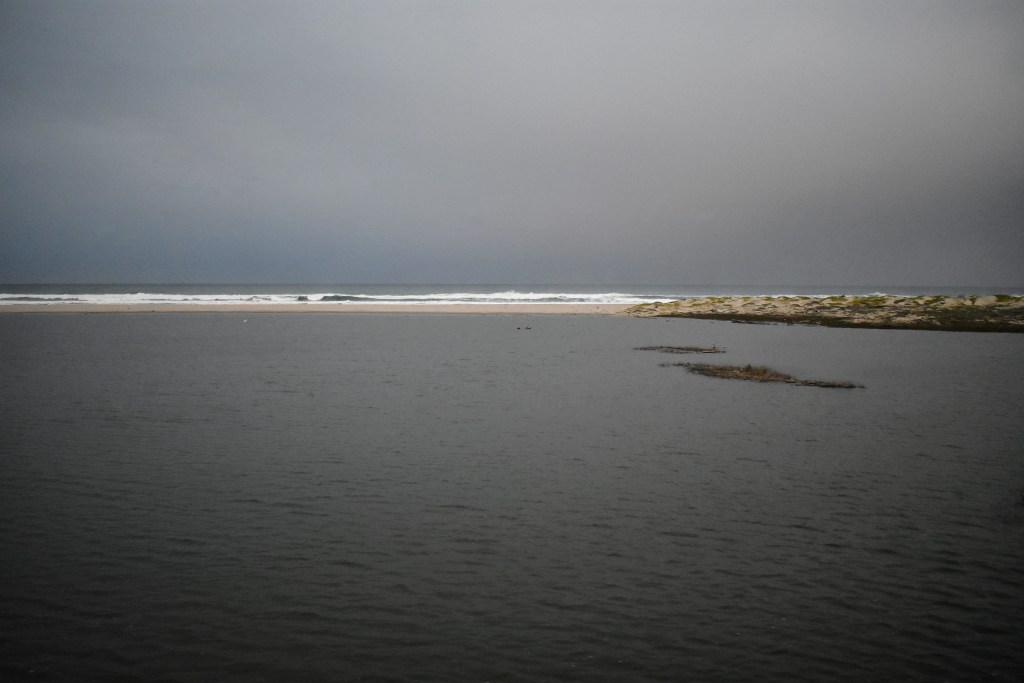
California 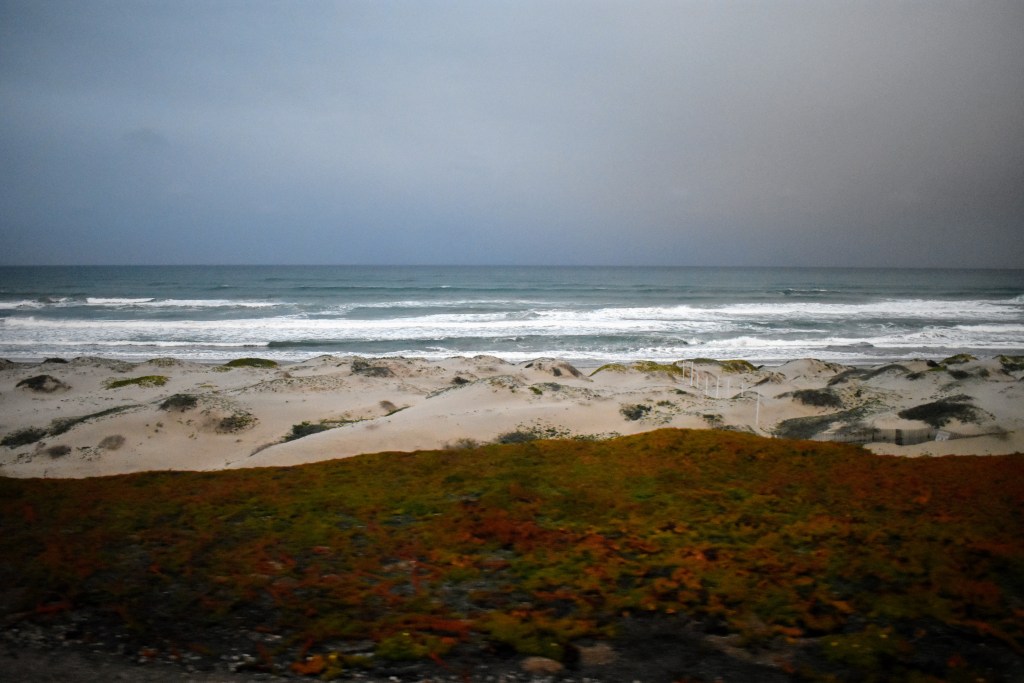
California 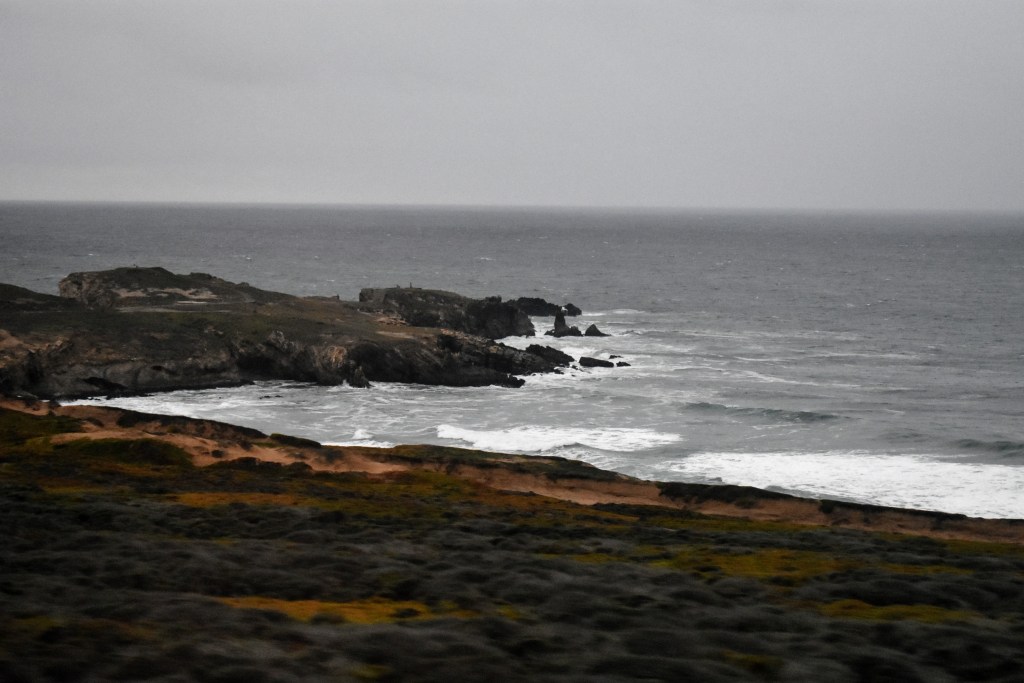
California We eventually left the coast and came a little bit more inland as we got closer to L.A. and the stops we had to make on the way. We had made pretty good time on this trip and made it to Union Station (just about everywhere it’s “Union Station” except for Seattle, where it was King Street Station, and smaller stations that are simply unnamed) around 10. After we got our bag, we walked through the gorgeous entrance to the main part of the station, which was all a mix of Art Deco, Mission Revival (that very Spanish California style), and Streamline Moderne—thank you Wikipedia. We finally got a Lyft despite the fact that I had not considered it was Christmas Eve until the moment I logged in and saw how difficult it was to find a driver.
As we waited we were treated to a very L.A. welcome outside the station as a security guard yelled at a woman to pull her pants up and the woman yelled back that she had to pee. I’ll state here that one of the things that struck us most on this whole trip is the sheer scale of the homelessness epidemic in our country. It was absolutely heartbreaking and the subject of many of our discussions during our trip. We know a lot of factors play into homelessness: mental illness, abusive relationships, drug and/or alcohol abuse, and physical disabilities to name just a few. But it became increasingly clear, too, that the cities we were visiting all needed to put many more resources into not only helping the current homeless population but also into programs to address the causes of homelessness in the first place. *steps down off of soapbox*
So, we finally got that Lyft and made our way to our hotel, the Westin Bonaventure. Dear reader, it was swank. Water features in the lobby. A circular café area in the middle. Once we had checked in, we were told that our room was in the middle tower. THAT’S RIGHT. I SAID TOWER. We got on the elevator. IT WAS A FRICKIN’ GLASS ELEVATOR FROM THE LOBBY UP THE OUTSIDE OF THE TOWER. I nearly exploded from excitement. We got to our room and found that it also had an in-room coffee/tea maker. ALSO VERY EXCITING. I don’t know why some of these fancy places don’t have either an in-room coffee/tea maker or a free coffee/tea bar, but I was very pleased to see this one. We had us some chamomile tea before bed!
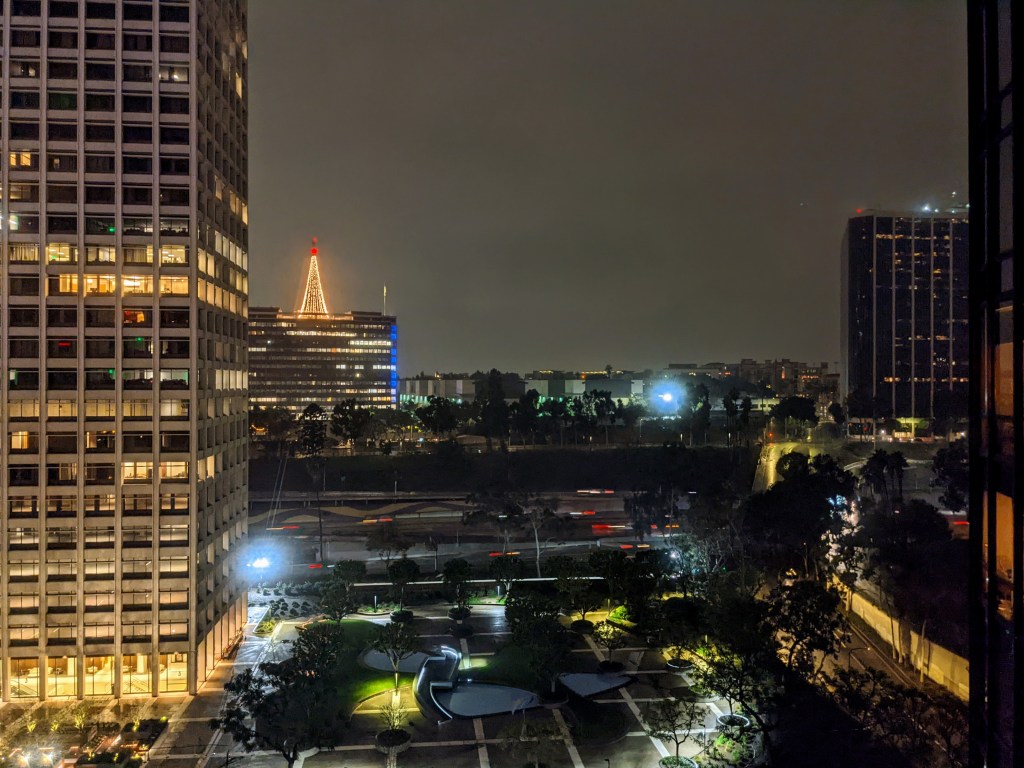
View from the hotel room -
Little Coyote Cutouts
Day 8 – Friday, December 24, 2021
Thanks to my early night and Mom just always waking up at an ungodly hour of the morning, we were able to get an early start, get our stuff together, and head out of the hotel by about 8. We got a Lyft to King Street Station, checked our bag, and found a place to sit until the train started boarding. I left Mom with the carry-ons and went to get photos of the station and scrounge some breakfast, which turned out to be a delicious bagel and muffin.

King St Station 
201 S Jackson St doors Our train, the Coast Starlight, boarded on time and we found ourselves upstairs but on the right side of the train this time. I quickly realized that this would put us on the coast-side! We settled in for another day of vista-viewing from the train. This leg would be going from Seattle down to LA over the course of two days, and the last third or so would be along the coast. But we had lots to see before then!
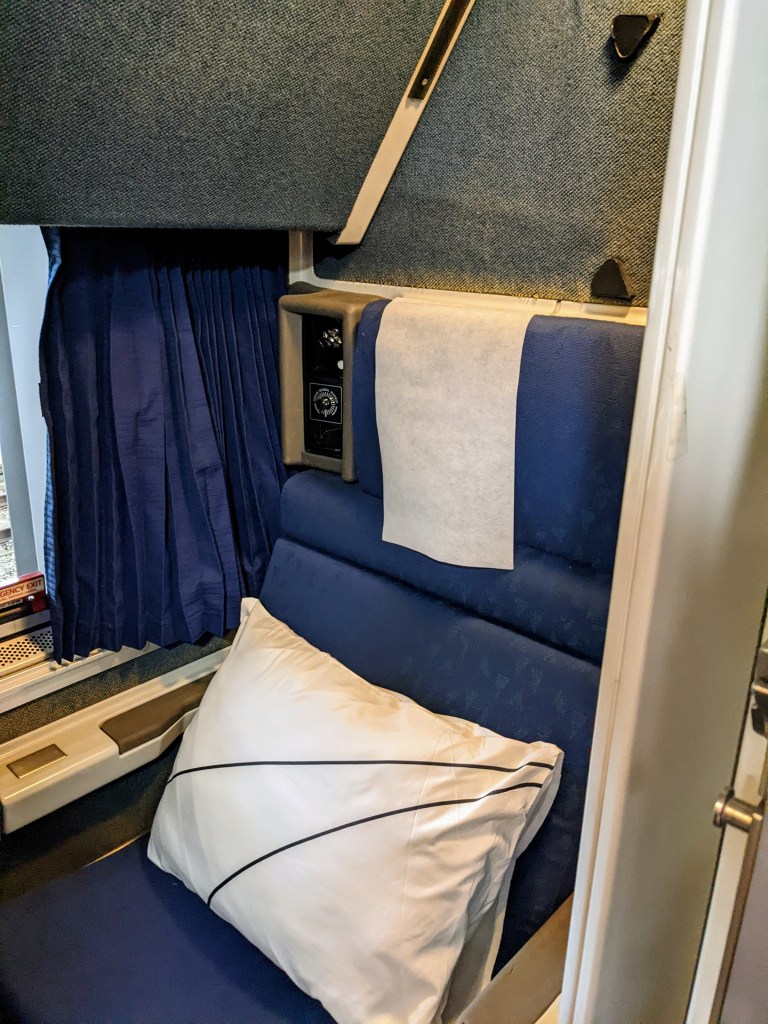
Our roomette We passed many waterfalls next to the tracks, fields of rotting pumpkins, and mountains in the distance. At one point we passed a large pond with what appeared to be trumpeter swans! We noticed a lot of different types of birds, though the train was often going too fast to get an ID. But great egrets, great blue herons, and vultures are usually pretty easy to identify. We saw lots of gulls, ducks, probably grebes, crows and ravens, and several hawks—most likely Cooper’s hawks or red-tailed hawks. At one point, we passed some fields that had these coyote-shaped cut-outs, presumably there to scare off little critters.
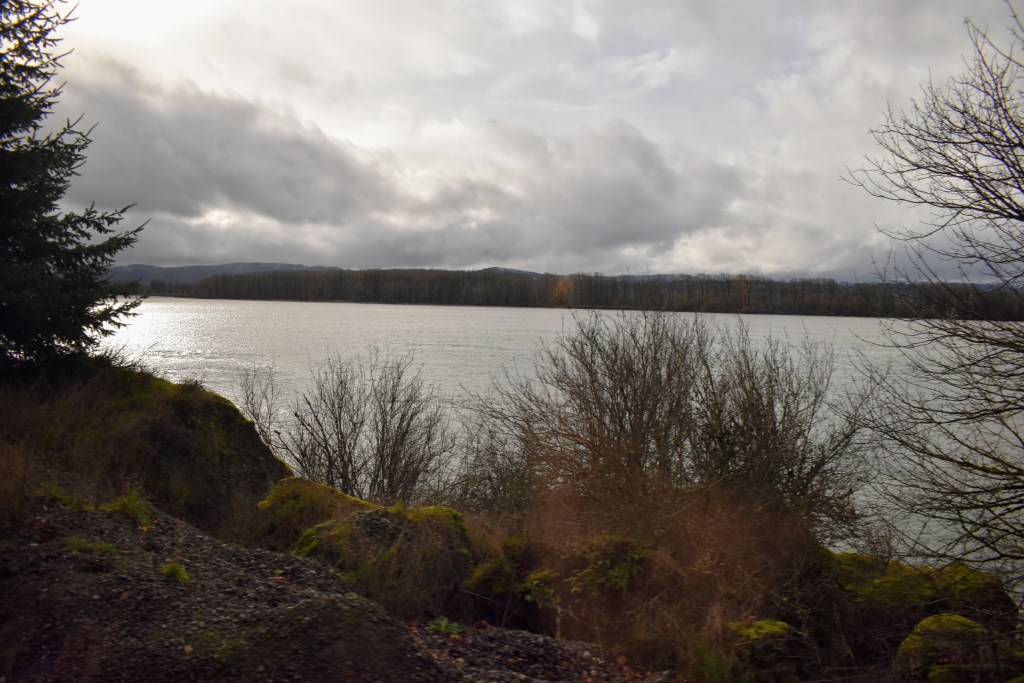
Commencement Bay As it got later and we got into Oregon, we started climbing in elevation. By dinner time we were seeing snow-covered evergreens and snowplows out and about in the towns we passed. The day passed quite quickly as we alternated looking out the window, reading, and doing word puzzles. I worked a bit on this journal and we finally got to bed about 10:30 or so.
-
The California Sea Lions in Seattle are Losers
Day 7 – Thursday, December 23, 2021
We wanted to fit as much in as possible, so an early start was essential. We got up about 7:30 so we could leave around 8 and find a place for breakfast. On Wednesday evening we had discussed a game plan and thought about starting at the Chihuly Gardens and Space Needle, but in the end, decided to start with the boat tour and the Underground Tour before getting a Lyft down to the Olympic Sculpture Garden and finishing with a Chihuly/Space Needle one-two punch. It would make more sense to do it that way since the boat tours were more time-sensitive than any of the rest of it.
The first boat tour wasn’t scheduled to leave until 10:45, so we wandered in that direction with the intention of stopping for breakfast somewhere. We indeed found a “somewhere”—a little café/convenience store where we were able to get tea and breakfast sandwiches. (Side note: Why is American cheese considered an acceptable topping on anything? It’s basically unflavored, barely edible plastic.)
Since we still had time before the boat tour would even let us board (I had used our CityPass to reserve our place for the first tour), I thought it might be a good idea to wander down 1st Street and go past the Pike Place Market again in the daylight. It was definitely a more representative experience, though we didn’t go into the market proper. We passed by a map shop where we both gawked at the window displays, and I resisted the urge to get more tea and a crumpet. One thing I like about Google Maps is that it often has tourist attractions or popular photo opportunities marked on it—like the Gum Wall (which at this point should just be called, like, the Gum Alley or the Gum Passage).
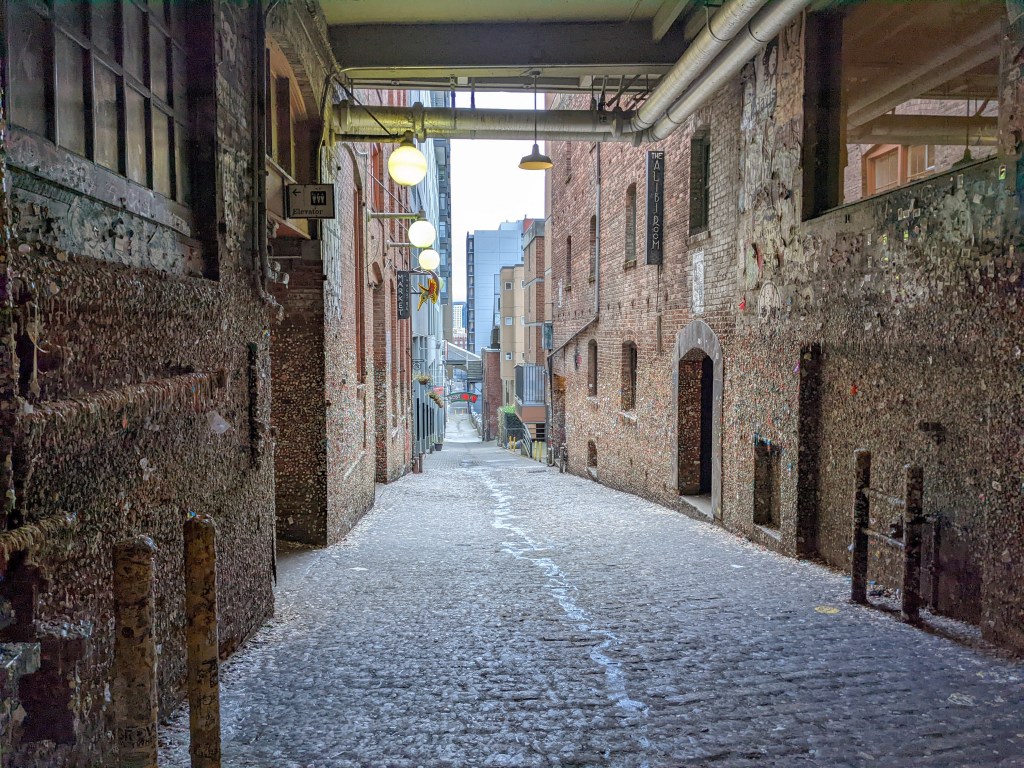
Gum Wall We still got to the pier with time to spare, so more wandering ensued with a quick jaunt into a souvenir shop for a small carrying bag, more postcards, another magnet, a warm hat for Mom, and a Sleepless in Seattle sleepshirt.
We finally boarded the boat (the Salish Explorer), Mom satisfied that it had interior space and restrooms, and prepared for the first tour of the day. The boat had three decks: two with lots of indoor seating, one of which also had a small café, and the third was the open-air top deck. Mom elected to stay on the middle deck, inside, with most of the rest of the passengers and I ventured out to the top deck where I could get photos from both sides without too much trouble and without any spots or glare from interfering windows. Our tour guide, Hesper, was very knowledgeable about pretty much everything we saw. The tour started by going up the coast of Elliott Bay, past the skyline of the city. We were regaled with information about the various buildings and sites, like the Smith Tower, Seattle’s first skyscraper and home to a $17,000/month penthouse (which comes with a reading room in the ball at the top of the pyramid which makes up the penthouse). The famous Edgewater Hotel, where the Beatles were photographed hanging out of their room windows with fishing poles, was initially planned to open for the 1962 World’s Fair, along with the Space Needle. While the Space Needle was finished just in time (and was in fact dedicated the same day the fair opened), the Edgewater was not quite so lucky. It was delayed by issues with building so long (it was being built out over the water after all) that it only opened a couple of weeks after the fair had closed. Because they weren’t able to take advantage of the millions of fairgoers coming to the city, they came up with the gimmick of giving guests fishing poles so they could fish from their bedroom windows. Without adequate space to clean their catches. Great idea.
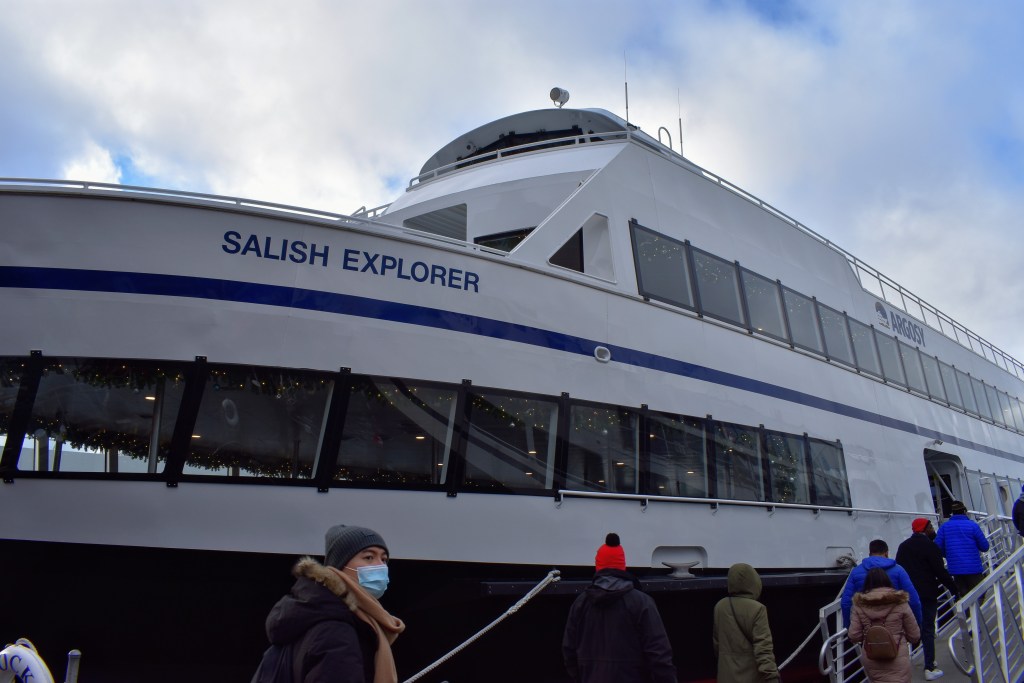
Getting on the boat
Pier 56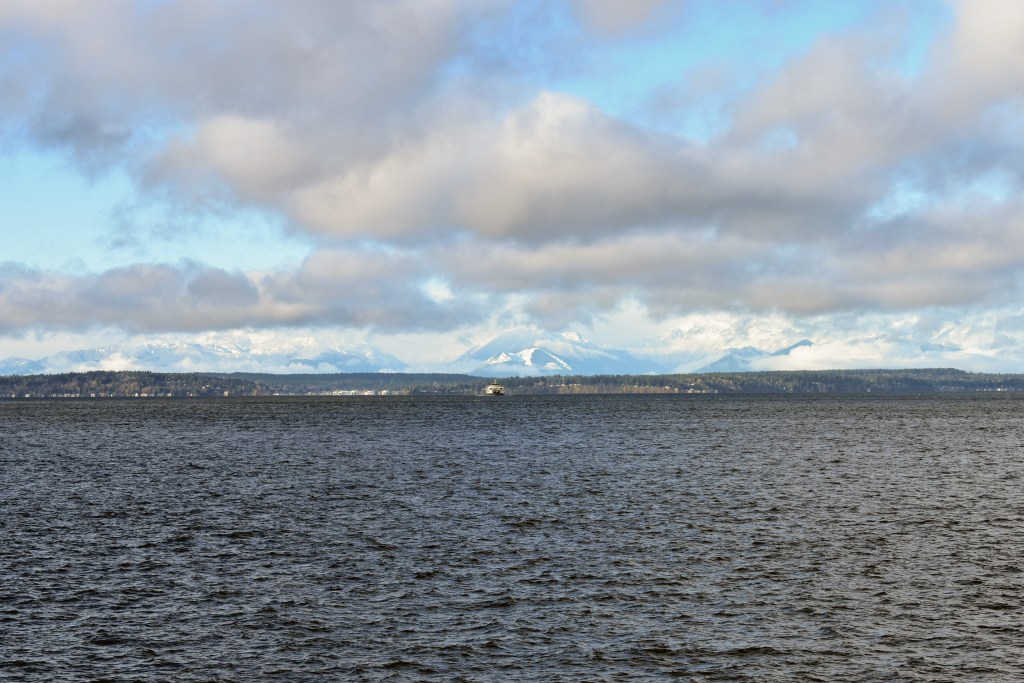
Ferry crossing Elliott Bay 
Skyline from Elliott Bay 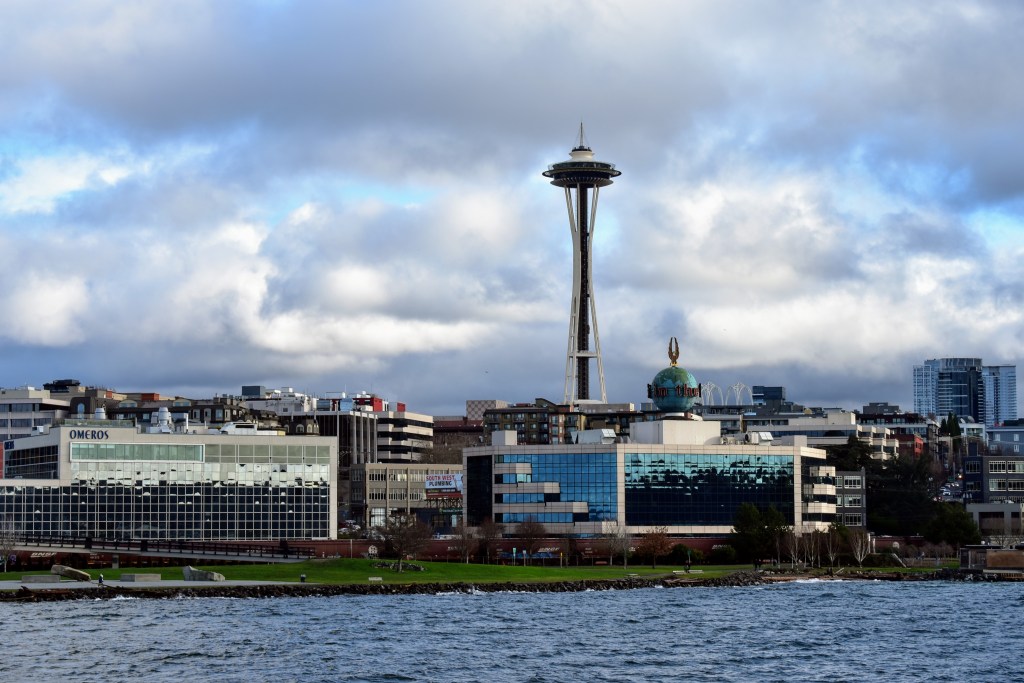
Skyline from Elliott Bay 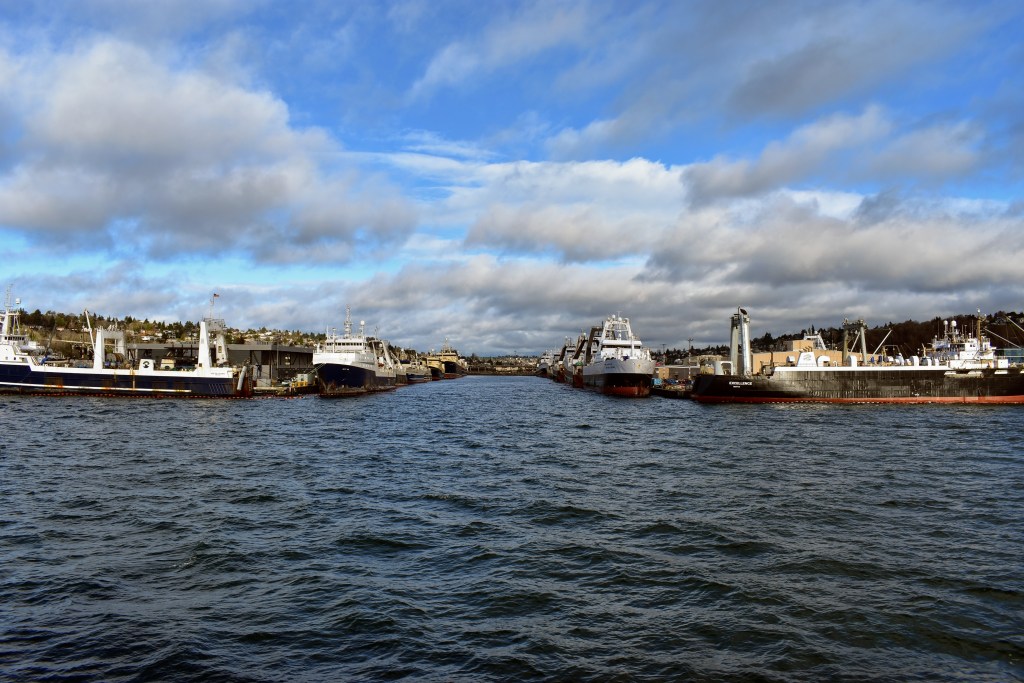
Pier 90 and the Cruise Terminal As we sailed up the east side of the bay, around the top, and then back down the middle of the bay, and back towards the ship loading area, we saw lots of boats and ships. We saw cargo ships, we saw Alaskan fishing trawlers, we saw ferries. Of course, a lot of industry in Seattle centers around the bay and shipping—in fact, the markets in Asia ship to and from Seattle for anything going to or coming from any further than the west coast as Seattle is a day’s sailing closer to Asia than anywhere else on the mainland. Lots of grain getting loaded onto cargo ships there. We also saw some vessels in dry dock, with California sea lions hanging out on the floating barrier around it, as well as container ships being loaded and unloaded with massive cranes. The containers that would fit on one ship would make a 30-mile long train. The California sea lions, Hesper informed us, that we were seeing were the losers. The males would compete for beach territory in California, so only the ones who lost those fights would migrate to Seattle over the winter to fatten up and get ready to try again the next year.
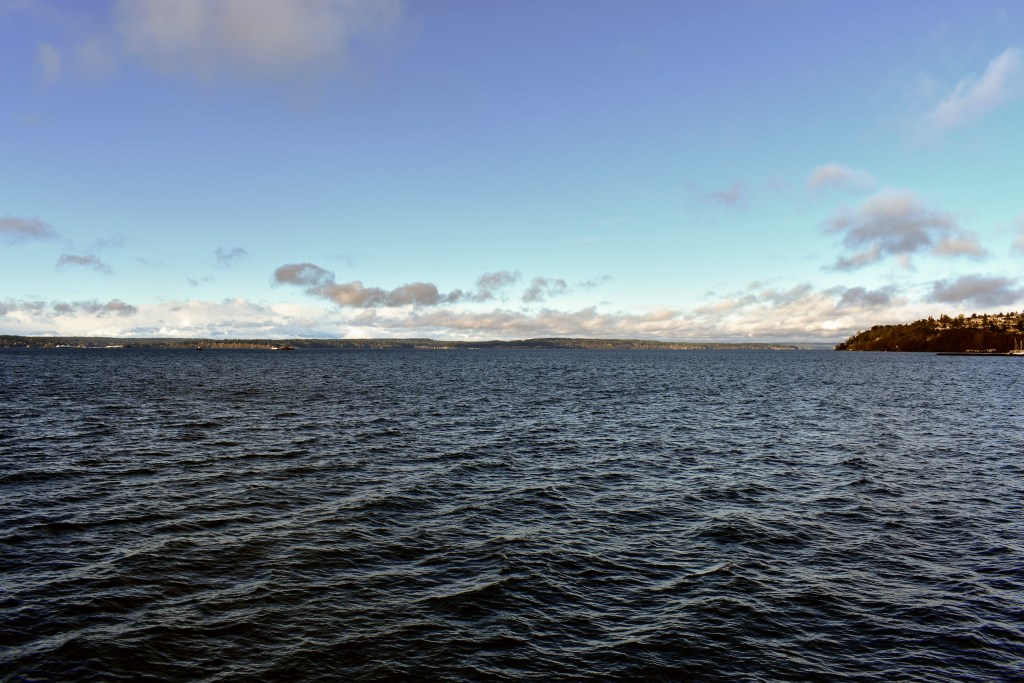
Elliot Bay 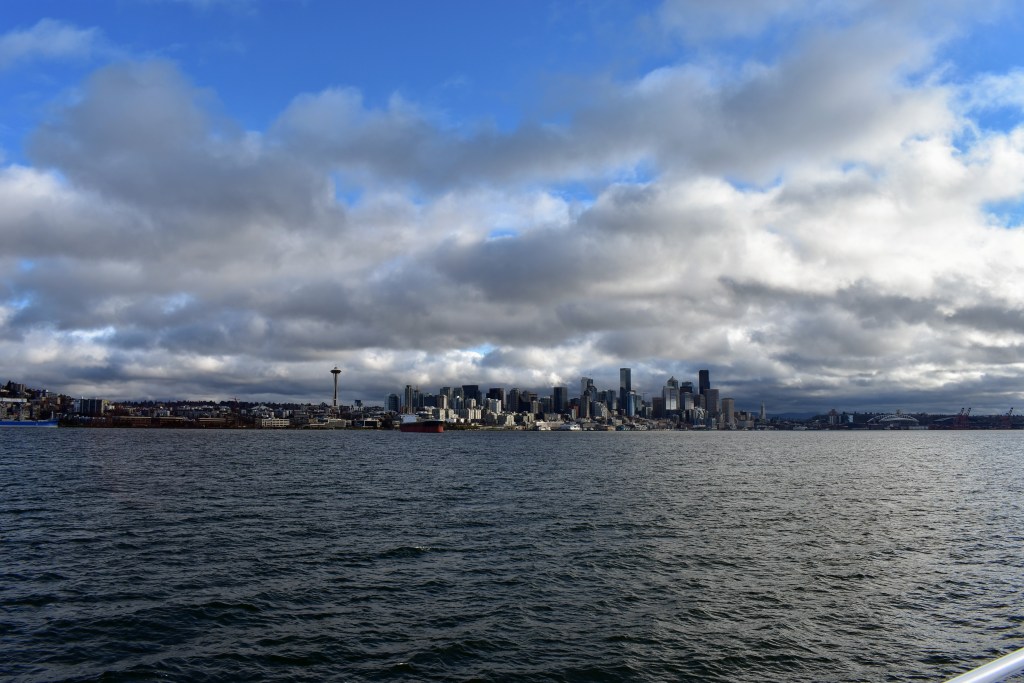
Skyline from Elliott Bay 
California sea lions (the losers) 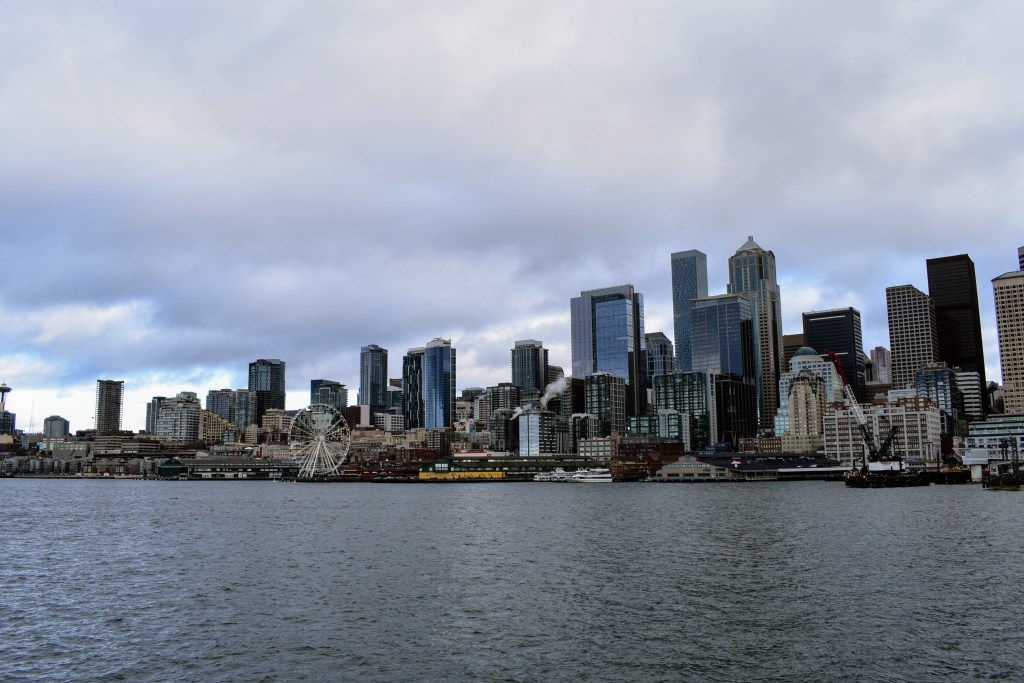
Skyline from Elliott Bay After gawking at the huge container ships and massive cranes, we headed back to the pier. Hesper told one more story that really caught my interest. Apparently, in 2011, the Seahawks (I have it on good authority from the train conductor on the Empire Builder that “nobody likes the Seahawks, go Rams”) were playing somebody or other. At the same time, there were some researchers from the University of Washington downtown with seismographic equipment getting some readings because Seattle sits on some fault lines. Well, apparently Marshawn Lynch (known to me only as a guest star on “Brooklyn Nine-Nine”) decided to run a 67-yard touchdown that day. Keep in mind that the stadium is built like a giant clam, so noise gets amplified. The seismographic instruments began to go wild. The cheering and stomping and yelling from the crowd that day registered as more than a 2.0 on the Richter scale at its height. Since then, seismographic instruments have been installed in the stadium itself so that the crowd can see how loud they are in real-time. Neat!
After getting off the boat, we walked a few blocks to Pioneer Square in order to take the Underground Tour. This tour was a bit more flexible with a group leaving every hour. We got there at 12 on the dot and were able to join that group. The tour itself focused on the founding of Seattle (by white settlers—there had already been native people on the land for hundreds of years) and all the issues they ran into. It basically boiled down to the fact that the first white settlers started staking out their land at low tide and were unpleasantly surprised to find their claims flooded later when the tide came in. But they stuck with it, built a sawmill, and started cutting down trees. As the city grew, apparently no one ever thought to, y’know, build a wall or levee or something to keep the tide out, so the water was always playing havoc with construction, sewers, and their new toilets. Then the city burned down. At least, 33 blocks of the commercial district did. No one died, thankfully.
When they went to rebuild with brick buildings, the city was eventually persuaded to do something about the terrible water lines, sewage lines, and the water constantly coming in with the tides. So what they decided to do was raise the street level to the second story of these buildings, which also meant building a wall at the water’s edge where the street ended. And, voilá! Several problems solved at once!
Anyway, this tour went into several areas where the first stories of these buildings are still accessible, under the current street level. It was pretty cool to see the difference in brickwork on some of the buildings, after all, why would you waste fancy brickwork on the first story if it was going to be more of a basement level before long? We also heard about how much of this was funded: by the taxes paid by Madame Lou and her “seamstresses.” Nudge, nudge.
After the Underground Tour, we wandered back up 1st Street to Pike Place Market in order to visit that map store. We got books and a small illustrated poster of the National Parks! From there we decided that the Olympic Sculpture Park was close enough to walk to and we had plenty of time.
The sculpture park was wonderful. Full of art of different sizes as well as areas for native plants. There were several large installations, like Wake by Richard Serra, which immediately reminded us of the shapes of the cargo ships in the bay, and Seattle Cloud Cover by Teresita Fernández. But we especially liked Calder’s Eagle (we’ve seen two of what I’m calling Calder’s aviary now!) and Split by Roxy Paine, which was a large aluminum tree. We could have spent a lot more time there and both agreed that there ought to be more spaces like it, where art and nature come together in public spaces where people can walk or sit or picnic or whatever.
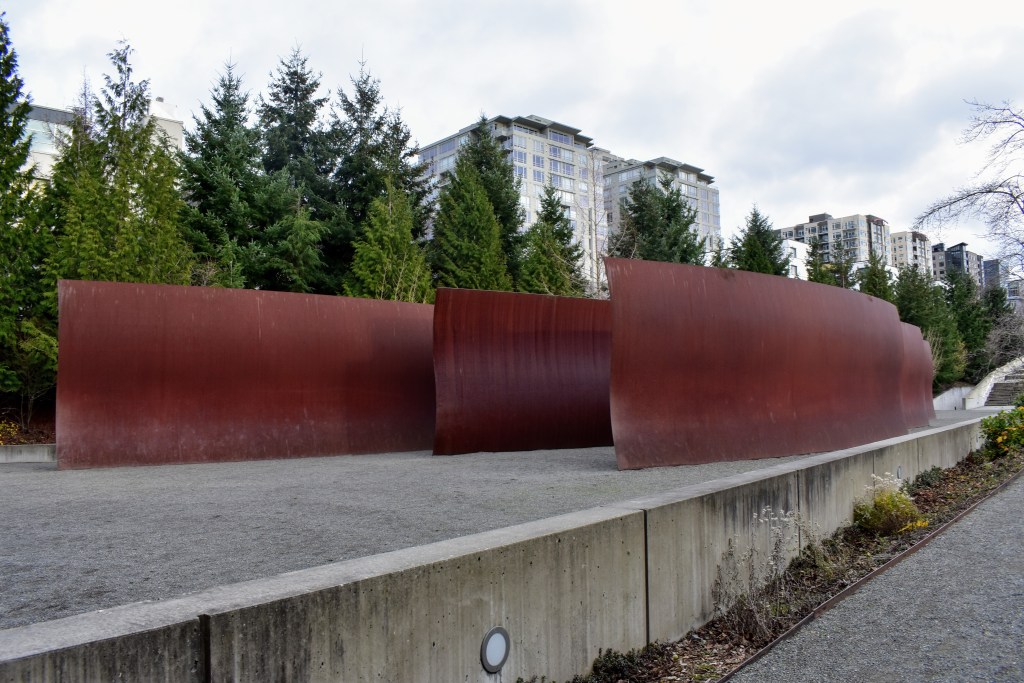
Wake by Richard Serra 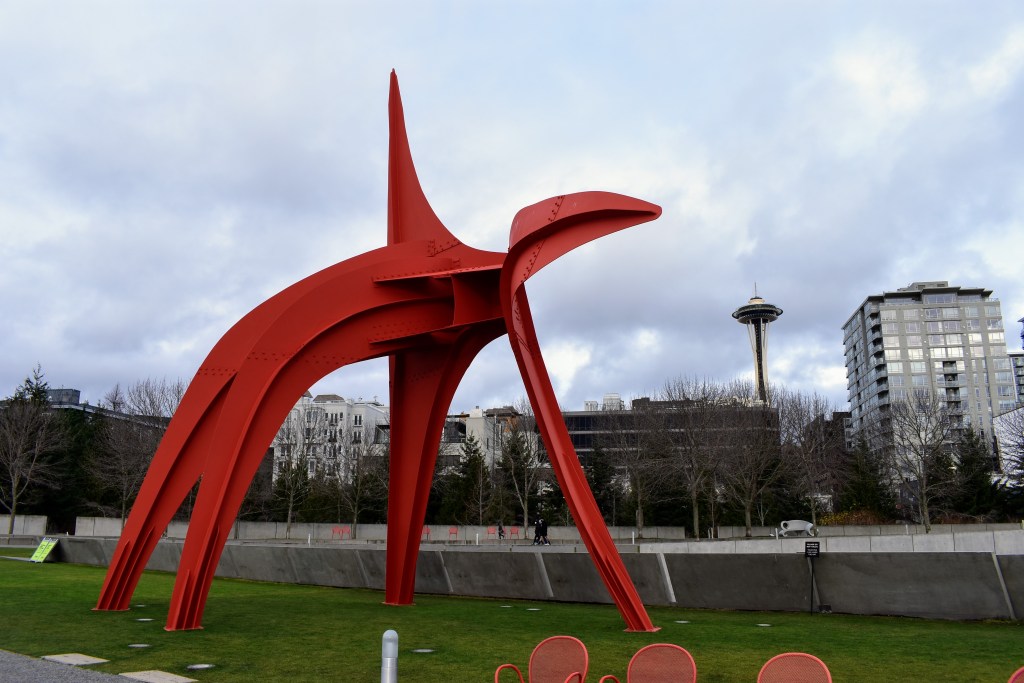
Eagle by Alexander Calder We walked up Broad Street a couple of blocks and got to the Seattle Center, home to many things but most notably the Space Needle. However, our first stop was the Chihuly Gardens and Glass. We marveled over the pillars, chandeliers, balls, and reeds that comprised many of the works. Of course, we had to linger over the display of Macchia and stare in awe at the Persian Ceiling and the display of light as it filtered through the different glass pieces. We came to the conservatory and the huge, suspended piece down the center. We took our time in the garden, looking at all the different colors of reeds and balls both on bright display and hidden amongst the plants. We also saw a real bunny rabbit! Of course, many places have reduced the services that they are providing right now (due more to COVID than the holidays), and this included the Collections Café at the back of the museum. But you could still walk through the café and look at the displays of different things that Dale Chihuly has collected through the years. Yes! He is a collector and not a hoarder! You can tell because things are organized and displayed, *wink.*
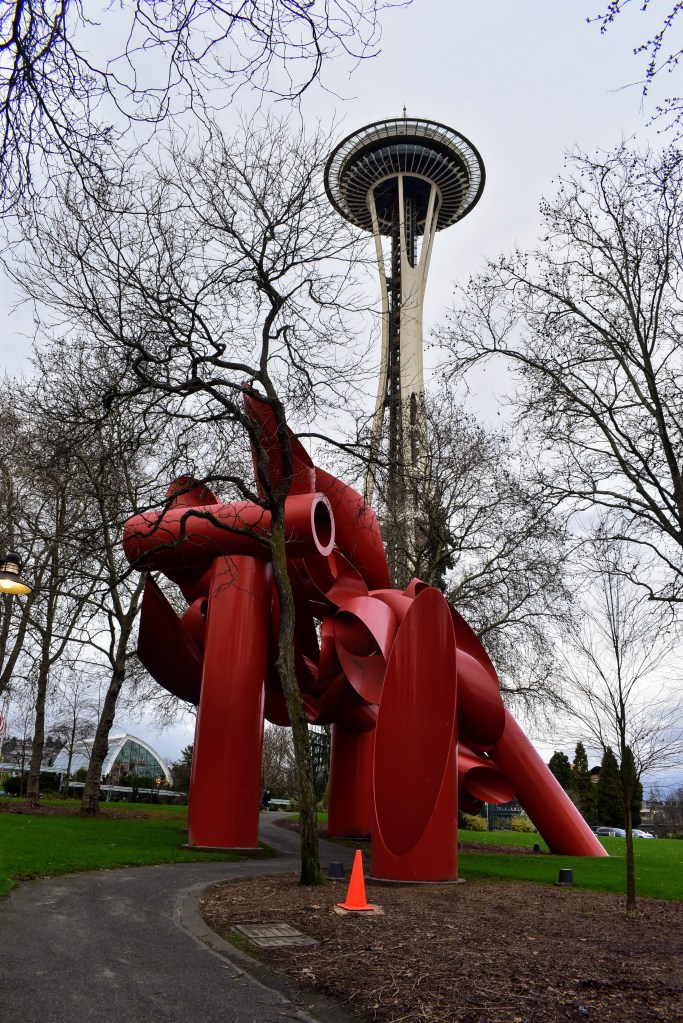
Olympic Illiad by Alexander Liberman 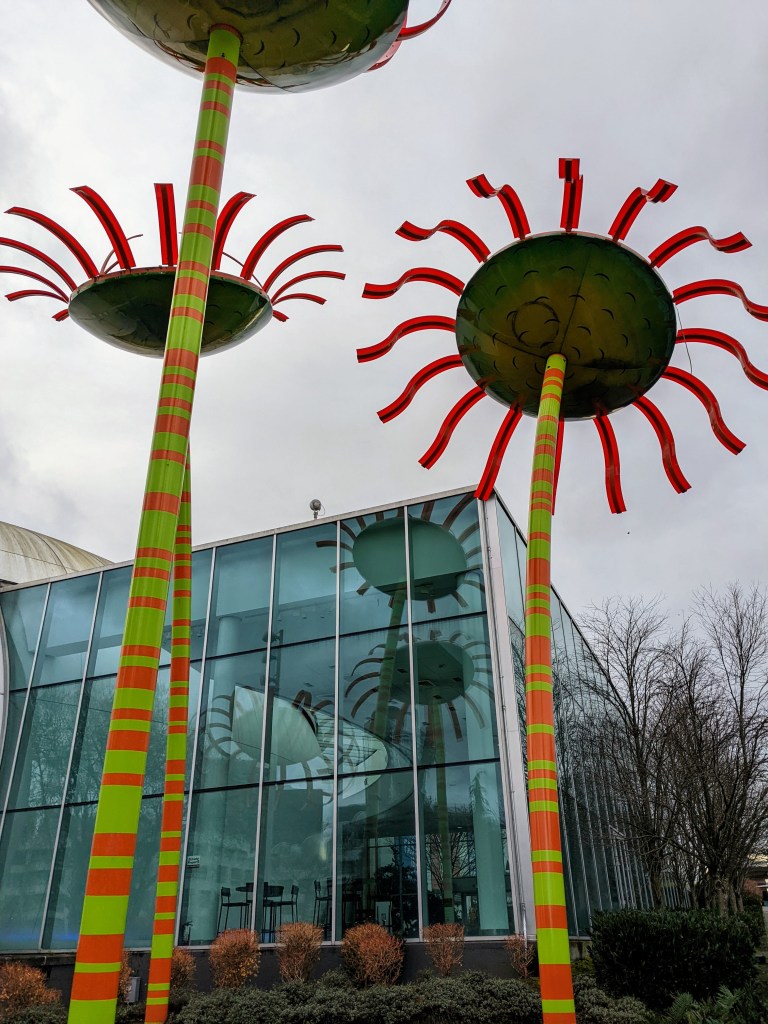
Sonic Bloom by Dan Corson 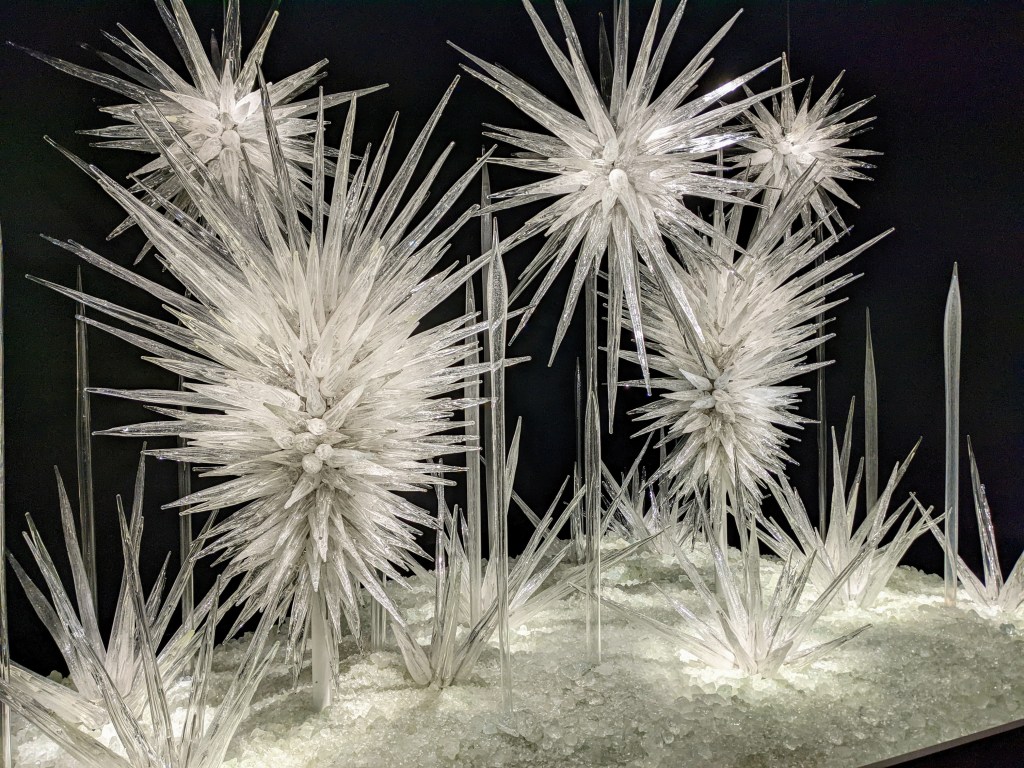
Winter Brilliance
Chihuly Gardens and Glass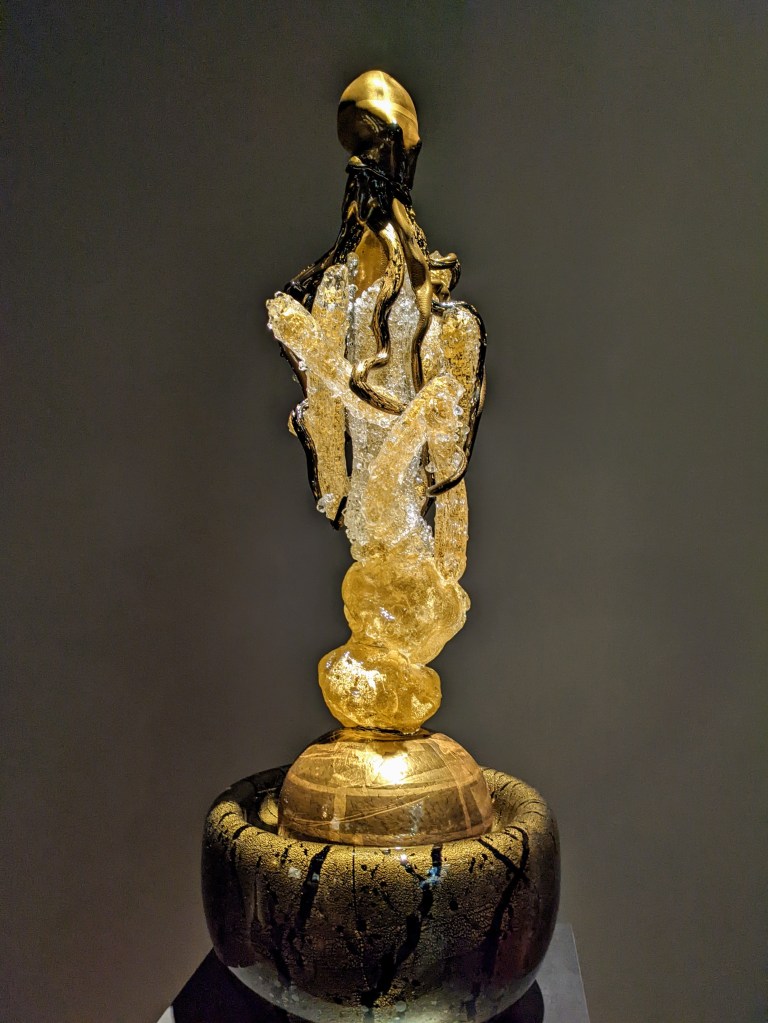
Sealife Vessel
Chihuly Gardens and Glass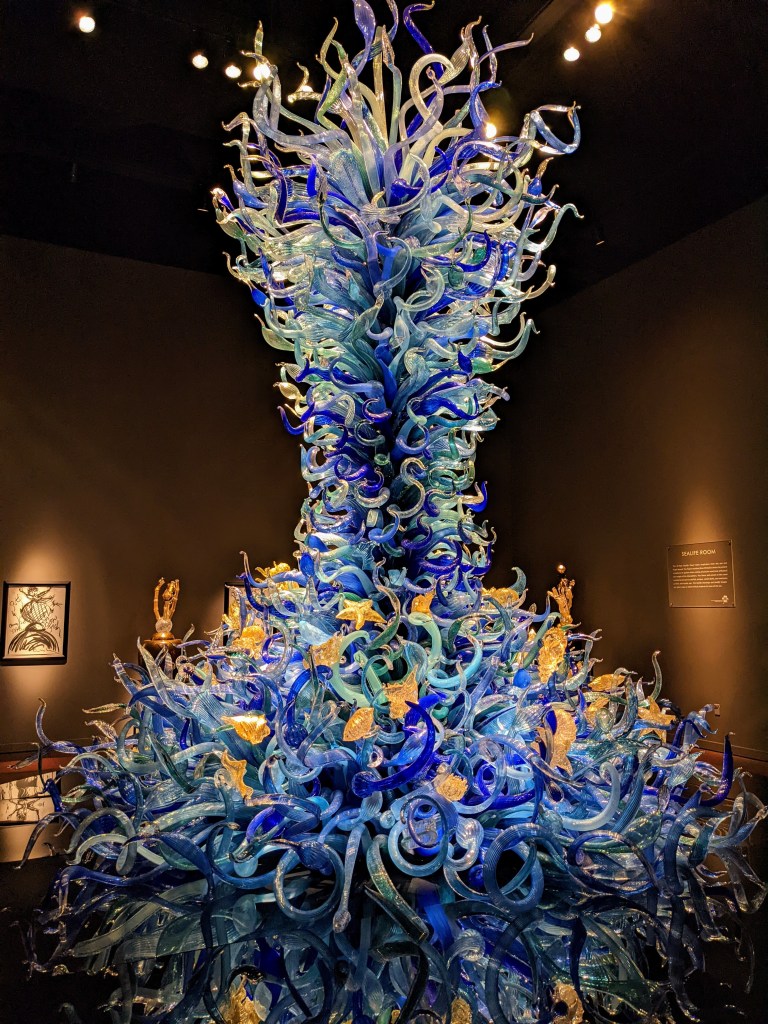
Sealife Tower
Chihuly Gardens and Glass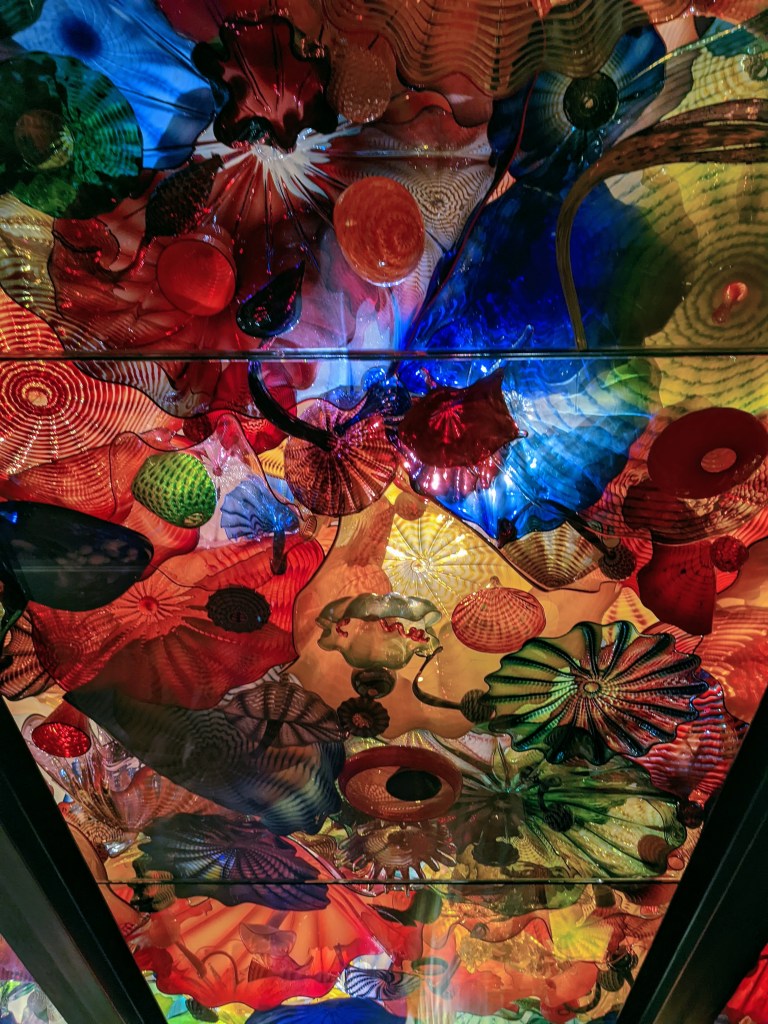
Persian Ceiling
Chihuly Gardens and Glass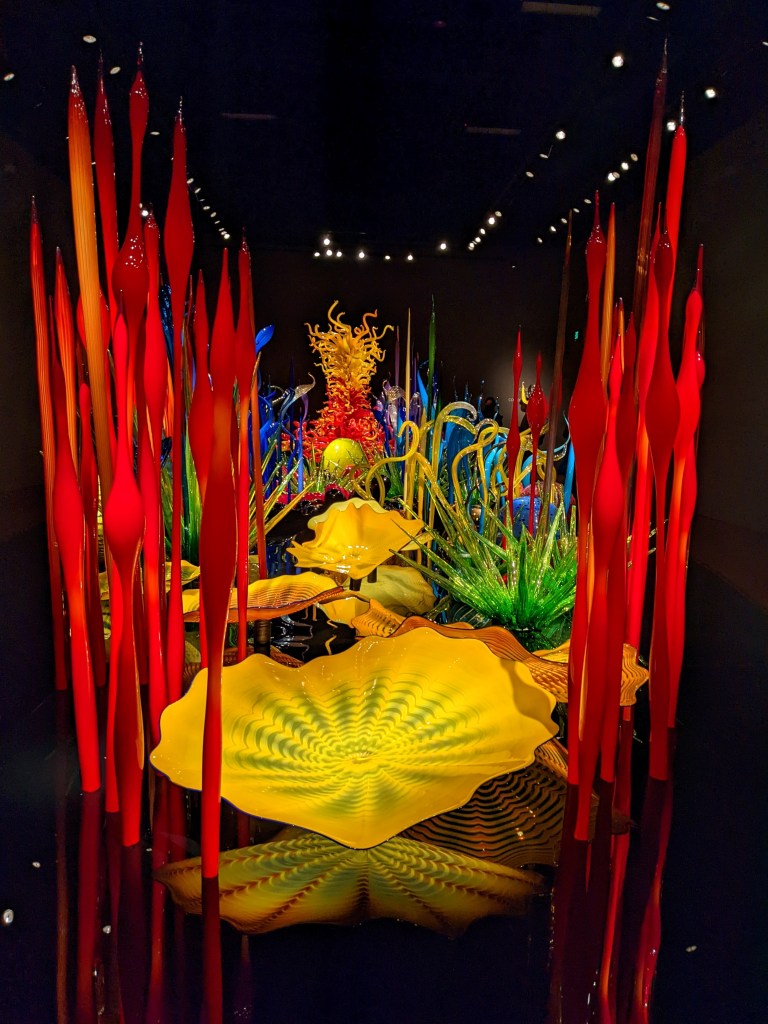
Mille Fiori
Chihuly Gardens and Glass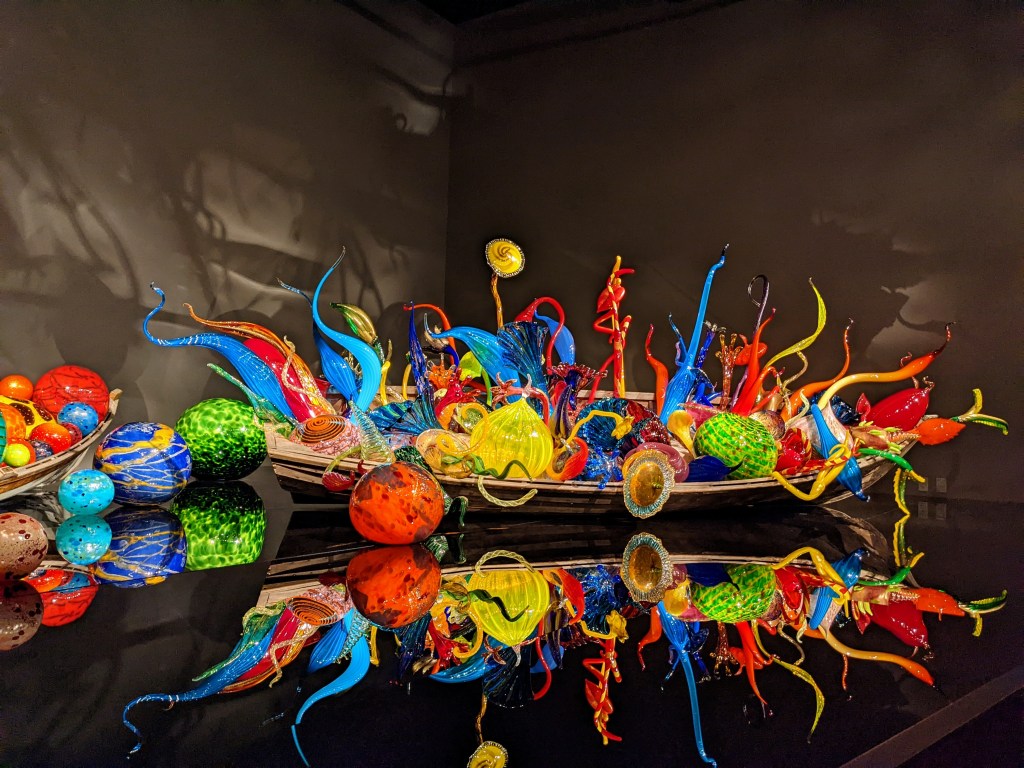
Niijima Floats and Ikebana
Chihuly Gardens and Glass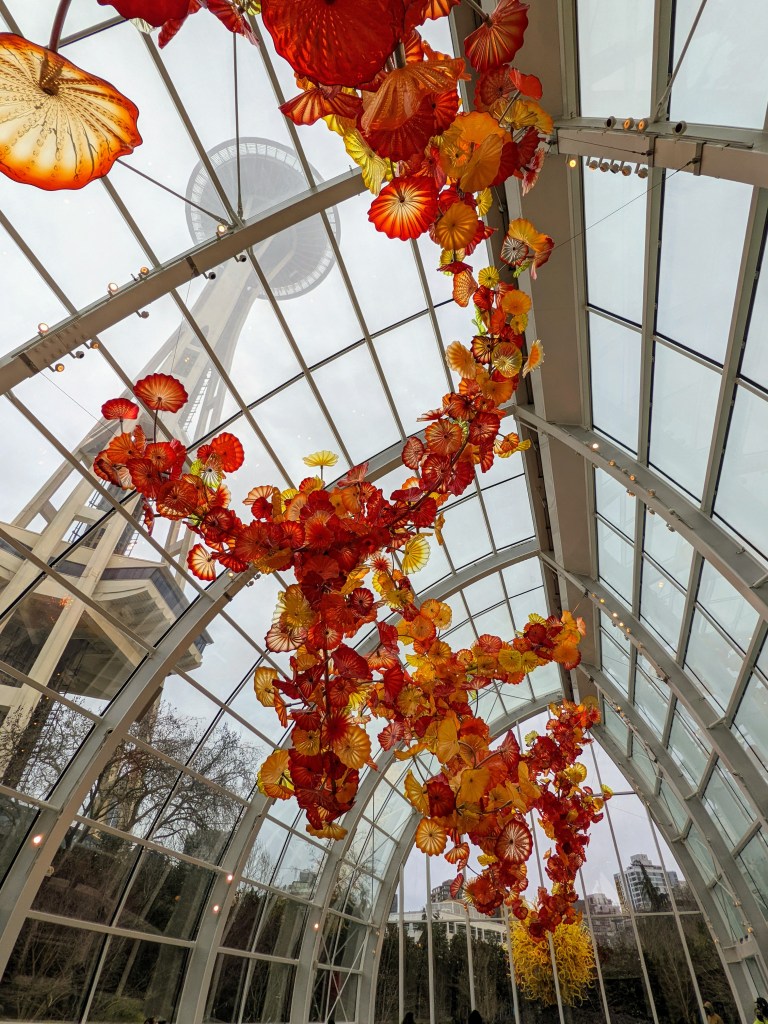
Glasshouse and Space Needle
Chihuly Gardens and Glass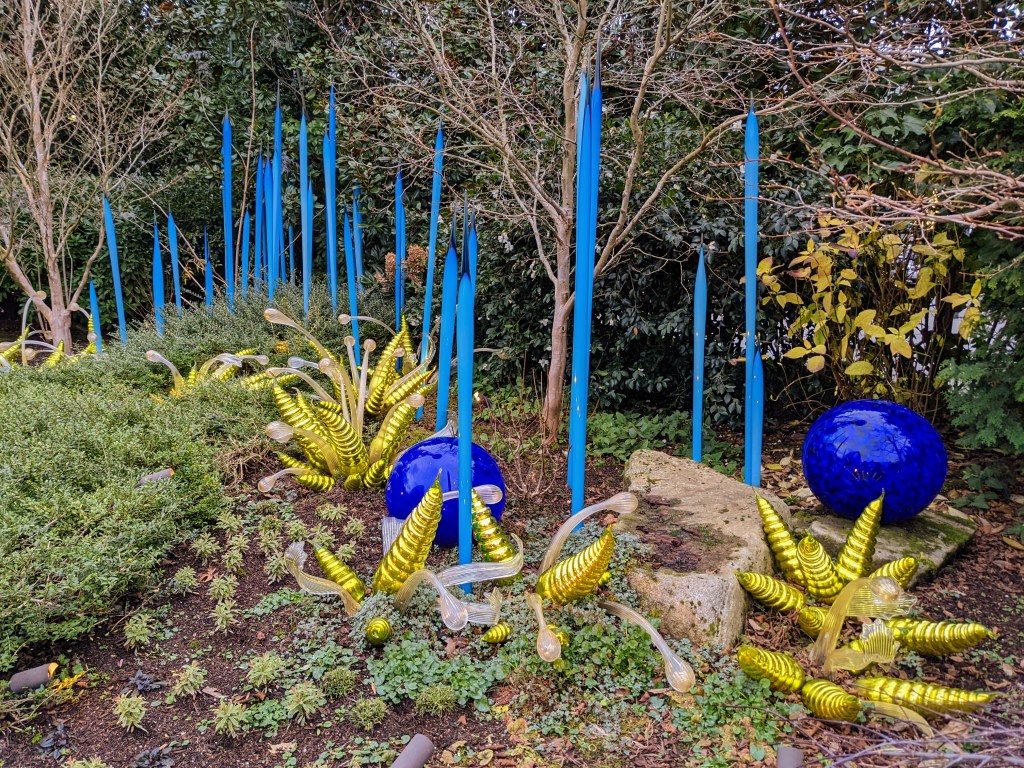
The Garden
Chihuly Gardens and Glass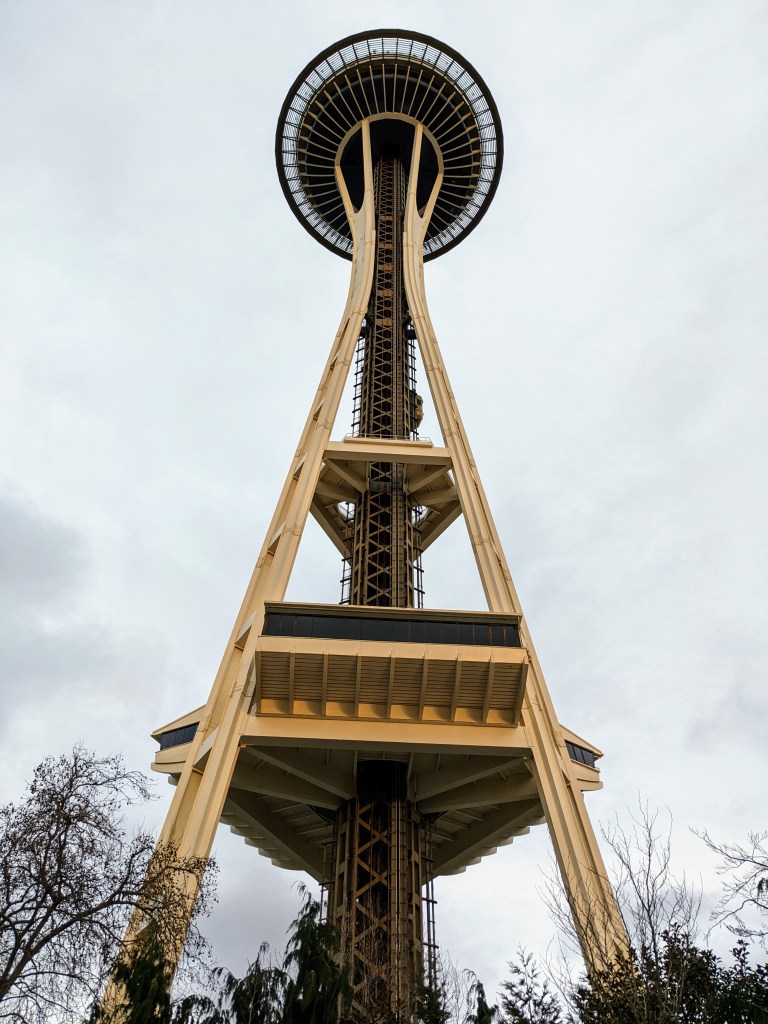
Space Needle from Chihuly Gardens and Glass 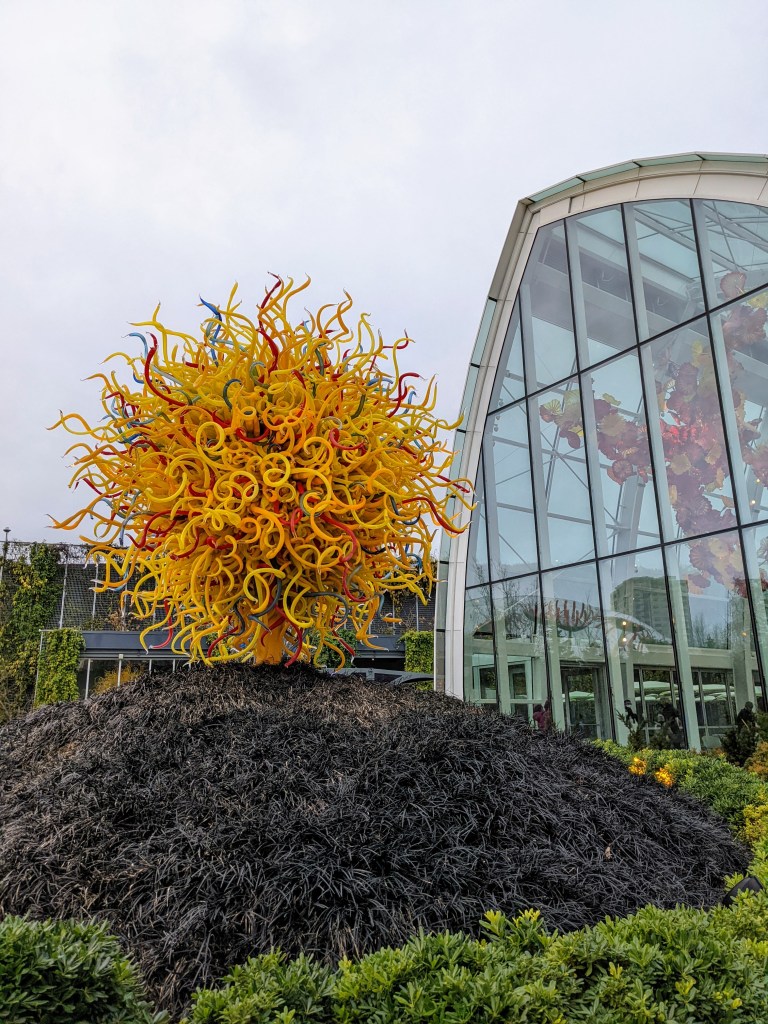
The Garden and Glasshouse
Chihuly Gardens and GlassWe finished our visit to the Gardens and Glass with a narrated demonstration of glass blowing and sculpting at the Community Hot Shop. It was fascinating to see a ball of liquid glass be transformed into a vase. The technique used involved using frit, small pieces of colored glass, to add color to the vase. It gives the final piece a speckled look. Chihuly used layers of frit for the Macchia pieces, with a layer of chunky white in the middle, to get the amazing color variations in those pieces. The different vases and bowls made in the demonstrations are all sold in the Space Needle gift shop in order to raise money to support local artists.
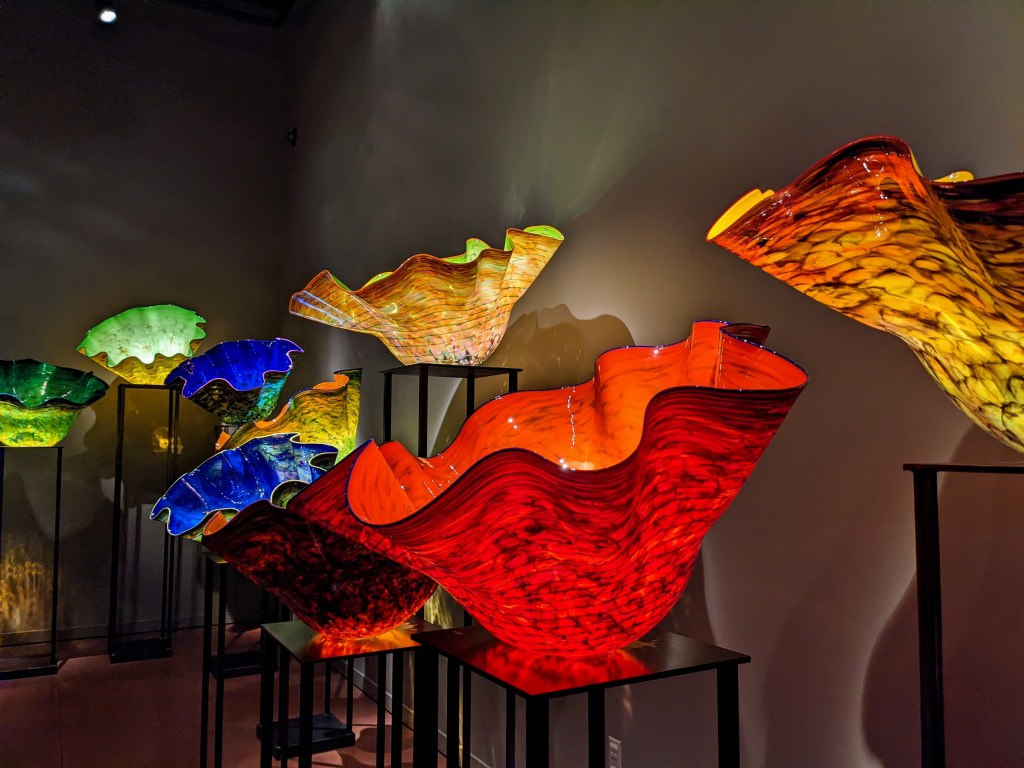
Macchia
Chihuly Gardens and Glass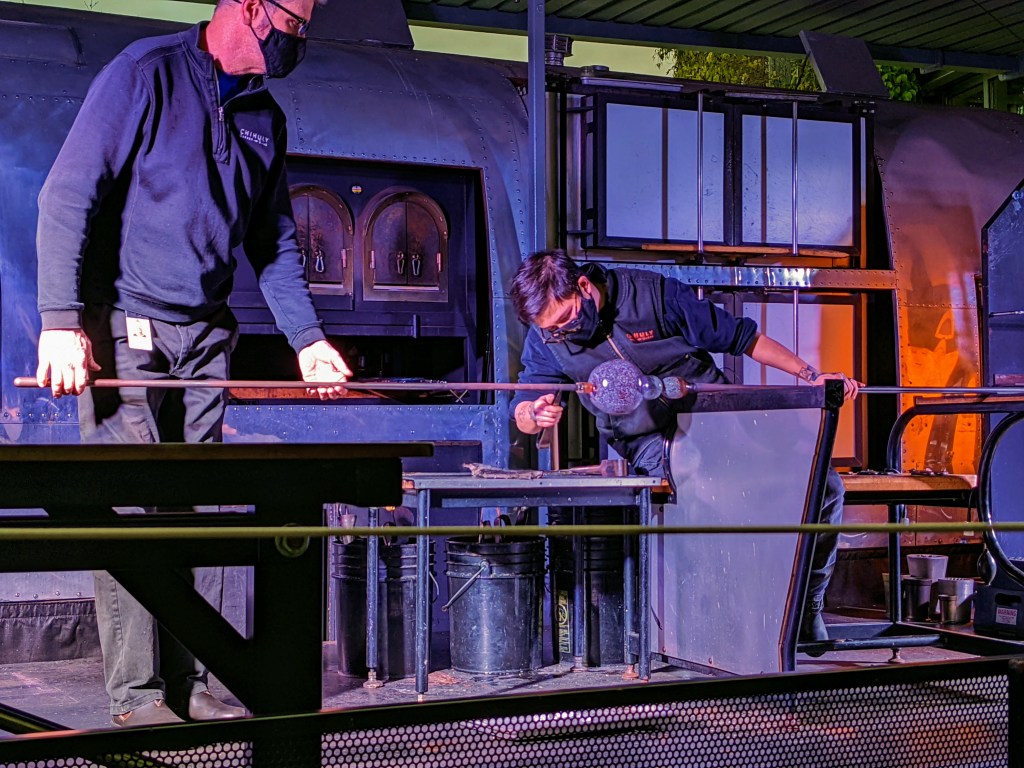
Glass blowing demonstration
Chihuly Gardens and GlassOur final stop of the day was…the Space Needle! We weren’t able to get a ticket for immediate access, so we poked around the gift shop for a while, then wandered around the Seattle Center area, and into the Seattle Armory food and event center. Most food spots had already closed at that point and we decided that we’d probably be too tired to do much of anything except go back to the hotel once we were done at the Space Needle, so we decided that we’d probably just get dinner at the hotel again.

Howard S Wright Memorial Fountain Christmas “Tree”
Space Needle Loop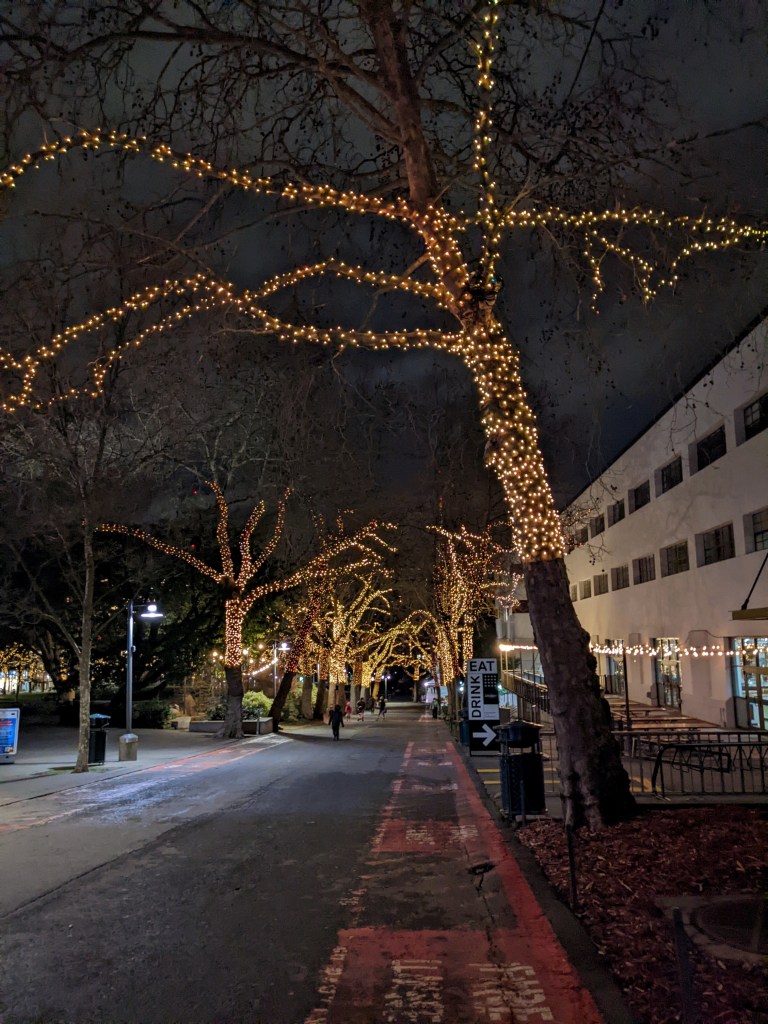
Lighted trees
Seattle CenterOnce we were within about five minutes of our ticketed start time, we were allowed to make our way into the Needle. We passed a bunch of informational displays on the building of the Needle. I had had no idea that it was erected so quickly, basically in the span of a year. We got on an elevator and were whisked to the top!
The area of the Needle open to the public comprises two floors at the top: the bigger deck above, with angled glass, so that you can almost lean over the side of the tower, and the slightly smaller deck with the rotating floor that has glass panels in it so you can see down the curved sides to the base. We walked around the top deck and found that the Atmos Café was open and serving food as well as drinks. So we ended up having dinner at the top of the Space Needle! A hot dog for Mom, chicken tenders and fries for me (with a delicious, curry-like dipping sauce), and Honeycrisp ciders for both of us. Yum!
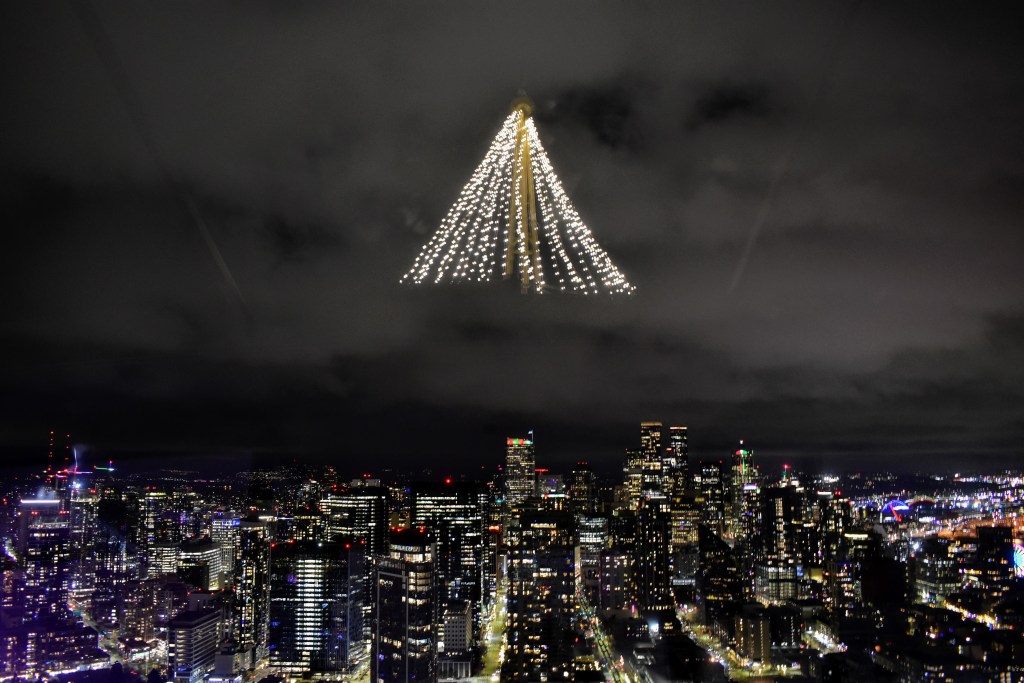
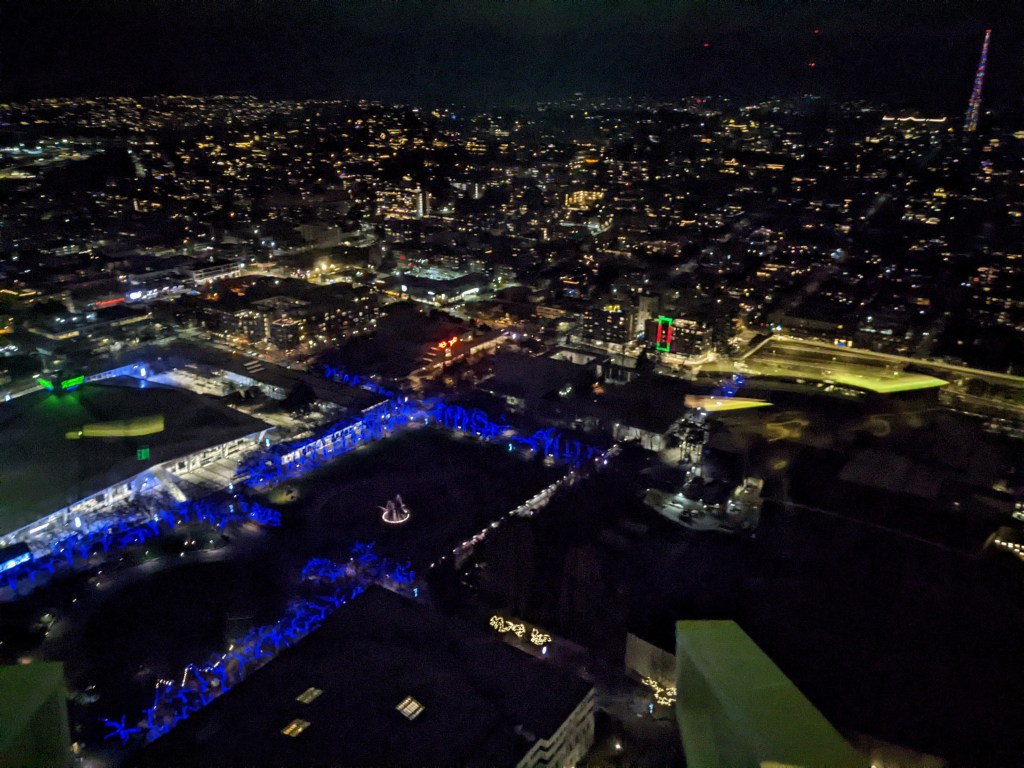
The skyline with the reflection of the lights on top 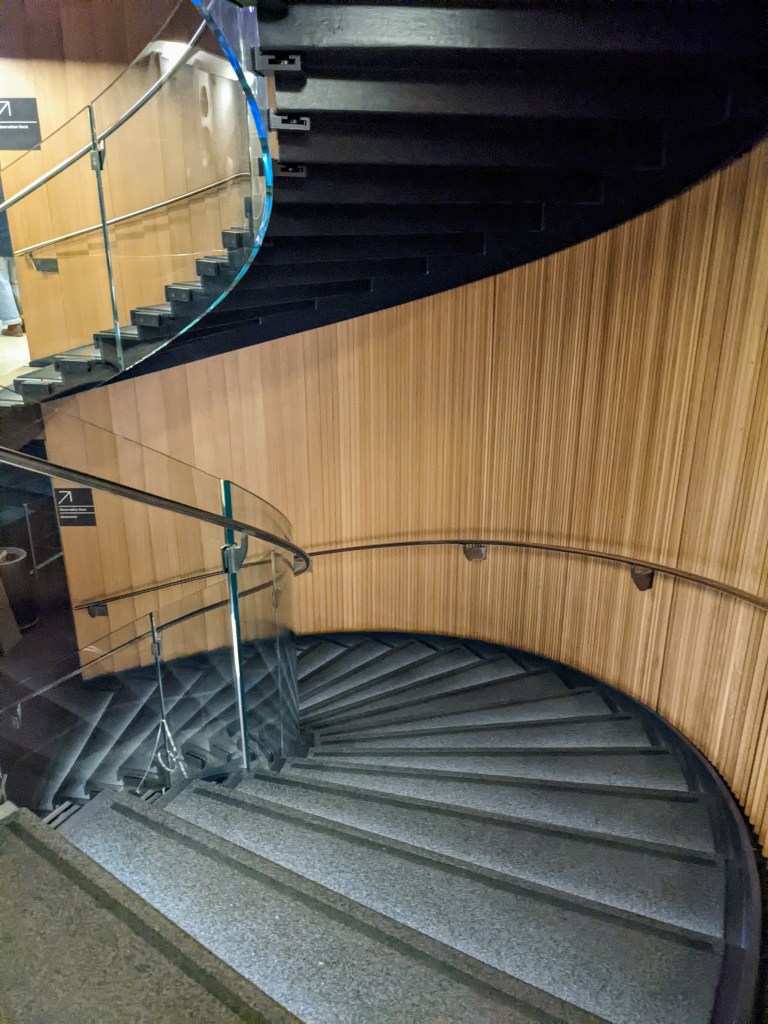
Going downstairs in the Space Needle We walked down to the Loupe Deck and were able to not only watch as the skyline of Seattle slowly circled by, but we were also able to see the cog mechanisms that rotated the floor! The rotation is powered by a 1 horsepower motor, which is pretty amazing!
The skyline 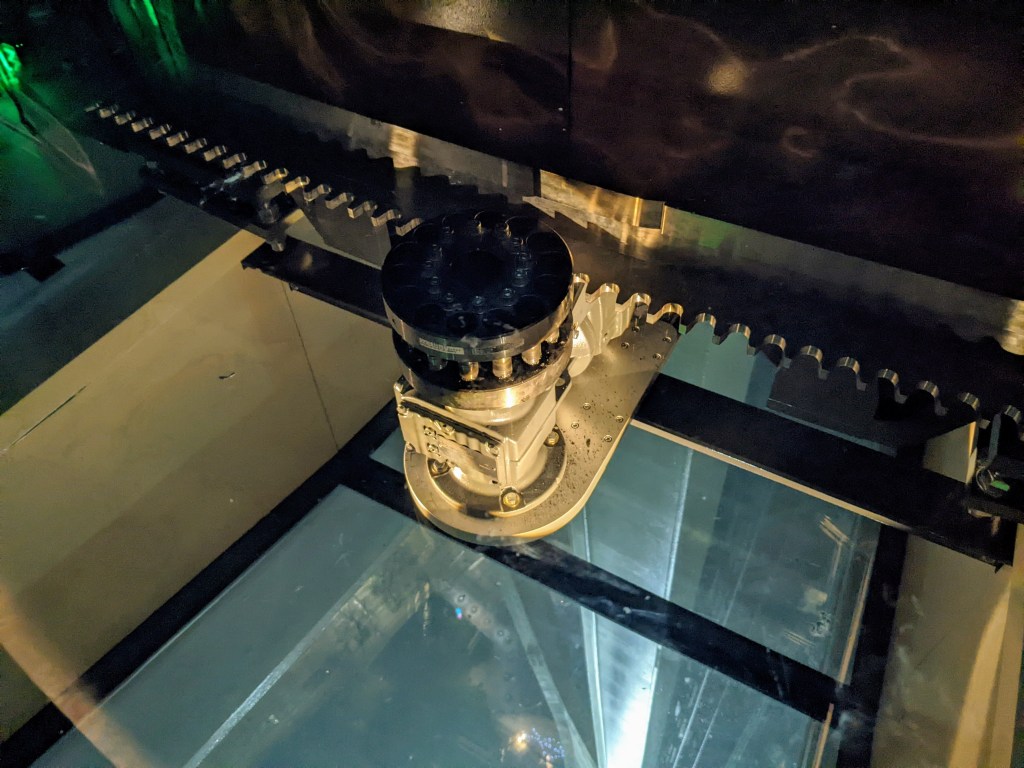
The moving mechanism 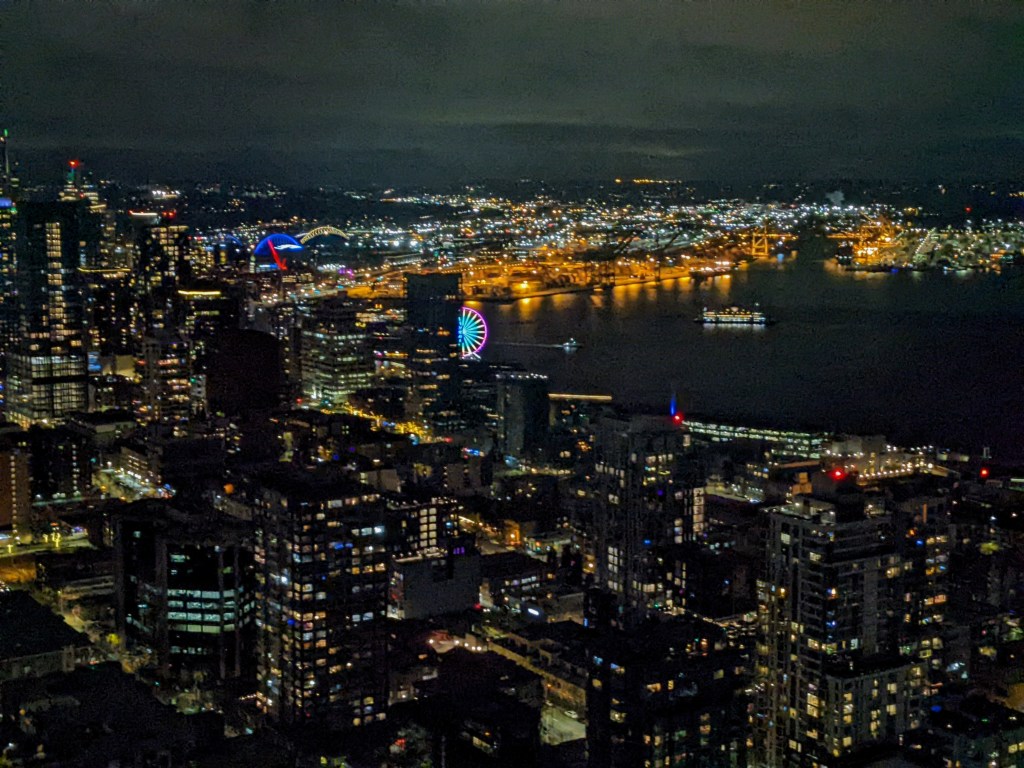
The skyline After getting a Lyft back to the hotel (our feet were a bit tired at that point), it was only a little after 8, but I was pooped! I intended to work more on this journal, but the battery in my computer had died and then I pretty much followed it!
-
It’s Always Raining in Seattle
Day 6 – Wednesday, December 22, 2021
We had requested a wake-up knock around 6:30 since breakfast was only set to be served until 7. We could always just throw on some clothes and finish getting ready later. But we hadn’t accounted for the extra hour gained during the night, so both Mom and I woke up before then. Our car attendant, Cody, could be heard creeping up and down the hall, greeting people and quietly telling them that because we were still running about three hours behind, it had been decided to keep the dining car open for breakfast later than originally intended. Mom and I got ready and ended up going for breakfast around 7:15.
We were supposed to get into Seattle around 10:30 a.m., but the delay meant that we got to see more of the scenery going by: the Columbia River, the Cascade Mountains, snow-covered evergreens, a lone fisherman in a small boat, and wide vistas when we were between mountains. As we got closer to the coast and came down in elevation, the snow cleared up and we started seeing more of that wet, Pacific Northwest green that so characterizes the area. That’s when we started seeing more wildlife as well, particularly birds. At one point we saw some ducks and such before Mom exclaimed, “Is that a bald eagle?!” Sure enough, there were about five or six that had congregated in that one area, including two that appeared to have a nest in one of the trees. Of course, I was so excited that I didn’t get a picture.
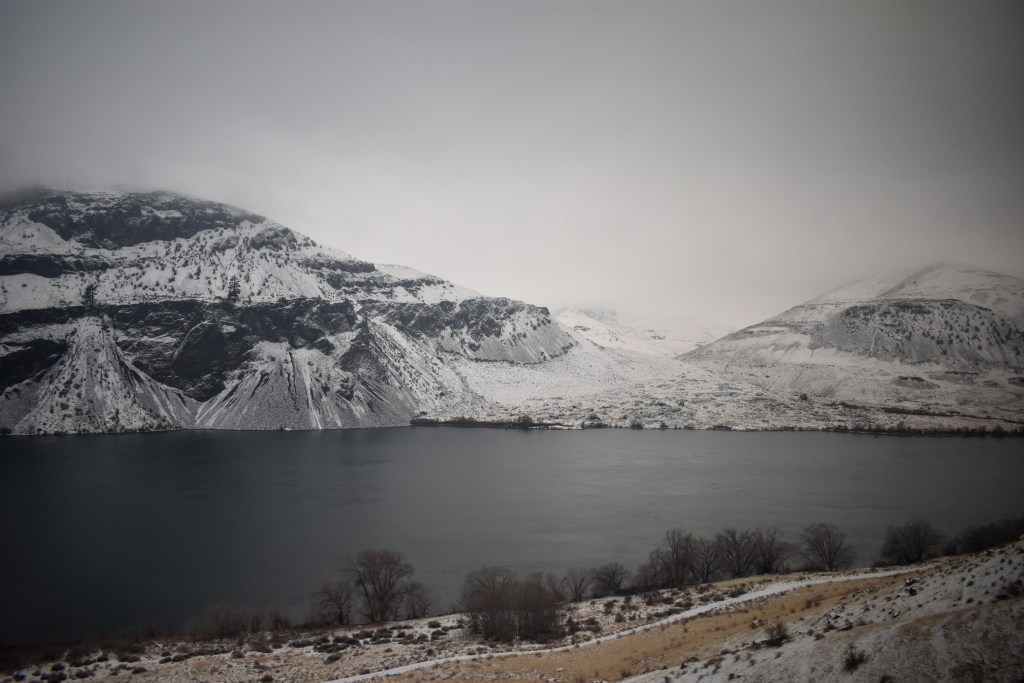
Columbia River 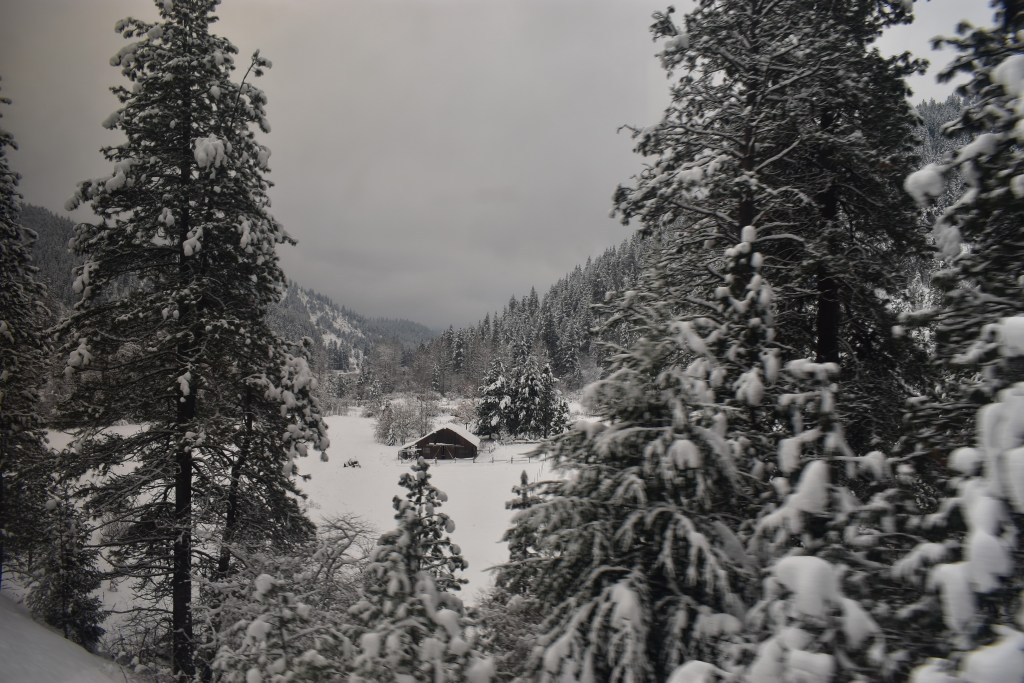
Snow in Washington Because we were on the left side of the train, we were facing inland as we started traveling along Puget Sound. But we saw lots of houses with huge windows facing in that direction. Our across-the-hall neighbor, Gary, kept up a running commentary for a while on the things we were seeing and his plans to go fly fishing with his buddies.
As we came into Seattle, we passed right by the Olympic Sculpture Garden and saw the Space Needle—both of which were on our list for further touristic investigation. We coasted into the station at just about 1:45. Once we got our checked bag, it was off to the Warwick Seattle hotel! We were checked in by a young woman with purple hair and a Deathly Hallows tattoo.
We were able to proceed straight up to our room so we could drop off our stuff and decide what to do with the rest of the day. After allowing our stuff to explode all over the room, we looked at what kind of thing we already had for Seattle—for Chicago and LA our package included the hop-on/hop-off tours. For Seattle, we had the CityPass. No transport included, but we could get into about five different attractions with just the one ticket. We eliminated the zoo as being too far away and not unique enough to Seattle to try and fit it in during our time there. A look at the map showed that the Chihuly Gardens and Glass was right next to the Space Needle—probably a bit much to try and fit both in at that point—and a quick check online showed that the boat tours were already done for the day. That left the Seattle Aquarium, which was an easy walk from the hotel and just across the street from the Pike Place Market. Armed with umbrellas (of course it was raining, do you even have to ask?) and our coats, we set off towards the waterfront. We did keep getting distracted by sights and interesting architecture, as well as trying to scout a place for breakfast.
Seattle is hillier than one might expect. Windier, too. So we were very glad to get inside the aquarium. This was no Newport or Atlanta aqua wonderland. Instead, the Seattle Aquarium focused mostly on the sea life that could be found just outside in Elliott Bay and Puget Sound, including the giant Pacific octopus (which was right on the glass at head height and it was so cool), orca, harbor seals, a bajillion types of fish (I’m pretty sure that’s an accurate number), and corals. They even had an area where they had some shorebirds that had been rescued, like a black oystercatcher. Of course, a lot of the focus was on salmon, both as a fish itself as well as the only food source for the resident orca.
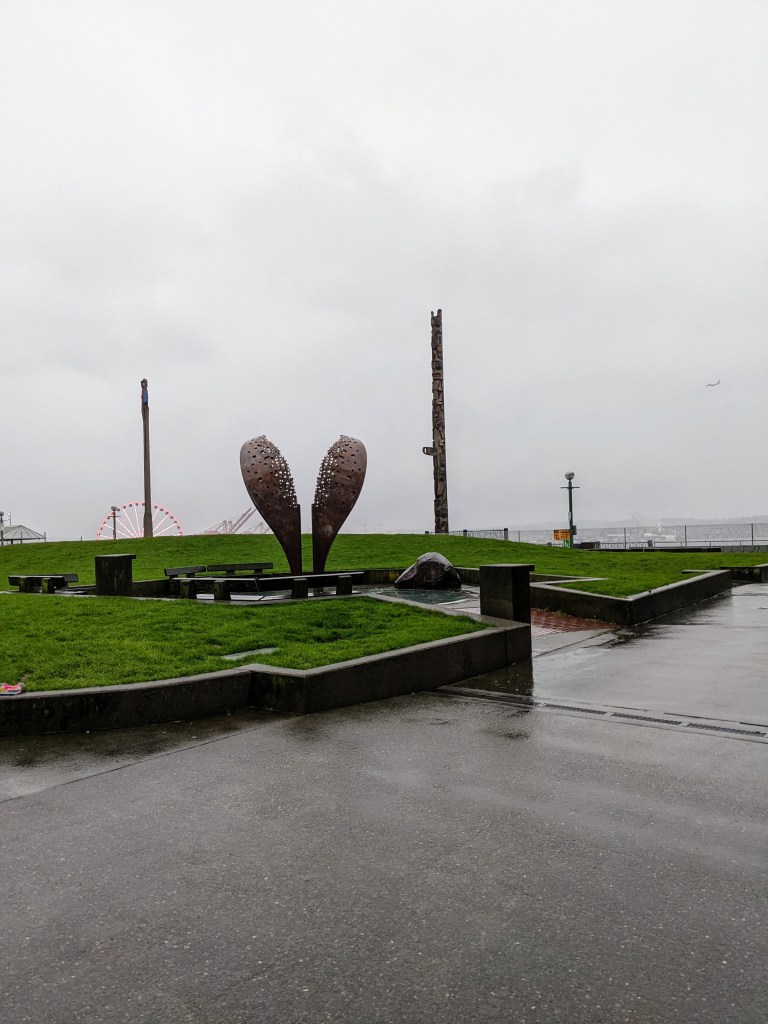
Tree of Life by Clark Wiegman for the Homeless Remembrance Project
Victor Steinbrueck Park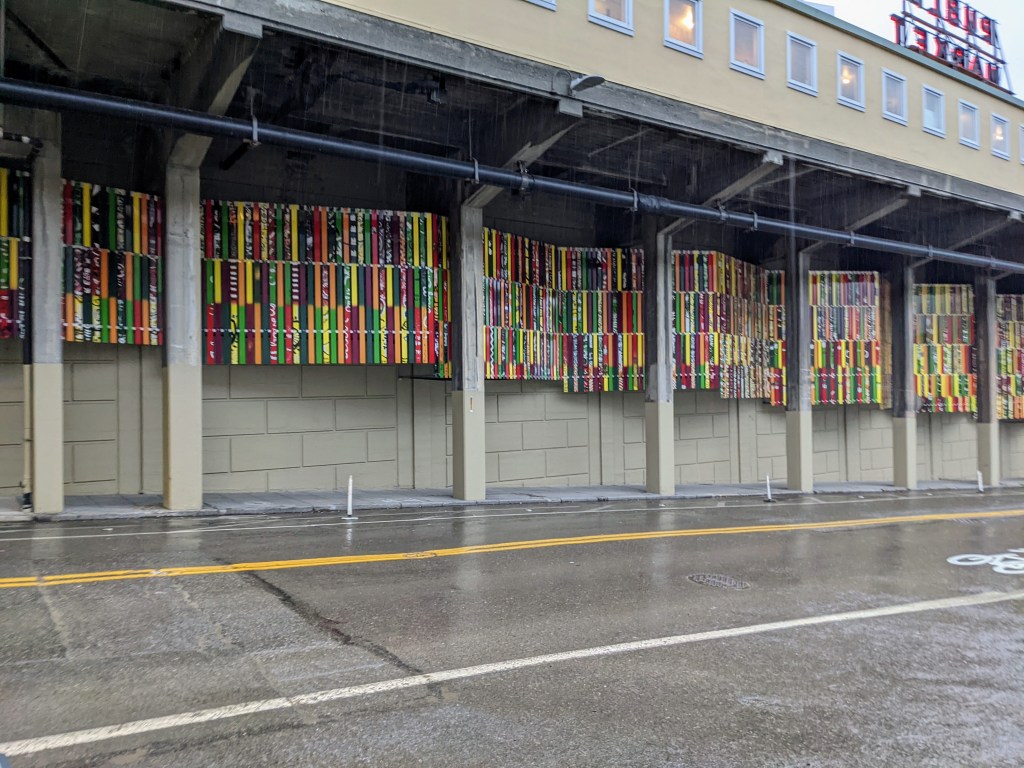
Pike Place Market from the back 
On the pier
Seattle Aquarium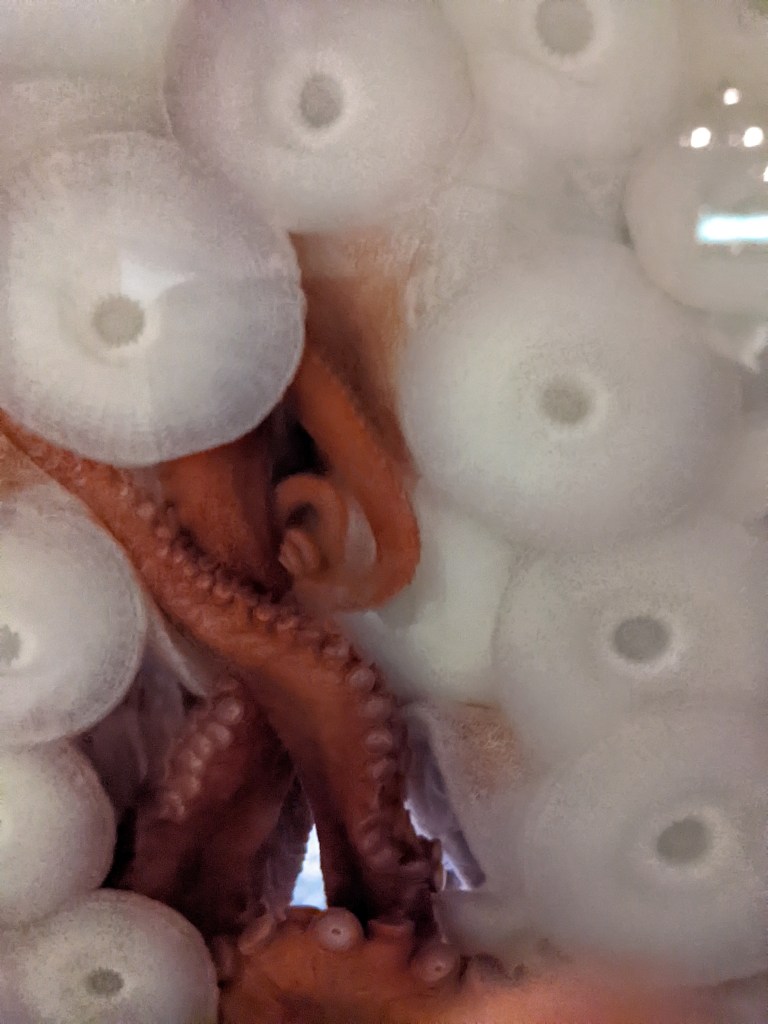
Octopus 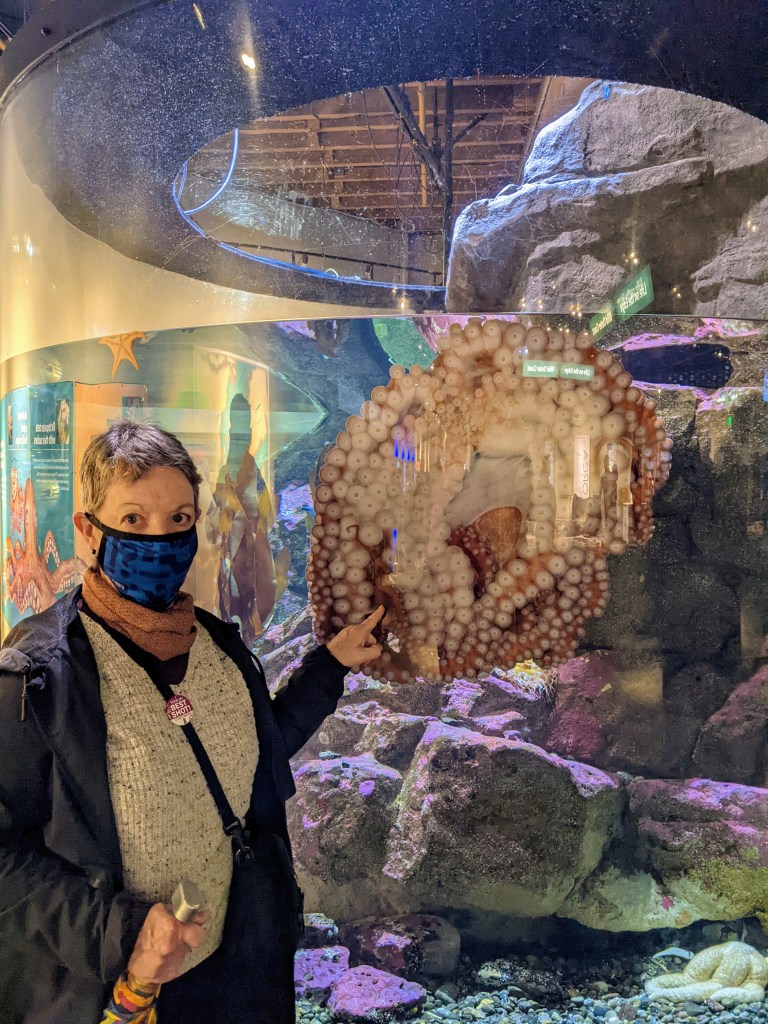
Mommy with the octopus 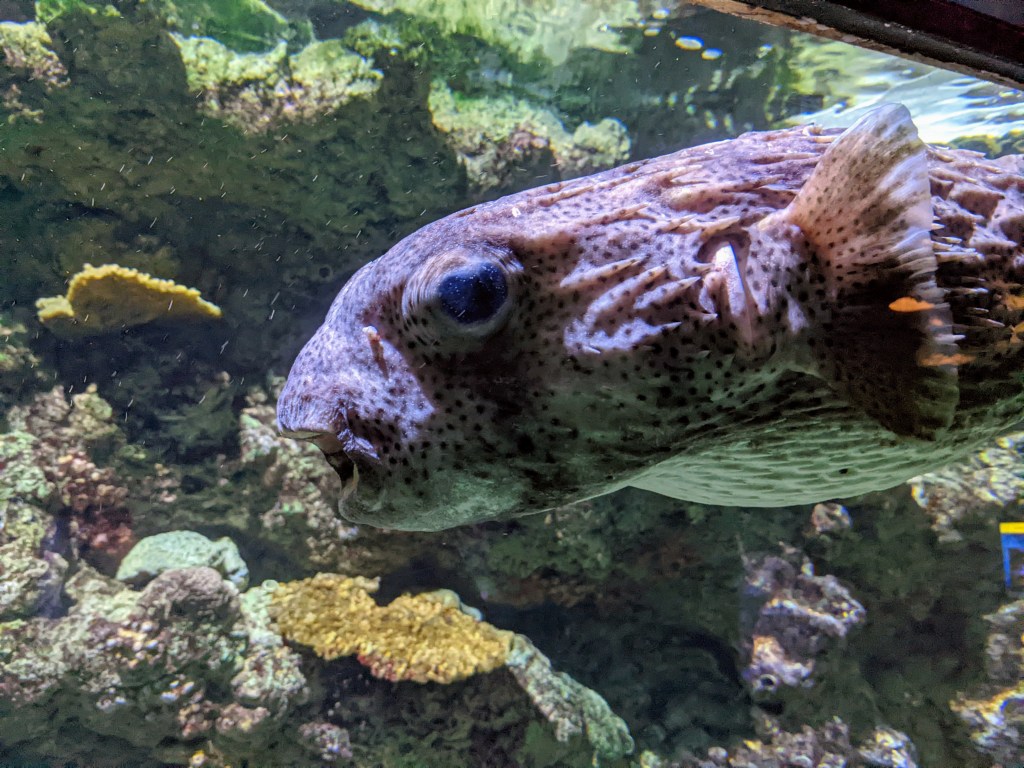
Pufferfish By the time we had left the aquarium around 5:30, most of the shops in Pike Place Market had closed up—including the restaurants where we had had a vague idea of having dinner. We were able to go into a small shop to get some postcards, a magnet, and a SPOON. Since it didn’t occur to me to go the other way down the waterfront, we ended up just walking back to the hotel and having dinner there. On the upside, we were back in the room in time for “Jeopardy!”
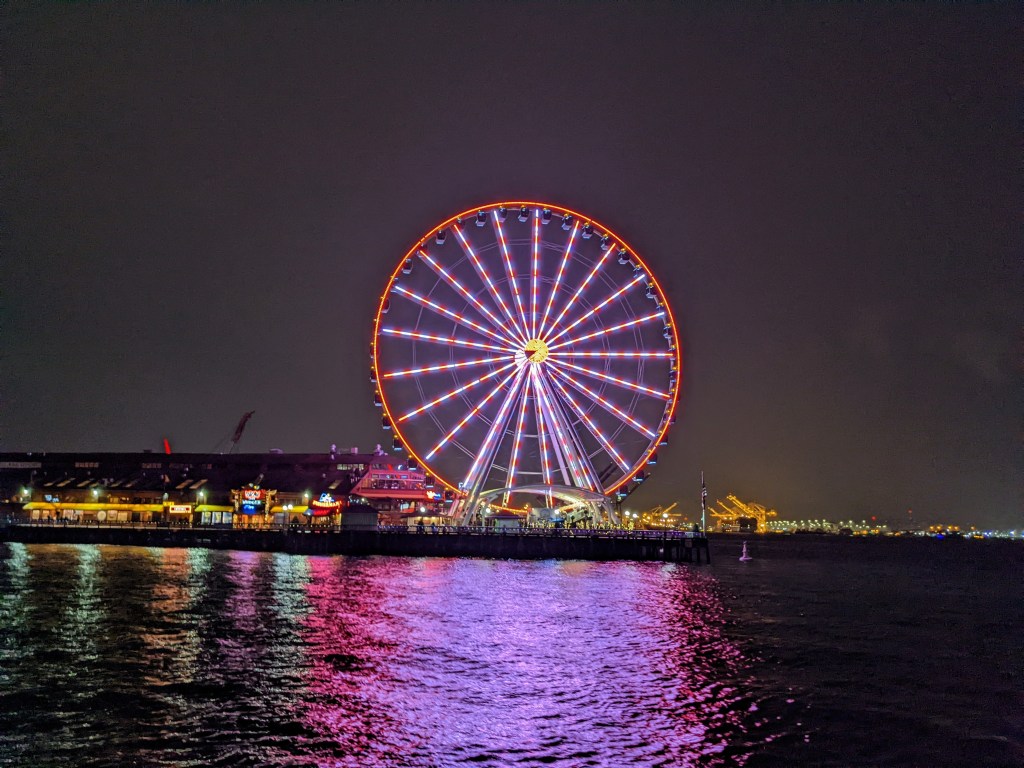
View of the Seattle Great Wheel 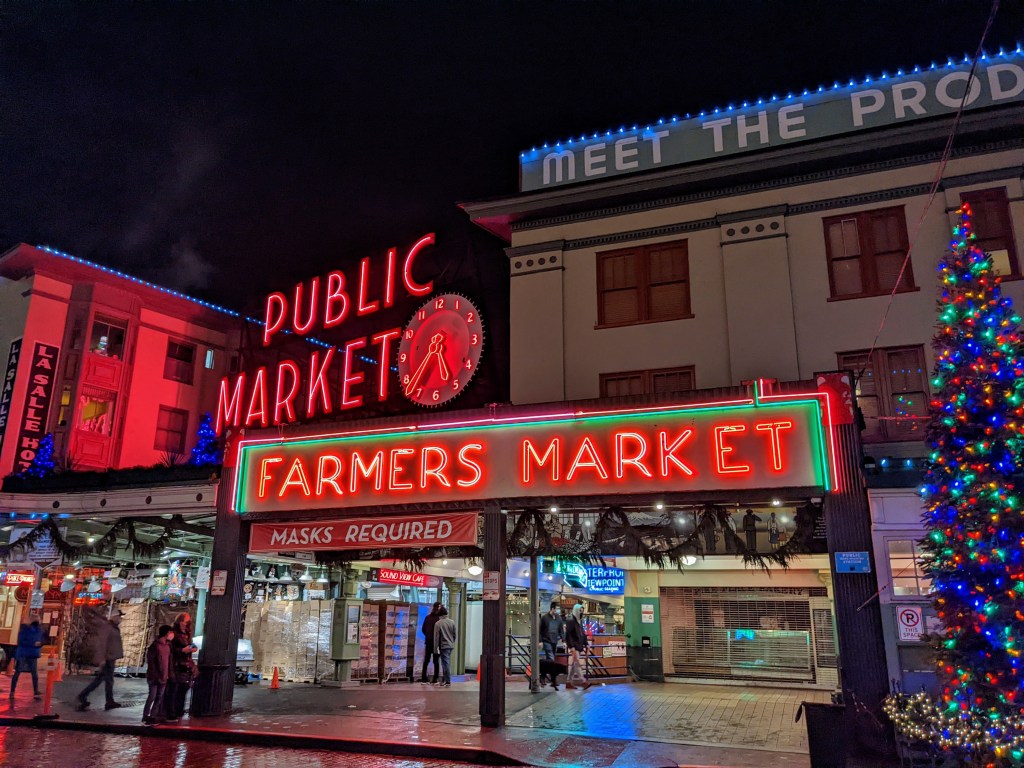
Pike Place Market Another early night for us since we knew that we’d be busy, busy, busy the next day.
-
“Why not Minot? Freezin’s the reason!”
Day 5 – Tuesday, December 21, 2021
We got up at about 7 a.m. and took turns getting dressed and visiting the bathroom. We got to breakfast a little before 8 and watched the landscape getting lighter and lighter. Mom commented on the kind of column of light that the sun made as it was rising. I didn’t realize it until later in the day, but we were greeting the shortest day of the year and the first day of winter on a train in North Dakota! We were still finishing up our breakfast when we started hearing announcements about the conductor being sorry for the delay and we’d be up and running again shortly, etc. We had been stopped for a bit and it turned out that one of the cars had brakes on that wouldn’t release and it was keeping the train from continuing on to the next stop: Minot, ND.

North Dakota They finally got the issue with the brakes fixed (I guess brakes that are working too well are better than brakes that aren’t working well enough?) and we pulled into Minot a bit late. Despite the conductor saying that due to the previous delay, we’d only be in Minot for 15-20 minutes—long enough for a quick breath of fresh air or a smoke break—we were there for over an hour. We eventually rolled out of Minot (a chilly 7°) around 11:30. Shortly thereafter, the dining car waitress came on the intercom to say that lunch would be served at 11:30-1 mountain time, which didn’t apply to our phones/watches/other timekeeping devices at that moment. When Mom and I did end up down in the dining car, we were told it was a bit full but they’d page us in a couple of minutes when a table was ready. We went back to our room (Cody had put the bunks up while we were at breakfast) and waited. Nothing. After a good 30 minutes of waiting, we went back to the dining car, only to be told they’d tried paging us multiple times! Fortunately, there were tables free at that point and we could get on with lunch (Caesar salads for both of us, but I had chicken on mine).

Montana 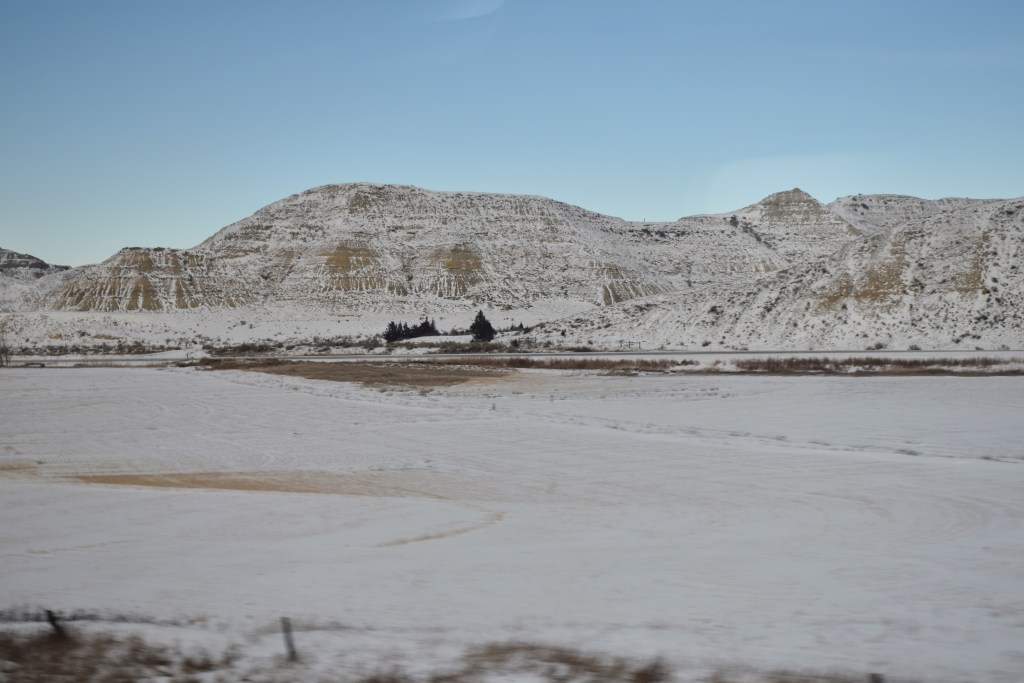
Montana Once we were done with our afternoon repast, we took ourselves down to the lounge car to better see the scenery on both sides of the car. While all of the trains we’d been on to this point had passed through some pretty industrial areas, they had all also passed through gorgeous vistas. Northern North Dakota was pretty well coated with snow, but we still saw several small groups of mule deer, ring-necked pheasants, pigeons, magpies, and a lone coyote. Along with the cows and horses, of course!
We stayed in the lounge car for several hours so I could catch up on this journal and try to get photos of interesting things before the train passed them by. I got approximately 1,000,000 photos of the intense, red sunset, which also produced a kind of column of light as the sun dipped below the horizon. Once the sun had pretty well set, there wasn’t a lot left to see in the lounge car, so we headed back to the roomette until dinner.
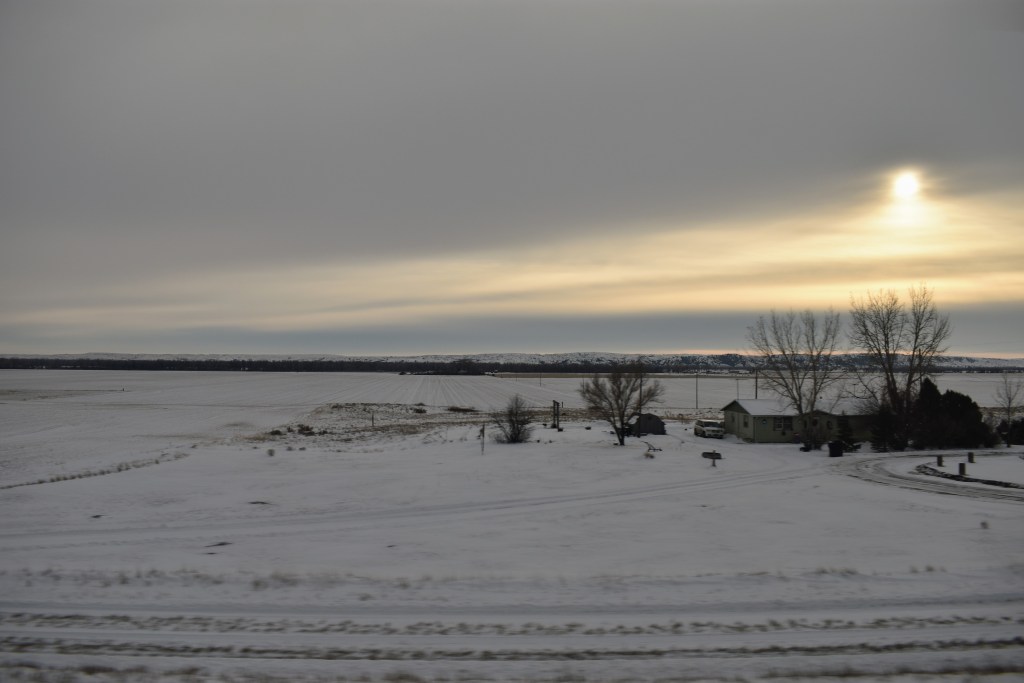
Montana 
Montana The meals for the sleeping car passengers on Amtrak are pretty generous, and they seem to be even more so on the Western long-distance journeys. Both breakfast and lunch are pretty huge plates of whichever dish you order and the dinner is three courses. For our final night on the Empire Builder (all the long-distance trains have different names), Mom and I both got the steak for our main, which was a fantastic choice, though she had the lobster crab cake for a starter and I had the green chile cheese tamale (YUM) while she had the carrot cake and I had the chocolate torte for dessert. But I don’t think there’s been a meal so far that we haven’t enjoyed.
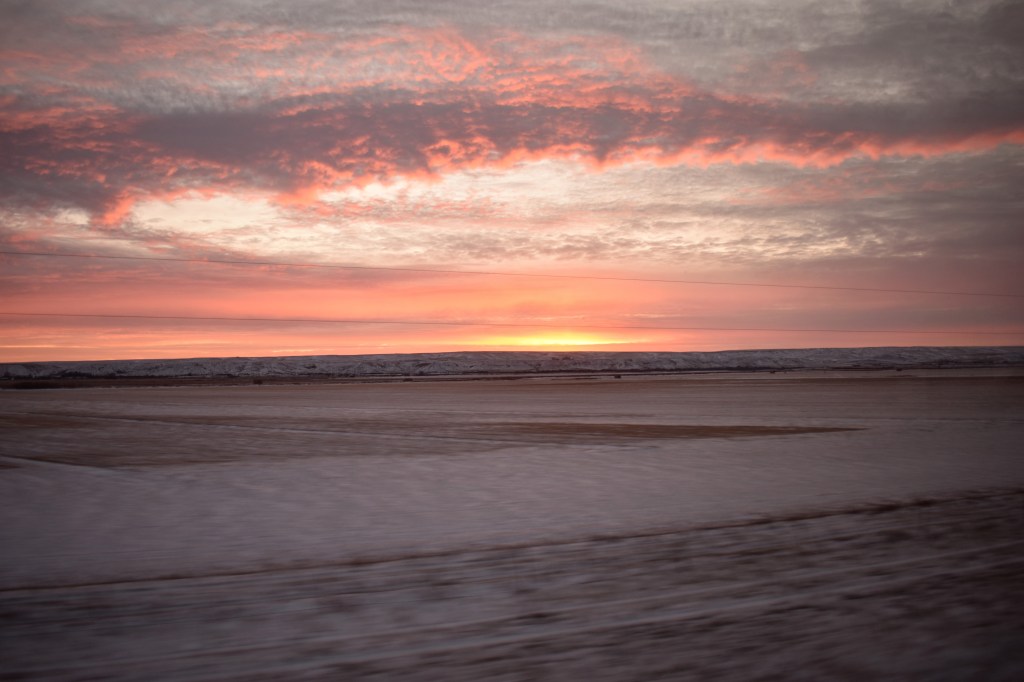
Montana We had a pretty early night, all things considered, and I zonked out about 10:45 (making sure I’d done my Duolingo first, because no one wants to lose a streak!). We were still in Montana at that point and were running about three hours behind. The train would get into Spokane early in the morning, where it would actually split into two trains—one to Seattle and one to Portland, OR. So we’d be waking up in the Pacific time zone and with a smaller train than we started with. No lounge car in the morning, but the dining car was coming with us!

Strom Travel Diaries
A collection of photos and blogs from Claire and Elizabeth's travels

